


Overview
According to the Commonwealth War Graves Commission (CWGC), Florence War Cemetery today contains 1,632 Commonwealth burials of the Second World War. The site was chosen in November 1944 for the burial of those who had died in the military hospitals in and around Florence, but most of those who rest here lost their lives in the fighting in this area between July and September 1944. After the war 83 graves were moved here from Arrow Route Cemetery, when it proved impossible to acquire that site permanently; most of them are men who fell in the fighting in the Apennines in the winter of 1944–1945.
The final layout of the cemetery, designed by the British architect Louis de Soissons, was completed after the war. Buried here are soldiers, sailors and airmen of the Commonwealth forces who died during the Italian campaign, from the landing in Calabria on 3 September 1943 to the surrender of the German forces in Italy, which took effect on 2 May 1945. The cemetery is in the care of the Commonwealth War Graves Commission (until 1960 the Imperial War Graves Commission), which still maintains it today.
Access
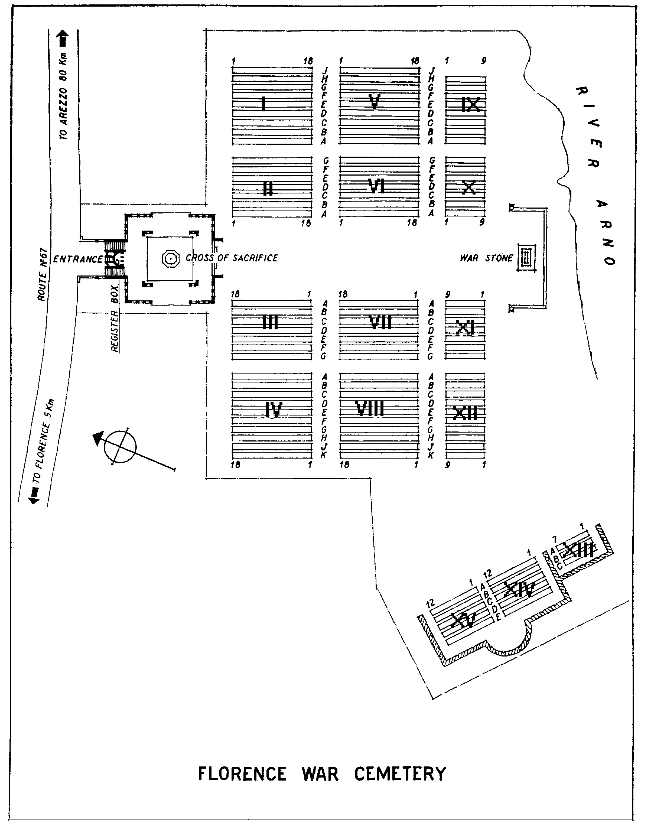
The cemetery is entered by a monumental staircase with two symmetrical flights, faced in travertine and yellow sandstone. Beneath the staircase is a shrine, hidden from view at the entrance and open towards the cemetery. The burial area stretches on level ground as far as the bank of the Arno, with rows of white headstones grouped in plots of various sizes. Here lie war dead from the United Kingdom, New Zealand, South Africa, India, Canada and other Commonwealth countries, belonging to different units: not only of the British Eighth Army, but also of the divisions of XIII Corps that came under the US Fifth Army in August 1944, as well as airmen and servicemen who died in hospital. The CWGC records 1,632 burials, of which 1,616 are identified casualties.
In line with the entrance stands the Cross of Sacrifice, in white marble, on an octagonal base. Further on are two arched gateways faced in yellow sandstone and, beyond them, the Stone of Remembrance, the altar-shaped block of white marble that the Commission places in its larger cemeteries.
Geographical position
Florence War Cemetery lies along the Via Aretina, near the Florence–Rome railway line, on the edge of the municipality of Fiesole and on the eastern outskirts of Florence. To the south the bank of the Arno bounds the cemetery and links it visually to the hills on the far side of the river. The land is granted free of charge by the Italian State to the Commission for as long as it remains in use as a war cemetery, under the Agreement signed in Rome on 27 August 1953 between Italy and the Commonwealth countries and given effect by Law no. 262 of 2 February 1955.
Cemetery Address:
Via Aretina 38
50061 Girone – Compiobbi (FI) (Municipality of Fiesole)
The battle of San Michele a Torri and the New Zealanders buried at Girone
In the summer of 1944, on the hills of Scandicci overlooking the Val di Pesa, around San Michele a Torri, on the heights of La Roveta and at La Romola, one of the hardest engagements of the campaign in Tuscany was fought: the battle of San Michele. Some authors have called it a “second Cassino” because of the price paid by the New Zealanders. Facing each other were the 2nd New Zealand Division, commanded by General Bernard Freyberg, and German units of the 29. Panzergrenadier-Division and the 4. Fallschirmjäger-Division, supported by Tiger heavy tanks. For decades in Italy the battle was regarded as just one of many clashes between the Allies and the Germans. Claudio Biscarini has reconstructed the events from archival documents, photographs and eyewitness accounts in San Michele, la battaglia dimenticata, Scandicci, Centrolibro, 2005. The overall number of dead and wounded on both sides has yet to be established from official sources; for the fighting south of Florence as a whole, the volume edited by S. Fusi, To the Gateways of Florence (2011), puts the New Zealand dead at more than two hundred.
The New Zealanders took over the sector on 22 July 1944. The struggle for San Michele a Torri and the nearby heights lasted from 27 July into the first days of August, against German troops conducting a fighting withdrawal along successive lines, which Field Marshal Kesselring had ordered to gain the time needed to complete the Gothic Line in the Apennines. There was house-to-house fighting around the village church, which was almost destroyed, under artillery fire and Allied air attacks, until the German units fell back towards the Arno. Allied troops then entered Scandicci, liberated on 4 August 1944, and the districts of Florence south of the Arno; on 11 August the uprising in the city began the liberation of the rest of Florence. Long forgotten in Italy, the battle of San Michele was a decisive stage in the summer 1944 campaign in Tuscany.
According to the New Zealand War Graves Project, 243 New Zealand soldiers are buried in the cemetery at Girone: many fell in the fighting in the Val di Pesa and on the hills south of Florence, others died in hospital or in the following months. They are also remembered by the memorial stone to the New Zealand dead at San Michele a Torri, inscribed in Italian, English and Māori, where every year the Municipality of Scandicci commemorates them during the celebrations of the town's liberation on 4 August. The cemetery, cared for by the Commonwealth War Graves Commission, is a place of contemplation open to all, where the memory of those who died that summer invites reflection and reconciliation.


