

edited by Daniele Baggiani
Premise

The following text is a complete and revised transcription of an excerpt from Gerhard Muhm's book. La tattica tedesca nella campagna d’Italia, published in A. Montemaggi (ed.), Linea Gotica avamposto dei Balcani, Rome, Edizioni Civitas, 1993. The text has also been made available on the website lineagotica.eu. Spelling corrections have been made, and some paragraphs have been reorganized, with introductory additions concerning the figures of Gerhard Muhm and Albert Kesselring in relation to the "aggressive retreat" carried out by German forces in Italy.
Gerhard Muhm, a Wehrmacht officer, fought in the front line in the Italian Campaign. After the war he served as a consultant and instructor with various Allied armies. He explains the principles of the aggressive German defense applied by Kesselring in Italy
Muhm, decorated for valor, applied in the field the so-called Auftragstaktik (“mission tactics”), which allowed subordinate commanders to make independent decisions based on the actual situation. This operational flexibility, which encouraged individual initiative, contrasted with the more rigid discipline of the Anglo-Saxon armies, focused on the literal execution of orders.
The text describes various episodes of battles, counterattacks, and defensive operations conducted by German troops during the strategic retreat ordered by Kesselring, who refined the tactic of mobile defense or “aggressive retreat.” Kesselring, the supreme commander of German forces in Italy, utilized the mountainous terrain and limited resources to slow the Allied advance while maintaining the cohesion of his troops despite the enemy's numerical and material superiority. The Auftragstaktik, which Muhm and many other officers successfully applied, allowed German troops to quickly adapt to changing combat conditions, offering resistance even in critical situations. This approach, rooted in Prussian military tradition, enabled faster response times and more efficient troop management during crises.
The importance of this text lies in its detailed account of the operations conducted by German forces along the Italian peninsula. From Rome to the Gothic Line, the battles were fought with extreme ferocity, testing the endurance of the Allied forces of the American Fifth Army and the British Eighth Army. Muhm offers a vivid picture of how the tenacity and training of the German troops affected the length of the Italian Campaign, making the Allied advance extremely costly in terms of time and human lives.
Ultimately, this document is a valuable testimony to the kind of fighting that took place in Italy and to the ability of the German forces to slow down, and in some cases halt, the Allied advance through tactics based on flexibility, which gave the German soldier freedom of decision and thus made him adaptable and skilled at making the most of the resources at his disposal.
A critical note
Muhm’s text should be read for what it is: the testimony, written decades later, of a front-line officer of the 29. Panzergrenadier-Division, attentive to the tactical and professional dimension of war. It says nothing about the other side of the Italian Campaign: the war waged by German forces against the civilian population.
The same Kesselring whom Muhm presents as a master of elastic defense signed, on June 17, 1944, an order on the fight against the partisans in which he promised to protect “any commander who exceeds our usual restraint in the choice and severity of the means”; on July 1 there followed an order providing for the arrest of part of the male population in areas of partisan activity. In the summer and autumn of 1944, along the retreat toward the Gothic Line, massacres of civilians multiplied (see War against civilians: the reasons behind the German massacres of 1944-1945).
In 1947 a British military court sitting in Venice sentenced Kesselring to death for the Fosse Ardeatine massacre and for the reprisal orders against civilians; the sentence was commuted to life imprisonment, and in 1952 Kesselring was released. Remembering the military competence of the German units does not mean forgetting these responsibilities: both belong to the same history.
Gerhard Muhm
Gerhard Muhm was a brilliant Wehrmacht officer and a direct witness to the clashes of the Italian Campaign during World War II. Born in January 1924, Muhm exemplified the exceptional German military training of that era. During the conflict, he distinguished himself through his courage, earning four decorations for valor.
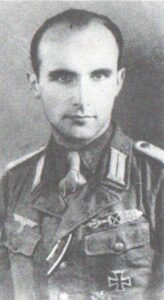
Gerhard Muhm, Wehrmacht officer
After the war, Muhm became one of the most influential German officers in the field of military strategy. He was the first German officer to be admitted to the Italian War College in Civitavecchia, a rarity at the time. He later held important positions within NATO in both Italy and Germany. After ending his active military career, he taught Military History, with particular attention to the Italian Campaign, at the Canadian War College. He was also a military-history consultant for the Defense Mapping School of Intelligence (DMSI), based in Fairfax, in the United States, where he contributed strategic and operational research.
The Educational and Military Journey
Gerhard Muhm volunteered for the Wehrmacht in July 1942, at just 18 years old, requesting to be assigned to the motorized infantry. He was assigned to the 151. Infanterie-Regiment regiment in Kassel, which, after the defeat at Stalingrad, was transformed into the Panzergrenadier-Regiment. He was commissioned as an officer on November 28, 1943, in Breslau (today Wrocław), at a ceremony also attended by Adolf Hitler. Muhm’s training was intensive and highly specialized, following the German model that alternated periods of theoretical instruction with practical periods on the battlefield. He completed his military training in the following stages:
- July 1942 – April 1943: Attended the Military Academy in Budweis (now České Budějovice, Czech Republic), with training as a squad leader.
- September – November 1943:: Attended the Schule für Panzergrenadiere (Armored Grenadier School) in Königsbrück, near Dresden, specializing as a platoon commander.
- February – March 1944:: Took part in a course for company commanders at the Armored Troops School in Krampnitz, near Potsdam (- (see two images below).
-

- German tanks loaded on railway flatcars

-

- A train carrying German tanks in a station

During these periods, Muhm received comprehensive training in military tactics at the battalion and regimental levels, which proved essential for his operational career. Starting in May 1943, he served as a squad leader in the 5. Kompanie of his regiment, later advancing to platoon commander in the 1. Bataillon.
His Experience in the Italian Campaign
The true test of his training came during the Italian Campaign. From May 21, 1944, until his capture on April 18, 1945, Muhm participated in all the major operations of the 29. Panzergrenadier-Division. Specifically, he was involved in the counterattack at Amaseno and Monte delle Fate during the German counteroffensive between Terracina and Vallecorsa. It was here that he distinguished himself as the commander of the 1. Kompanie, 1. Bataillon, 15. Panzergrenadier-Regiment, leading his men into battle with great determination until his capture by British troops north of Argenta.
Muhm is remembered for his discipline and adherence to the Auftragstaktik, the "mission tactics," which allowed German officers to operate with a degree of operational autonomy, adapting battle plans to conditions on the ground. This doctrine proved particularly effective during the Italian Campaign, where German forces, despite numerical and strategic disadvantages, managed to resist the Allies thanks to their adaptability and initiative.
Bibliography for further reading
- Gerhard Muhm, Geschichte der 1. Kompanie, Panzergrenadier-Regiment 15 (1945-46).
- Gerhard Muhm, La tattica tedesca nella Campagna d’Italia, in Amedeo Montemaggi (ed.), Linea Gotica, avamposto dei Balcani, Rome, Edizioni Civitas, 1993.
- Albert Kesselring, Soldat bis zum letzten Tag, Bonn, Athenäum, 1953.
- Gordon A. Craig, Die preußisch-deutsche Armee 1640–1945. Staat im Staate, Düsseldorf, Droste, 1960.
- Mario Puddu, Tra due invasioni. La campagna d’Italia, 1943-45, Rome, 1965.
- Kurt von Tippelskirch, Geschichte des Zweiten Weltkriegs, Bonn, Athenäum, 1951.
-

- The Panzer divisions systematically put the principles of “mission-type tactics” into practice

-

- The Panzer divisions were Germany's best weapon in the context of a rapidly mobile war.