

Manuel Noferini
In September 1944, German armoured vehicles—the same machines that had helped the Third Reich achieve its sweeping conquests of Poland, France and the Balkans at the beginning of the war—no longer operated with the ease they once had. Allied air superiority made any movement during daylight extremely risky, and even when stationary the vehicles had to be carefully camouflaged to avoid attacks by “Jabos” (the German abbreviation for fighter-bombers) or being targeted by artillery fire.1
Their numbers had also become insignificant compared with the forces the Allies—and above all the “Arsenal of Democracy”—were able to deploy, not least because Allied bombing had devastated Germany’s industrial base.
As far as armoured vehicles were concerned, toward the end of the war German industry devoted considerable resources to the production of assault guns—Sturmgeschütz in German—which were easier and cheaper to manufacture than conventional tanks because they lacked a turret, yet remained formidable weapons thanks to guns powerful enough to engage both enemy armour and infantry effectively.2
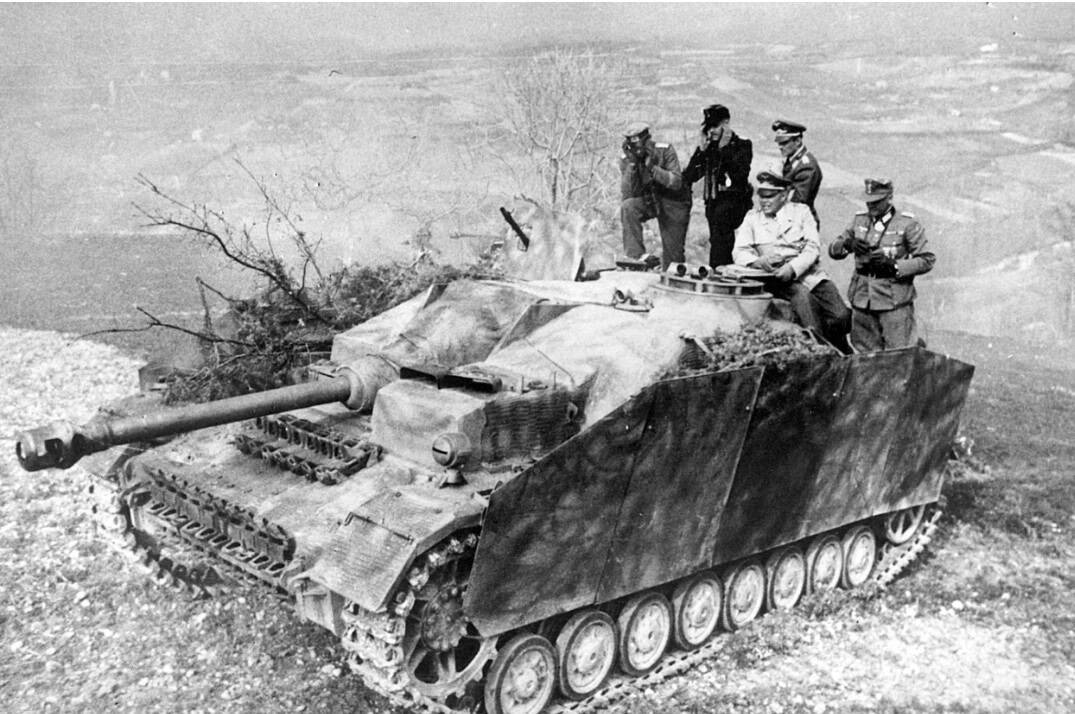
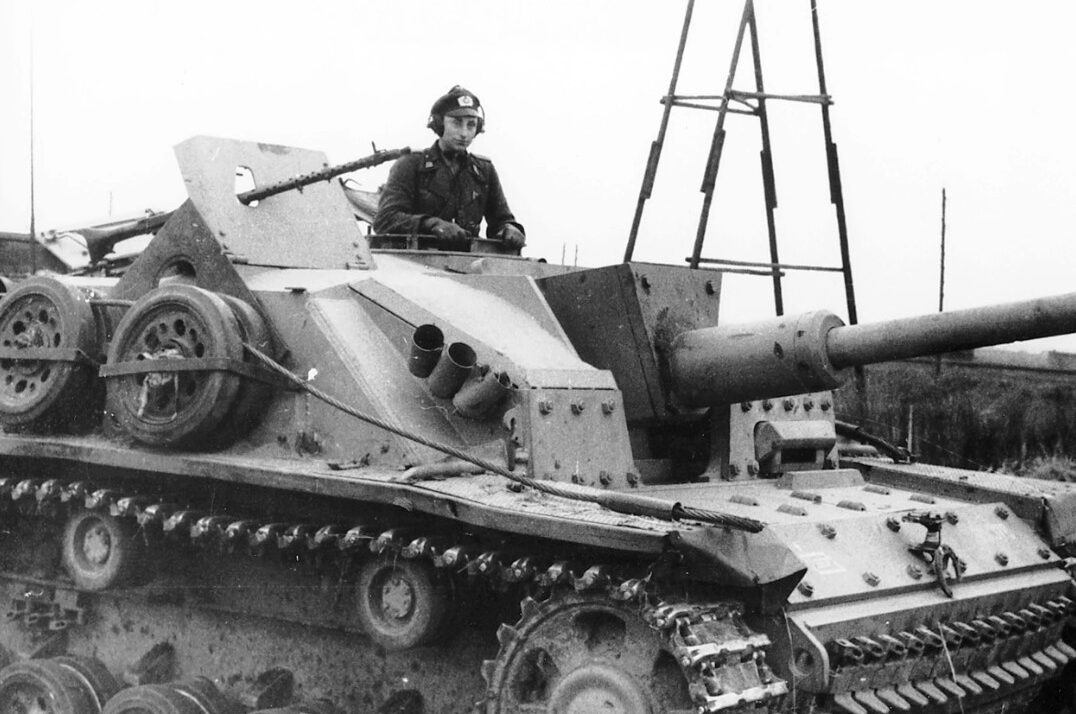
These armoured vehicles were widely used along the Gothic Line, but the limited number available meant that they were often deployed individually wherever it was considered necessary to establish a strongpoint to check the enemy advance.
In the Giogo Pass area, probably no more than three or four such vehicles were in action. They belonged to Heeres-Sturmgeschütz-Brigade 907, a unit directly subordinate to the I Fallschirm-Korps.3 One vehicle in particular proved quite active and caused the American forces some trouble, although the damage it ultimately inflicted on the enemy was fairly limited. This armoured vehicle appears in American reports dated September 14, which mention an “enemy tank” moving in the area and an unsuccessful attempt to destroy it with a bazooka. That afternoon, what was probably the same vehicle—incorrectly identified as a Panzer IV with a short-barrelled gun—was spotted 200 yards north of the Giogo Pass.4
On September 17, according once again to American reports, the vehicle appeared at the head of a counterattack, shelling Hill 926, though with little effect.5 Il 18 settembre alle ore 17.30 è annotata nel diario della Brigata Granatieri “Lehr” la presenza di uno Sturmgeschütz a Rifredo, insieme a una mitragliatrice pesante. Si tratta dell’elemento centrale di un punto di resistenza approntato al fine di contrastare l’ulteriore avanzata delle truppe americane dopo la perdita del passo del Giogo.6
Later, in a photograph taken by a U.S. Army war correspondent, we can see what was very probably the same armoured vehicle abandoned at the roadside after being hit by artillery fire or an air attack. The location appears to be the stretch of road linking the small village to the pass.
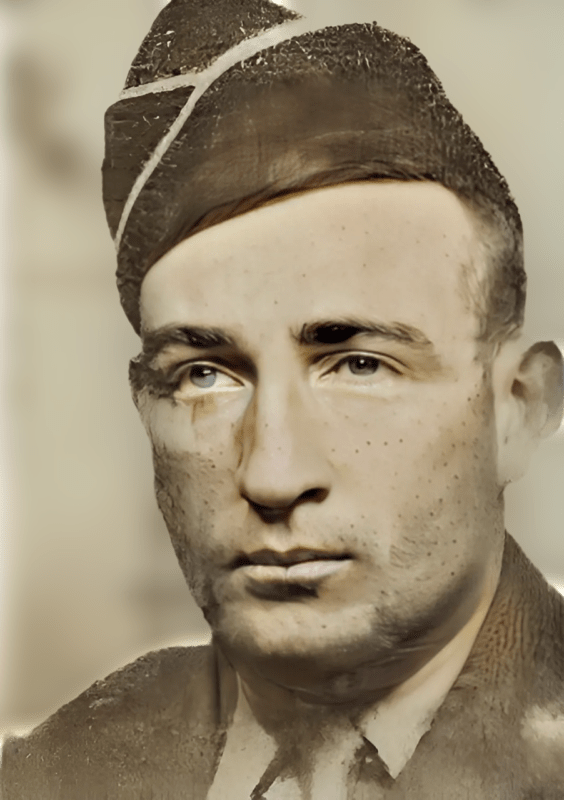
Among the crew was a young man from Meggenthal, Bavaria: Mathias HölzlThe son of a bricklayer, although only nineteen years old, he was already a veteran corporal decorated with the Iron Cross Second Class, the Assault Badge and the Wound Badge.

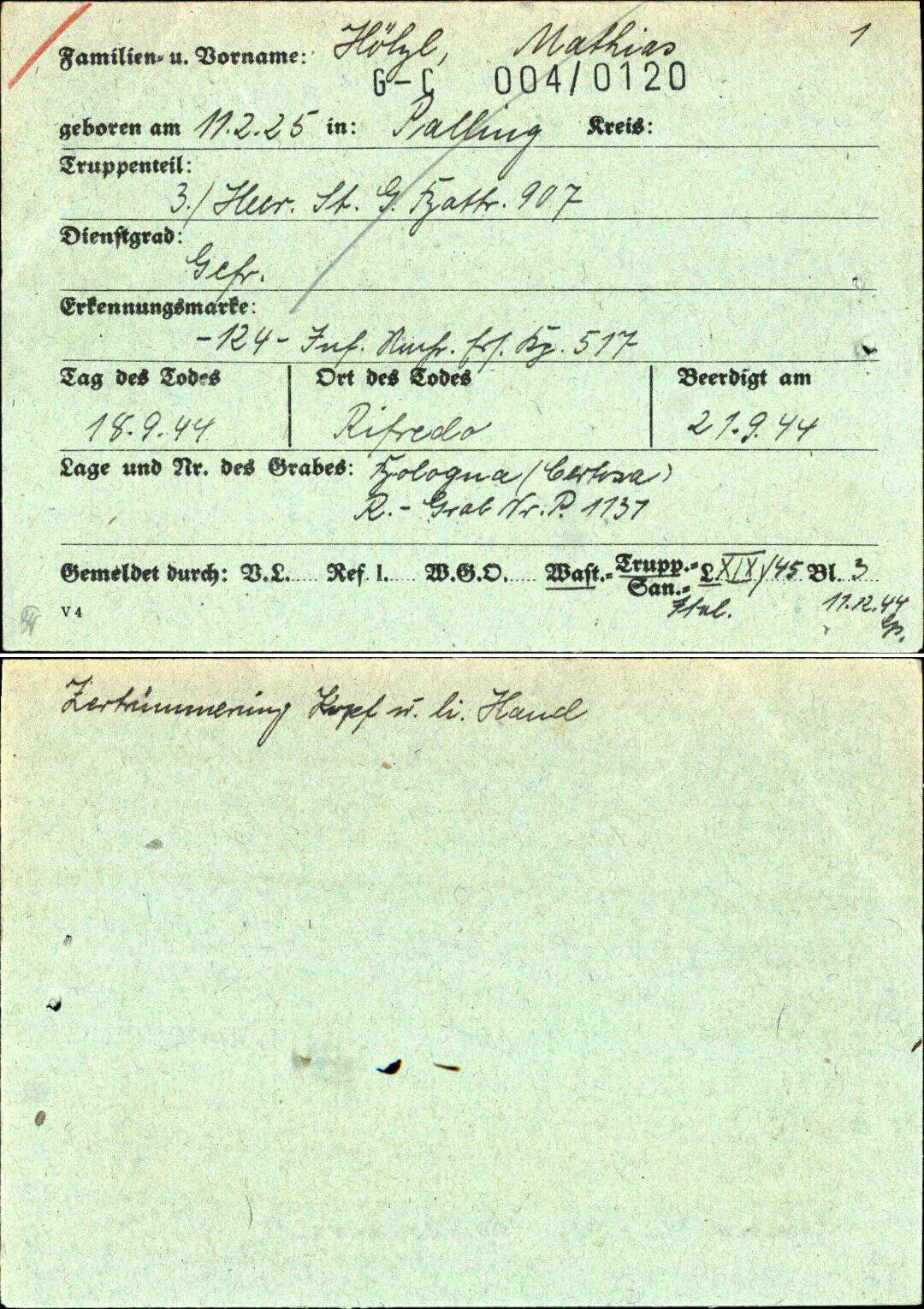
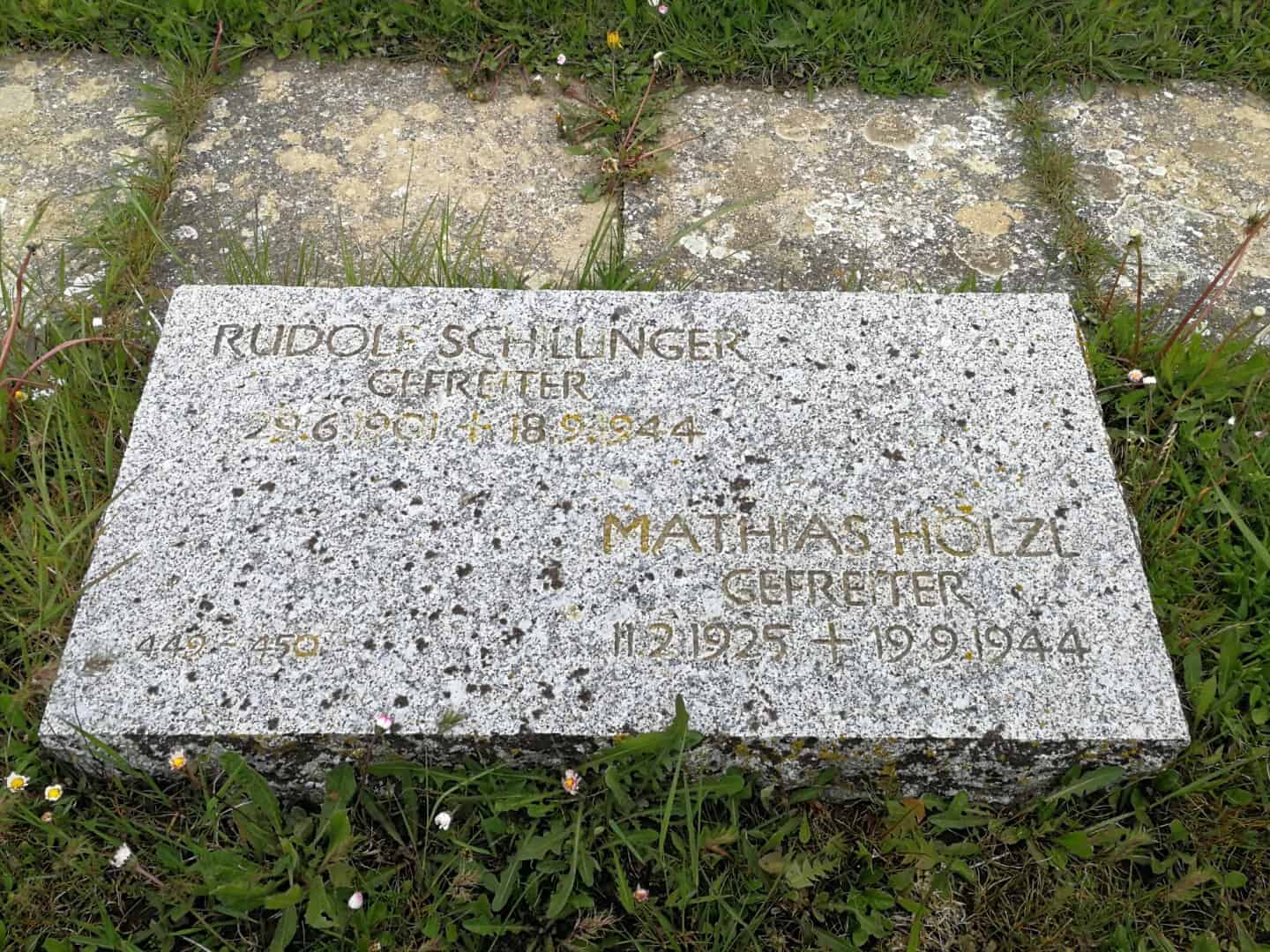
The attack on his Sturmgeschütz proved fatal. His death notice states that his left hand and skull were “shattered,” suggesting that he may have been killed instantly. His comrades did not leave him behind, however, but carried him with them and later buried him in Bologna’s Certosa Cemetery. Exhumed after the war, Mathias now rests in the German War Cemetery at the Futa Pass, Block 51, Grave 450.7
-

- Memorial card for Mathias Hölzl, a German soldier who died in 1944 at the age of 19, featuring prayers and religious dedications.

-
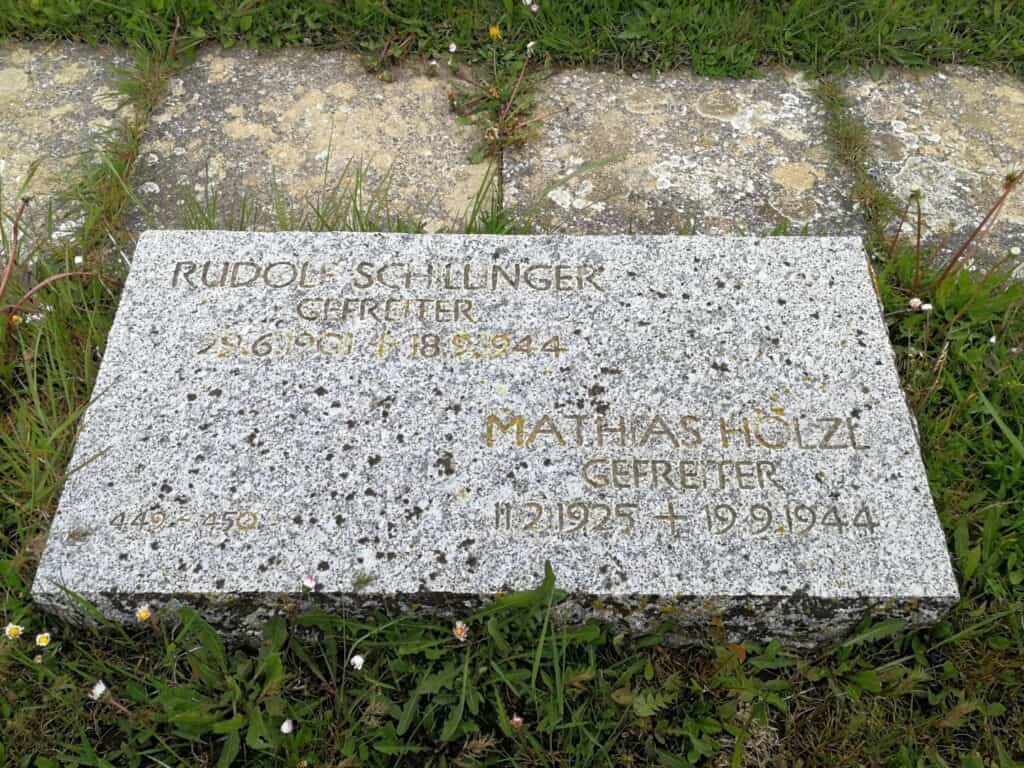
- Lapide di Rudolf Schillinger e Mathias Hölzl,sul prato del Cimitero di Guerra Germanico del Passo della Futa: Blocco 51 Tomba 450.
Footnotes
1. The “Jabos” and Air Superiority “Jabo” was the commonly used abbreviation for Jagdbomber, literally “fighter-bomber.” For German soldiers on both the Western and Italian fronts, the term came to have a very concrete meaning: Allied tactical aircraft capable of striking columns, vehicles, artillery positions and troop concentrations, making daylight movement extremely dangerous. The problem is particularly well documented in the Giogo area. During the September fighting, Allied tactical air support struck targets located behind the German positions.
2. Sturmgeschütz: Not a Tank, but an Assault Gun The Sturmgeschütz was developed on the eve of the war as a weapon designed to accompany infantry directly, destroying fortifications, machine-gun nests and other strongpoints. Its technical concept differed from that of a conventional tank: the gun was mounted in a fixed armoured superstructure rather than in a rotating turret. The Sturmgeschütz III, built on the Panzer III chassis, became the most widely produced vehicle of this type. The absence of a turret gave it a lower profile and made it relatively simpler to manufacture. Early versions were armed with a short-barrelled 7.5 cm gun intended primarily for infantry support; as the war progressed, later versions appeared with a long-barrelled 7.5 cm gun that was far more effective against enemy armoured vehicles. The Sturmgeschütz Sturmgeschütz thus came to play an important anti-tank role as well.
3. The Heeres-Sturmgeschütz-Brigade 907. The Sturmgeschütz-Abteilung 907 was formed at Schweinfurt on January 10, 1944, and transferred to Italy almost immediately. On February 14, it was redesignated as the Sturmgeschütz-Brigade 907 and on June 10 it received its final designation as the Heeres-Sturmgeschütz-Brigade 907It fought on the Italian front, initially in the Anzio and Cassino areas and later during the retreat toward the Gothic Line.
4. September 14: Two Bazooka Rockets Fired at the “Enemy Tank” The episode of September 14 is the best-documented of the entire story. The men of Company B, 338th Infantry Regiment, 85th Infantry Division, were positioned on the western slope of Monte Altuzzo when they spotted an “enemy tank” emerging from behind a building along the road. The vehicle stopped about 500 yards farther north and below their position. Pfc. Leslie H. Albritton moved forward with a bazooka. His first rocket fell about one hundred yards short. The vehicle started up and began moving behind a bend; Albritton fired again. The second rocket came much closer, landing about twenty-five yards from the target, but missed once more. The German vehicle immediately returned fire with a round that narrowly missed the Americans. With both available rockets expended, the bazooka team was forced to withdraw.
5. September 17: An Armoured Vehicle in the Counterattack on Hill 926 During the night of September 16–17, the Americans finally succeeded in reaching the summit of Monte Altuzzo. Hill 926 formed the dominant point of the massif and one of the key positions in the defence of the Giogo Pass. It was precisely during those hours that the Grenadier-Lehr-Brigade, reserve of the I. Fallschirm-Korps, reserve of the I Fallschirm-Korps. The official U.S. Army history reports that its two battalions had reached the sector and that the II Battalion moved into positions on Monte Verruca and Monte Altuzzo during the night, while the men of the 338th Infantry were climbing toward the ridge. On September 17, the Germans launched repeated counterattacks in an attempt to retake the lost positions. During one of these actions, American records once again note the presence of an armoured vehicle: a “German tank” moved through the depression north of Altuzzo’s western summit and south of the road, firing toward Hill 926 without achieving any significant results.
6. From the Giogo Pass to Rifredo: The Defence After the Breakthrough The geographical setting helps explain the subsequent employment of the Sturmgeschütz. Once the heights of Monte Altuzzo, Monte Verruca and Monticelli had been taken, troops of the U.S. II Corps were able to cross the Giogo Pass and advance along the road toward Firenzuola. On the morning of September 18, the 2nd Battalion of the 338th Infantry moved forward along the road, while elements of the 3rd Battalion reached Barco, about 1,600 yards north of the pass. By then, the Gothic Line in that sector had been breached
7. Mathias Hölzl: A Name Behind the Vehicle With Mathias Hölzl, the story of the armoured vehicle ceases to be merely a technical and military account. The documentation brought to light through specialist research includes a Sterbebild – the traditional memorial card commonly used in German-speaking Catholic regions – and a record from the Deutsche Dienststelle (WASt). The latter links Hölzl to the Heeres-Sturmgeschütz-Brigade 907 and records his death at Rifredo on September 18, 1944. The same documentation also notes his subsequent burial in Bologna’s Certosa Cemetery. The records of the Deutsche Dienststelle are particularly valuable for this type of research. During and after the war, the WASt collected millions of records concerning military personnel, casualties, missing soldiers, service details and burials.
Bibliography
Documentary Sources and Official Studies
- MacDonald, Charles B.; Mathews, Sidney T., Three Battles: Arnaville, Altuzzo, and Schmidt, Washington, D.C., Office of the Chief of Military History, Department of the Army, 1952, particularly the section Break-Through at Monte Altuzzo. The work is now published by the U.S. Army Center of Military History as CMH Pub 11-7. It is the key source for reconstructing the sightings of the armoured vehicle on September 14 and 17, the bazooka attack, and the photograph of the knocked-out vehicle.
- Fifth Army, Fifth Army History, Part VII: The Gothic Line, official historical documentation of the U.S. Fifth Army concerning the offensive from the Arno and the breakthrough of the Gothic Line in September 1944.
- U.S. Army Center of Military History, North Apennines, 1944–1945, series The U.S. Army Campaigns of World War II, for the broader operational context of the Fifth Army offensive through the Giogo Pass.
- Grenadier-Lehr-Brigade, Kriegstagebuch, June 26–November 4, 1944, CAMO, Bestand 500, Findbuch 12484, Akte 11, now digitised as part of the project German Documents in Russia.
Studies and Reference Works
- Anderson, Thomas, Sturmartillerie: Spearhead of the Infantry, Oxford–New York, Osprey Publishing, 2016. A general study of the development, organisation, tactical employment and technical evolution of the Sturmartillerie. Sturmartillerie .
- Battistelli, Pier Paolo, Assault on the Gothic Line 1944. The Allied Attempted Breakthrough into Northern Italy, Campaign 387, Oxford-New York, Osprey Publishing, 2023.
- Spielberger, Walter J., Sturmgeschütz & Its Variants, Atglen, PA, Schiffer Military History, 1997. A standard reference work on the technical development of the various versions of the Sturmgeschütz and other vehicles of the Sturmartillerie. Sturmartillerie.
- Tessin, Georg, Verbände und Truppen der deutschen Wehrmacht und Waffen-SS im Zweiten Weltkrieg 1939–1945, Band 13: Die Landstreitkräfte 801–13400, Osnabrück, Biblio Verlag, 1976. A fundamental reference work for the organizational history and designations of German units, including the 907th.