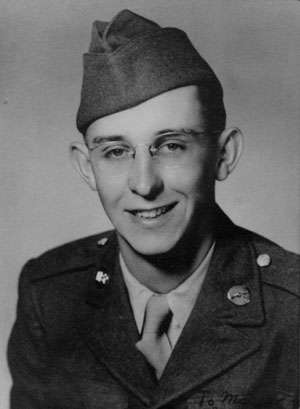


Manuel Noferini and Daniele Baggiani
This is the story of Elmer Julius Kunze, a soldier of the 338th Regiment, 85th Division. In September 1944, together with his comrades, he was among the first to reach the summit of Monte Altuzzo during the fighting for the Giogo Pass. His experience is not only part of military history, but also a reminder of the hardships and trials faced by so many young soldiers.
The Gotica Toscana Museum is in touch with his daughter, Robbie Kunze Humphrey, who has shared memories and documents to give a fuller picture of her father: not only the soldier wounded in battle, but also the man who was able to rebuild his life after the war. Robbie has visited the places where Elmer fought several times, weaving family memory into the shared history the museum preserves.
Her collaboration means a great deal to us: through her contribution, the story of Elmer Julius Kunze remains alive as part of a shared memory that brings together individual experiences and collective history.
Roots of Freedom
Elmer Julius Kunze was born on February 22, 1912, in Warren County, Missouri, the son of Edwin Henry Kunze and Louise F. Oberlag.
His family descended from German emigrants who had settled along the Missouri River, in the area later known as the Missouri Rhineland. The Kunzes were members of the Giessen Emigration Society (Giessener Auswanderungsgesellschaft), founded in 1833 by Friedrich Münch and Paul Follenius and inspired by ideals of freedom and democracy: its aim was to build in America a farming and democratic community that could also serve as a model for Europe. In 1834 Elmer’s grandfather, then a four-year-old boy, crossed the Atlantic on the Medora, one of the Society’s two ships, together with his parents, Hermann and Wilhelmine Kunze. The German families of the area built farms, schools and churches that became the heart of an active and close-knit community. Their story soon became intertwined with that of the United States: during the American Civil War, many members of Missouri’s German communities enlisted in the Union Army, standing against slavery and for national unity. A century later, one of their descendants—Elmer Julius Kunze—would return to Europe as a soldier. His military experience, in a very different setting, carried on a family tradition marked by involvement in conflicts of historic importance.
Elmer’s first language was German, which he kept throughout his life. During World War II, this fact raised concerns within the family: the possibility that he might end up fighting against men who spoke the same language—perhaps even distant relatives still in Germany—was very real.
Training and Departure
When the United States entered the war, Elmer joined the U.S. Army and was assigned to the 85th Infantry Division “Custer,” 338th Infantry Regiment, Company C, 1st Platoon. The division had been formed in 1917 at Camp Custer, Michigan, a camp named after General George Armstrong Custer, from which it took its nickname; it was reactivated on May 15, 1942, at Camp Shelby, Mississippi.
Elmer’s training began at Camp Shelby, one of the main U.S. Army training centers during the war; in 1943 the division went on to maneuvers in Louisiana and to desert training in California. There the soldiers went through long marches, drills on rough terrain, weapons training and night maneuvers, all designed to prepare them for the conditions they would face in Europe. The experience involved not only technical instruction but also daily life in the barracks, which fostered familiarity and cooperation among the men.
According to family memories, it was at Camp Shelby that Elmer met Richard E. Fent, later platoon sergeant of the 3rd Platoon of his company, with whom he built a strong bond of trust. Later, during the battle for Monte Altuzzo, it was Fent who came to his aid and carried him to safety when Kunze was seriously wounded. That friendship, born during training, proved crucial in combat.
Minturno: Baptism of Fire
In the spring of 1944 the 85th Infantry Division, arriving from North Africa and landing at Naples between mid- and late March, went into the line on April 10 in the lower Garigliano sector. Elmer took part in the fighting on the Gustav Line, particularly around Minturno, not far from Formia. The American advance in that sector was slowed by well-organized German defenses: positions on the high ground controlled the main routes toward Cassino and Rome, and every step forward demanded prolonged fighting. The campaign often took on the character of positional warfare, fought at close range among ruined houses and trenches dug into the earth.
According to family memories, during those weeks Elmer was hit in the legs by shell fragments. The wounds were not severe enough to force him to leave his unit, and after treatment he returned to duty. The episode marked his first direct encounter with the intensity of enemy fire and with the harshness of a front where German resistance proved stronger than the Allies had initially expected.
From Minturno Elmer also found time to write to his county’s local newspaper, the “Banner,” as he himself calls it: most probably the Warrenton Banner, the weekly paper of Warrenton, the county seat of Warren County. His letter, published on May 18, 1944, offers a valuable glimpse of how American soldiers perceived the Italian front. It was not an official report but a short personal account that gave readers back home a concrete sense of the conditions of the campaign, the hardships faced by the troops and the daily life of the men in the field.
“Banner” (Warrenton, Missouri, USA), May 18, 1944.
Private Elmer Kunze writes from Italy
Private Elmer Kunze, serving with the United States Army on the battlefront in Italy, writes about his experiences in a letter addressed to the Banner, dated April 28:
“Dear Sirs:
Well I have neglected writing for a long time now, and I want to write and thank you for the Banner. For a while I sure missed it, as we had moved to Italy and it didn’t get here for a while.
We are on the front lines now and I don’t see how they can take all that is handed out to them. We give them ten shots to every one they send us.
My home now is a hole in the hillside, just big enough for two men and it is quite safe. Even Jerry’s screaming memies [sic; the German Nebelwerfer rockets] can hardly get us here.
It gives us a pretty good laugh to see about four or five men try to get into one when they send us a shell or two.
While visiting the Red Cross a while back and looking through the books of each state the boys that had signed their names, I noticed Howard Armstrong’s name and the date he had been there. It was about a month before I was there. I also noticed a few boys from Marthasville and other parts of Warren County.
The Red Cross is doing wonderful work here, even to giving the boys on the line doughnuts.
Well, I wish you and the Banner all the luck in the work, and I hope you keep the Banner coming my way and a ‘hello’ to everybody. I will sign off.
Sincerely,
(Signed) Elmer.”

The Advance Through Italy
After the breakthrough of the Gustav Line (May 1944), the 85th Infantry Division “Custer” pushed on toward Rome, which it entered on June 4–5, and continued along the Via Cassia beyond Monterosi, in constant clashes with German rearguards. On June 10 it was withdrawn from the line and spent about a month resting at the Castel Porziano estate, south of Rome, to reorganize and receive replacements; it was then sent to Tuscany.
In July the “Custer” moved to the Roccastrada area and then between Volterra and San Gimignano; from August 15 to 26 it held the south bank of the Arno west of Florence, carrying out patrols and defensive actions. Assembled afterwards between Montespertoli and Certaldo, it prepared for the offensive against the Apennines. On the night of September 11, the 338th Regiment, to which Kunze belonged, crossed Florence by truck and moved up Highway 65 to Vaglia, behind the Giogo front.
Monte Altuzzo, September 1944
On September 12, 1944, the battle for the Giogo Pass, a key point of the Gothic Line, began. From September 13, for five days, the 338th Infantry Regiment of the 85th Division fought to capture Monte Altuzzo (Hill 926), a position defended by bunkers, trenches and interconnected machine-gun nests. The attacks advanced slowly and with great difficulty: every slope and rocky ridge demanded repeated efforts and cost heavy casualties.
The regiment’s companies took turns in the assaults; when units were depleted, they were reinforced with platoons from other units. Company “C,” to which Elmer Julius Kunze belonged, was repeatedly in the front line. Before dawn on September 17, after days of fighting and German counterattacks, the 3rd Platoon of Company C, led by 2nd Lt. Albert J. Krasman and Platoon Sgt. Richard E. Fent, climbed to the crest; other men of the company followed, including those of the 1st Platoon. The Germans held two bunkers on the summit. According to the account of the American military historian Sidney T. Mathews, Pfc. Elmer J. Kunze attacked the right-hand bunker, dug into the top of the peak, together with Pfc. Lawrence Markey Jr.: while a German threw hand grenades, Kunze answered with his M1 rifle to cover Markey, who was trying to throw a grenade inside. Today a wooden cross commemorates the fighting. According to family memories, Kunze was hit in the torso by a bullet during the action; Mathews’s account does not record his wound.
According to the same family memory, Sergeant Fent, whom Kunze had met during training at Camp Shelby, reached him under fire and dragged him to cover, so that he could receive first aid. His intervention proved decisive in saving Kunze’s life.
Many years later, Fent’s widow told the story to Robbie Kunze Humphrey, Elmer’s daughter, confirming how events had unfolded. Both men survived the fighting on Monte Altuzzo and, back in the United States, stayed in touch over the years, bound by the shared memory of that experience.
After the war
Elmer Kunze returned to the United States, where he lived for many years with his wife and children. He never spoke about his experiences at the front. Only after his death, which occurred on March 23, 1983, at the age of 71, did his wife confide to their daughter Robbie that Elmer never took off his shirt in front of the children, so as not to show the scars left by his wounds in Italy. The war had marked him so profoundly that he did not want others to see what he had endured firsthand.
Elmer Julius Kunze is buried in Saint Paul’s Cemetery in Marthasville, Missouri. Rest in peace, Elmer. We love you.
Memory at MuGot
Elmer Julius Kunze’s daughter, Robbie Kunze Humphrey, donated her father’s original uniform to the Gotica Toscana Museum, where it is now displayed in the Giogo Room alongside other relics of the battle. The gift not only enriched the museum’s collection but was also an act of family remembrance: through her contact with the association, Robbie was able to piece together details of Elmer’s military life she had not known, filling gaps in a story that her father, like many veterans, had never wanted to tell in full.
For MuGot, it is a great honor to preserve the uniform of one of the heroes of Monte Altuzzo.
In 2023, on the occasion of the historical reenactment A Dive into History, Robbie returned to the battlefield. Together with reenactors, volunteers, and visitors, she retraced the path leading to the cross on Monte Altuzzo, exactly where Company “C” had fought in September 1944. The climb to the summit was not just a symbolic act: for her, it meant coming closer to the ground her father had once known under danger and hardship—a place that for decades had been only a name in the family’s memories.
During the ceremony, Robbie spoke before the audience to remember Elmer. In a simple tone, she talked about his story as a soldier and a father, sharing emotions and family memories. It was a deeply moving moment, where private memory and collective memory became intertwined: the experience of one man, who survived one of the hardest battles in the Apennines, was transformed into a shared story and a heritage for all.
A Pioneer’s Heir
From Germany to Missouri, from abolitionism to the fight against Nazism and Fascism, the story of Elmer Julius Kunze spans two centuries of history: an American soldier, descended from German immigrants who had chosen freedom, who returned to Europe to defend those same ideals.
Thank you, Elmer, for what you did for us. We will always remember you with gratitude and love.
Sources
- Sidney T. Mathews, Break-Through at Monte Altuzzo, in Charles B. MacDonald, Sidney T. Mathews, Three Battles: Arnaville, Altuzzo, and Schmidt, Washington, Office of the Chief of Military History, 1952, chapters IV–V.
- Letter from Elmer Kunze to the “Banner,” dated April 28, 1944, and published on May 18, 1944 (clipping reproduced above).
- Memories and documents shared by his daughter, Robbie Kunze Humphrey.
- For the movements of the 85th Infantry Division: 85th Infantry Division Association, History of the 85th Division (custermen.com).
- For the Giessen Emigration Society: State Historical Society of Missouri, Missouri Encyclopedia, entry “Paul Follenius.”
- Traveling Summer Republic and Stadtarchiv Gießen (eds.), Utopia. Revisiting a German State in America, Bremen, Edition Falkenberg, 2013 (ISBN 978-3-95494-595-5), bilingual German–English volume. According to Elmer’s daughter, Robbie Kunze Humphrey, the volume documents the Kunze family’s membership of the Giessen Society and their crossing on the Medora.


The uniform of Elmer Kunze on display at the MuGot