


research and text by Daniele Baggiani
The American Advance to the Arno: From Volterra to Pontedera
From the Livorno coast to Pisa and San Miniato, July 1944
Between 3 and 25 July 1944 IV Corps of the American Fifth Army pushed up through the hills between the Livorno coast and the Val d’Elsa as far as the Arno. At 9 a.m. on 18 July an infantry company reached the riverbank at Pontedera; the following night the Americans entered Livorno, on 23 July the part of Pisa south of the Arno, and on 23–24 July San Miniato. Then they halted for six weeks, while on the other bank the civilians remained under German occupation. This is the first installment of the series that Gotica Toscana devotes to the battles that prepared the way for the liberation of Florence.

Volterra, 9 July 1944. A squad of Company B, 349th Infantry, American 88th Division, climbs toward the town through the rubble: according to the caption of the time, it was the first to enter. Outflanked, the Germans had pulled out during the night without fighting for the town. (U.S. Army Signal Corps, photo by McWhirter; National Archives, 111-SC-191694, public domain)
In brief: the whole story in seven points
- Where and when. From the lower Val di Cecina to the Arno, on a front that ran from the sea to the hills of San Miniato: the coast and the hills around Livorno and Pisa, the valley of the Era (the Valdera), the hills of Palaia and Montaione. The advance lasted from 3 to 25 July 1944; six weeks of static front on the river followed, until 1 September.
- Who. The American IV Corps under General Willis D. Crittenberger, in General Mark W. Clark’s Fifth Army: the 34th Infantry Division with the Japanese American 442nd Regimental Combat Team, the 88th and 91st Infantry Divisions, and the 1st Armored Division. Facing them, the German XIV Panzer Corps under General Fridolin von Senger und Etterlin, with the 16th SS Panzergrenadier Division “Reichsführer-SS,” two Luftwaffe field divisions, the 26th Panzer Division and other units.
- Why it mattered. The Allies wanted the port of Livorno and the line of the Arno, from which to move against the Gothic Line. The Germans wanted to gain time to complete the Gothic Line in the Apennines. Meanwhile the Fifth Army was giving up divisions for the landing in Provence and was left with a front of four divisions.
- What happened. Rosignano was taken house by house; Volterra was abandoned by the Germans without a fight after the 88th Division had outflanked it; at Lajatico a night attack led to the capture of about 400 prisoners. On 18 July Company K of the 361st Infantry (91st Division) reached the Arno at Pontedera; on 19 July Livorno was in American hands, and on 23 July the part of Pisa south of the Arno.
- The civilians. At San Miniato, on 22 July, 55 civilians whom German soldiers had gathered in the cathedral were killed by the explosion of a shell: the studies collected in 2004–2005 by Leonardo Paggi for the municipality of San Miniato and the Region of Tuscany attribute it to American artillery. Along the line of retreat German units killed civilians at Rosignano, at San Piero a Grado, at Empoli; during the six weeks of static front, north of the Arno, came the massacres of August, from the Pisa area to the Padule di Fucecchio.
- The cost. In July 1944 alone the Americans of the Fifth Army suffered 7,081 casualties, that is, killed, wounded and missing, 1,276 of them killed; the 88th Division suffered 2,399 in the twenty-three days from Volterra to its relief at the end of July. German losses are only partly known. Civilian victims have to be counted municipality by municipality (section 9).
- Remembrance. Many towns on the river commemorate their liberation in September, when IV Corps crossed the Arno. The advance has been reconstructed in local studies, above all by Claudio Biscarini and Andrea Pestelli, but it remains little known outside Tuscany.
How to read this article
The main narrative can be read on its own, from beginning to end. Many paragraphs are followed by collapsed in-depth sections: readers who want to know more can open them and find the hour-by-hour details, the units, the people, the figures and the disagreements between sources. At the end of section 2, four in-depth sections serve as tools: “Who’s who,” “Glossary,” “The units” and “Chronology.” The advance is told column by column, from west to east: the coast (section 3), the hills of Volterra (4), the Valdera (5), then Livorno and Pisa (6) and San Miniato (7). American units are given in their US Army form (88th Division, 351st Infantry, 3rd Battalion). In the narrative, German units are given in English, with the original German form at first mention; in the in-depth sections and tables, in the German form used in the specialist studies (26. Panzer-Division, Grenadier-Regiment 1060, I Battalion with a Roman numeral). When we speak of “liberation” we always distinguish the arrival of the American units from the date commemorated by the municipality: in many towns on the Arno the two do not coincide (section 8). The date under which this article appears in the list of the series, 18 July 1944, is the day the Americans reached the river. Every statement has its note, and the notes are collected at the end in the in-depth section “Notes”; where the sources disagree, we say so, and the main disagreements are collected in the in-depth section “The sources disagree.”
In this article: 1. After Rome: toward the Arno, while the war was being decided elsewhere · 2. The terrain, the men, the enemy · 3. On the coast: Rosignano, Castellina, Hill 140 · 4. Volterra and the hills: the road of the 88th · 5. The 91st in the Valdera: from Chianni to Pontedera · 6. Livorno and Pisa · 7. San Miniato: the cathedral and the entry into the town · 8. Halted on the Arno · 9. What it cost · 10. Remembering today · Notes · Bibliography
At 5 a.m. on 18 July 1944 the American infantrymen of the 361st Infantry, 91st Division, resumed the attack northward. The 1st Battalion took Orceto; the 3rd advanced toward Pontedera with tanks and tank destroyers, the self-propelled antitank guns.[1] At 8 a.m. an infantry company, Company K, entered the town with tanks of the 1st Armored Regiment. An hour later, having silenced a few machine guns and snipers, those infantrymen reached the south bank of the Arno.[2] Most of the German units had already crossed the river; mortar and artillery fire came from the north bank, and there were booby traps among the rubble.[3] The Fifth Army history, written in 1945, records those men as “the first Americans to reach the Arno.”[4]
Company K was ordered to hold the town, and Pontedera remained on the front line for six weeks: at Pisa, at Pontedera and at a few other points, the Fifth Army history notes, the American forward lines were on the very bank of the river.[5] This is why, in many towns on the Arno, the liberation has two dates. The Americans entered the part of Pisa south of the river on 23 July; the city commemorates its liberation on 2 September, the day after American units had crossed the Arno. The Region of Tuscany also gives 2 September for Pontedera.[6]
Farther east, the British Eighth Army was still fighting in the Chianti: it reached the Arno at Florence on 4 August, more than two weeks after the Americans at Pontedera.[7]
Outside the towns it passed through, little is said about this advance, even though there is no lack of studies. In Tuscany it has been reconstructed by local researchers: Claudio Biscarini, who has studied the Arno front since the late 1980s and in 2022 devoted a book to the 88th Division from Volterra to San Miniato, and Andrea Pestelli, who in 2021 told the story of the Fifth Army’s operations from the Maremma to the Arno.[8] These are the reference works for anyone who wants to go beyond this article (as we explain below); issued by local publishers, they circulate little outside Tuscany, and the advance remains less known than the battle for Florence and the Gothic Line.[9]
This article tells the story of those three weeks and of the six weeks of static front that followed, with the same respect for the American soldiers who advanced, for the German soldiers who fell back fighting, and for the civilians caught between the two armies.
Why this story is little known, and the studies this article is based on
The American histories. The Fifth Army published its own official history as early as 1945; the volume of the US Army official history on the Italian campaign after Cassino, by Ernest F. Fisher, appeared in 1977 and devotes two chapters to the advance from the Cecina to the Arno. The divisions wrote their histories between 1945 and 1954.[10] They are thorough histories, but written from the units’ point of view: the Tuscan towns appear in them as objectives, the civilians almost never. None has been translated into Italian.[11] In 1986 the historian John Sloan Brown titled his history of the 88th Draftee Division: a division of conscripts.[12]
Local studies. In Tuscany the advance and the six weeks of static front on the river have been reconstructed above all by Claudio Biscarini, often together with Giuliano Lastraioli, Luciano Niccolai and Fabrizio Mandorlini, on the basis of American and German documents: Arno-Stellung. La quarantena degli alleati davanti a Empoli (with Lastraioli, 1988–1991), the volumes on Montopoli (1998), on Santa Croce, Castelfranco and Santa Maria a Monte (1999), and on Montelupo (2003); La strada per l'Arno dei Blue Devils. L'88th US Infantry Division da Volterra a San Miniato (7–24 luglio 1944) (2022); Fronte dell'Arno luglio–settembre 1944, on the war from San Miniato to Empoli as seen in unpublished documents from German archives (2024).[13] Andrea Pestelli, Gli Americani dalla Maremma al fiume Arno (2021), is a chronicle of the Fifth Army’s operations in the provinces of Grosseto, Pisa and Livorno.[14] There are also the studies by Fabrizio Pettinelli on the Valdera and the province of Pisa (1990 and 2005) and by Giuseppe Barsotti on occupied Pisa (2017), the diaries of the parish priests of the diocese of Volterra (2017), the war diary of Luciano Forte in Pontedera (2024), and the anniversary publications of the municipalities.[15]
Studies of the massacres and of memory. Since 1997 academic historians have studied in depth the German massacres of the summer of 1944 in Tuscany and their memory: Michele Battini and Paolo Pezzino, Gianluca Fulvetti, Carlo Gentile, the Atlante delle stragi naziste e fasciste in Italia, and, for San Miniato, the volume edited by Leonardo Paggi (2004–2005). In these studies the Americans appear mostly as the background to German violence or, at San Miniato, as the unintentional perpetrators of the massacre in the cathedral.[16]
What is missing. As far as the catalogs show, there is no study that brings together the operations, the civilians and the memory of the American advance in the provinces of Pisa and Livorno; there are no specific studies of Lajatico, Chianni, Terricciola, Palaia, Ponsacco and Peccioli in 1944; none of the local studies has been translated into English, and several key titles are held by very few libraries.[17] This is the author’s assessment, based on library catalogs, not a judgment on the quality of the studies.
What this article is based on. For this article it has not yet been possible to consult the books by Claudio Biscarini, who has written on this site about the war in Tuscany in July 1944, nor those by Andrea Pestelli and the other local studies cited here: we list them as reference works, without attributing to them any content we have not read. The narrative is based on the official history of the Fifth Army and on Fisher’s, on the histories of the divisions and of the 442nd, on Robin Kay’s New Zealand official history, on the German documents cited by Fisher and by Carlo Gentile, on the Atlante delle stragi and on the volume edited by Leonardo Paggi. Readers who compare this account with the books by Biscarini and Pestelli will certainly find more detail there, and perhaps some different dates: comments from readers, and from the authors, are welcome.
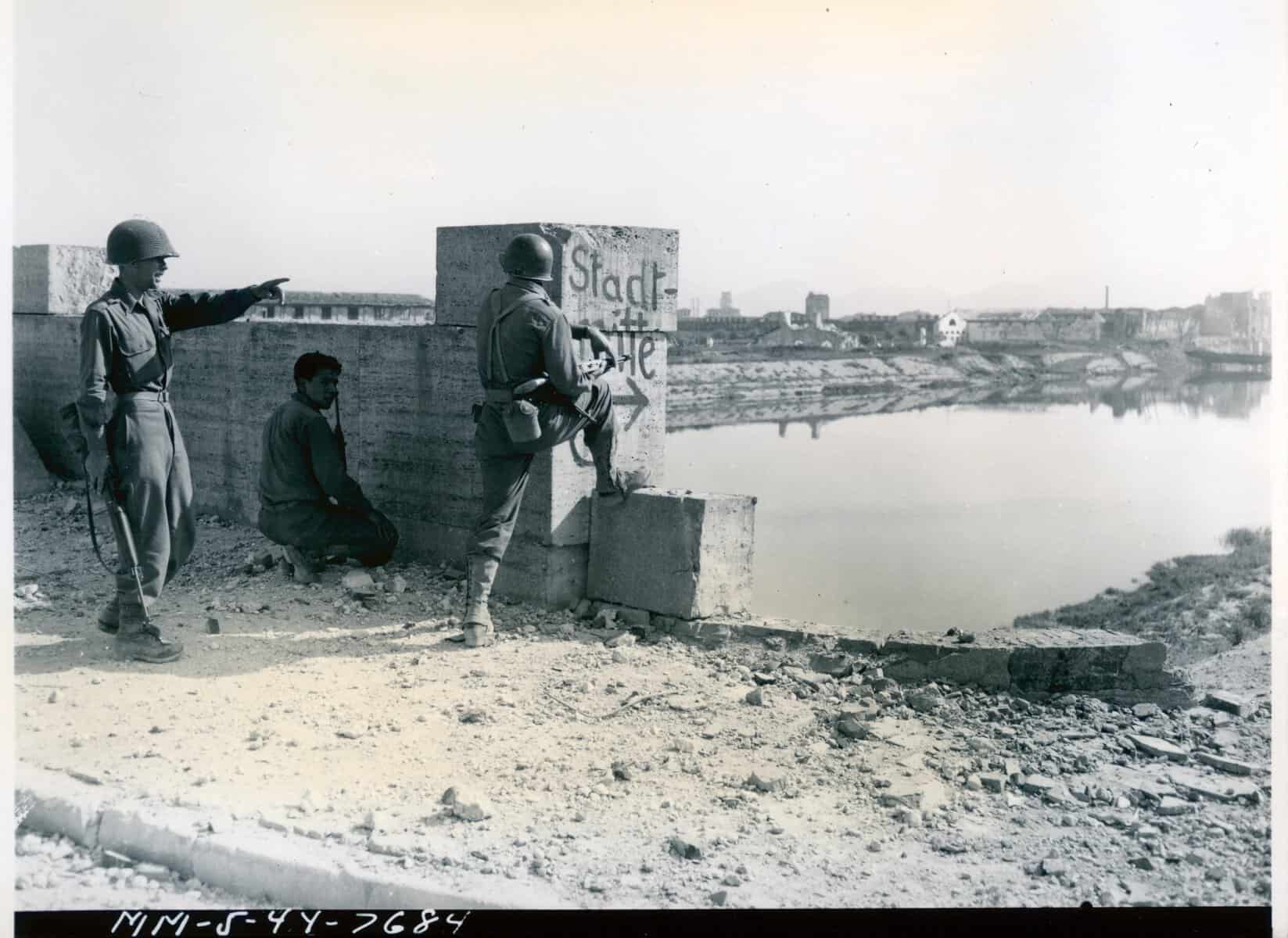
Pisa, late July 1944. A three-man American patrol watches the Arno from the south bank, sheltering behind a wall with a German road sign. Across the river the city was still in German hands, and would remain so until 1 September. (U.S. Army Signal Corps, MM-5-44-7684; Signal Corps Archive scan, Wikimedia Commons; public domain)
1. After Rome: toward the Arno, while the war was being decided elsewhere
On 1 July 1944 Field Marshal Albert Kesselring, commander of the German forces in Italy, laid down that the Arno would be the last line on which to delay the Allies before the Gothic Line; until then a few key sectors were to be held, among them Rosignano Solvay, on the coast.[18] The German armies did not withdraw to a fortified line, but by successive lines of withdrawal, marked on the map where the terrain favored the defense: lines which, as the New Zealand official historian Robin Kay points out, were not even dug in. The intermediate lines had girls’ names, such as Irmgard, Karin, Olga and Paula; the line of the lower Arno, from the sea to the confluence of the Elsa, was instead called the Heinrich Line.[19]
On the Allied side, meanwhile, the war was being decided elsewhere. At the beginning of July the Allied high command ordered the landing in southern France, on 15 August if possible, and the Italian campaign had to give up divisions to the new operation: General Mark W. Clark’s Fifth Army lost seven, and in the second half of July, Kay writes, it was “reduced to a front of four divisions.”[20] The sector left by the French passed at midnight on 22–23 July to the British Eighth Army, which included the New Zealanders: that is why it was they who reached the gates of Florence and fought at San Michele a Torri.[21]
The four divisions left at the front were those of General Willis D. Crittenberger’s IV Corps. On the coast fought the 34th Infantry Division, with the Japanese American 442nd Regimental Combat Team; inland was the 1st Armored Division, which on 8 July, in front of Volterra, handed over to the 88th Infantry Division. On 12 July the 91st Division came into the front line, complete for the first time.[22] The task was to take Livorno, with its port, and to bring the front up to the Arno: for the Allied commands, reaching the line from Pisa to Rimini, from one sea to the other, was the precondition for every later operation.[23]
The landing in Provence and the Italian campaign: an eighty-year debate
The decision. On 2 July the Combined Chiefs of Staff, the top American and British military leadership, ordered the British General Henry Maitland Wilson, Allied commander in the Mediterranean, to land in southern France, on 15 August if possible. On 5 July Wilson informed General Harold Alexander, who commanded the Allied armies in Italy, that the new operation had priority over the Italian campaign: up to four French and three American divisions would be taken from him, to be replaced by the American 92nd Infantry Division, an African American division, and by a Brazilian division. The Fifth Army lost the French Expeditionary Corps and the American VI Corps.[24]
The landing and the debate. The landing in southern France (Operation ANVIL, later renamed DRAGOON) took place on 15 August 1944. The American Seventh Army, made up of American and French units, pushed up the Rhône valley within a month and linked up with the armies that had landed in Normandy.[25] Opinion on the value of the operation was divided from the start. General Dwight D. Eisenhower wrote that no development of that period had contributed to the final victory “more decisively.” For Alexander, by contrast, its effect on the Italian campaign was “disastrous”: the Allied armies, “in full pursuit of a beaten enemy,” were called off from the chase, and Kesselring was given time to reorganize his scattered forces.[26] Clark judged the weakening of the Italian campaign “one of the outstanding political mistakes of the war.” Rudolf Böhmler, a German paratroop officer who had defended Monte Cassino, wrote that ANVIL “snatched the spear from Alexander’s hand.” General Fridolin von Senger und Etterlin, who in those weeks commanded the German corps deployed directly opposite the Americans, observed that German resistance in front of Bologna in the winter of 1944–45 would not have been so effective if several Allied divisions had not been withdrawn.[27]
Kay, who summarizes the debate in the New Zealand official history, judges that the seven divisions taken from the Fifth Army were inadequately replaced. He nevertheless urges caution: the critics of ANVIL presume that an Allied offensive beyond the Italian frontier would have succeeded, whereas the Allied armies might have been checked, as they had been south of Rome.[28] For the Americans in this article the most concrete consequence was the six weeks of static front on the Arno, described in section 8.
2. The terrain, the men, the enemy
Between the coast and the Val d’Elsa the landscape is one of hills and valleys: the Val di Cecina and the valley of the Era, the Valdera, which opens onto the plain of the Arno. The Americans advanced along four axes, which we call columns here, from west to east:
- on the coast and the hills around Livorno and Pisa, the 34th Division and the 442nd;
- from Volterra through Lajatico and Villamagna, the 88th;
- from the hills of Chianni across the Valdera, the 91st;
- on the right flank, through Palaia and Montaione toward San Miniato, elements of the 88th and an armored force, Task Force Ramey.[29]

The advance of the American IV Corps from the Val di Cecina to the Arno, 1–25 July 1944. On the coast the 34th Division and the Japanese American 442nd RCT reach Livorno on 19 July and the southern part of Pisa on the 23rd. Inland the 88th Division moves through Volterra, Lajatico and Palaia to San Miniato, while the 91st moves through Chianni, Terricciola and Ponsacco to Pontedera, where the first Americans reach the river on 18 July. Map by Gotica Toscana aps (2026), based on the Fifth Army History, Fisher (1977) and the division histories; arrows are schematic. Base: ISTAT boundaries (Openpolis, CC-BY), rivers © OpenStreetMap contributors (ODbL). Click the map to open it at full resolution.
The men were not all alike. The 34th came from the battle of Cecina, which had cost the 133rd Infantry alone 404 men killed, wounded and missing: for Fisher, the costliest battle for an American unit since the fall of Rome.[30] The 442nd Regimental Combat Team, with the 100th Infantry Battalion recruited in Hawaii, was made up of Japanese Americans, the sons of Japanese immigrants; many had volunteered from the camps in which the US government had confined their families (section 3).[31]
Facing them was the German Fourteenth Army (14. Armee) under General Joachim Lemelsen, and in particular the XIV Panzer Corps (XIV. Panzerkorps) under General Fridolin von Senger und Etterlin. On the coast fought the 16th SS Panzergrenadier Division “Reichsführer-SS” (16. SS-Panzergrenadier-Division), a division of the Waffen-SS, the military formations of the SS, together with two divisions formed from air force personnel, the 19th and 20th Luftwaffe field divisions; inland were the 26th Panzer Division (26. Panzer-Division), the 90th Panzergrenadier Division (90. Panzergrenadier-Division) in front of Volterra, and regiments of other divisions.[32]
The task of the German units was not to stop the Americans but to slow them down. On 7 July, in the hills east of Rosignano, prisoners from the 36th SS Regiment told men of the 442nd that they had orders to hold the line until the defenses at Pisa were ready.[33] During the night of 12–13 July, after the loss of Volterra, the Fourteenth Army “broke contact across its entire front and fell back on the Arno,” writes Fisher, quoting its war diary: not to the river itself, but to the next line.[34] Until 17 July the rearguards counterattacked with infantry and tanks at Soiana, Le Selve, Orceto and Fauglia.[35]
The other side: the German retreat, the units, a notebook
The sources. The German side is less well documented than the American one: the war diaries of the Fourteenth Army, kept in Freiburg, are known here only through Fisher’s quotations, and the other German sources only through the studies of Carlo Gentile.[36]
The retreat as seen from headquarters. The main narrative summarizes its stages (section 2). On 2 July Lemelsen withdrew the 29. Panzergrenadier-Division from the front and sent it into reserve on the Arno, west of Florence.[37] According to Fisher, the loss of Volterra opened a gap in the sector of the 90. Panzergrenadier-Division.[38] The withdrawal of the night of 12–13 July was neither a rout nor an arrival on the river: it was the move to the next line. The Fifth Army history speaks of a sudden withdrawal along the mountain front, the 442nd’s journals of a withdrawal of about 10 kilometers.[39]
The units. The 16. SS-Panzergrenadier-Division “Reichsführer-SS,” commanded by SS-Gruppenführer Max Simon, was assigned to the XIV. Panzerkorps at the end of June: one regiment fought at Cecina, the rest was in reserve near Livorno. The division reached the Arno at the end of July and at the beginning of August was holding the coast.[40] The two Luftwaffe divisions were made up of air force personnel employed as infantry; from 1 June 1944 they were officially called Luftwaffen-Sturm-Division, although the American sources go on calling them Luftwaffe Field Division. At the end of July, north of Pisa, they were being merged into a single formation: the 19th was disbanded in August and its artillery passed to the 20th.[41] The 26. Panzer-Division, commanded until July by Smilo von Lüttwitz and then by Eduard Crasemann, had absorbed a grenadier brigade, the 1027th, on 1 July; in the Valdera the Americans identified its Panzergrenadier-Regimenter 9 and 67 and its Panzer-Artillerie-Regiment 93.[42] The 362. Infanterie-Division was being rebuilt behind the front, while its regiments 1059 and 1060 were in the line.[43] General Hans Hecker’s 3. Panzergrenadier-Division had returned to the line around 10 July north of Volterra and San Gimignano; between 14 and 23 July some of its units were at San Miniato and in the surrounding area.[44]

Palaia, 19 July 1944. Sergeant Heinz Rodrian, formerly of the Afrika Korps and wounded at Cassino, in the prisoner-of-war cage: his name and story come from the American caption of the time, which says he was unhappy at being captured and still sure that Germany would win the war. Behind him, a woman of the village. (U.S. Army Signal Corps, SC 192056-S, photo by McWhirter; Signal Corps Archive scan, Wikimedia Commons; public domain)
A soldier. The notebook of a twenty-year-old soldier of the 16. SS, who died on 14 July 1944, quoted by Carlo Gentile, is given in section 3, in the account of Rosignano.
Fighting and killing. In that retreat the same division was both a military opponent of the Americans and the unit responsible for many killings of civilians. According to Gentile, the I Battalion of the 36th SS Regiment killed about 60 civilians in the Pisa area, among them the victims of two massacres at San Biagio in Cisanello at the beginning of August; the Atlante delle stragi also attributes to the division the killings at San Piero a Grado (23–24 July) and, in August, those at La Romagna and Nozzano, at Nodica and Migliarino, and at Laiano. Units of the 26. Panzer-Division carried out the massacre of the Padule di Fucecchio on 23 August (section 8).[45] The two facts stand together, and neither cancels the other.
What we do not know. The sources consulted do not give the names of the commanders of the 90. Panzergrenadier-Division in July 1944, of the 362. Infanterie-Division, of the two Luftwaffe divisions or of the LXXV. Armeekorps, which at the end of July held the mouth of the Arno and Pisa. German losses are known only in fragments (section 9).[46]
Who’s who: the people in this story
Americans
- Mark W. Clark (Lieutenant General): commander of the Fifth Army. On 21 July he replaced the commander of the 34th; he decided against extensive operations along the Arno, to spare II Corps for the Gothic Line.
- Alfred M. Gruenther (Major General): chief of staff of the Fifth Army.
- Willis D. Crittenberger (Major General): commander of IV Corps, to which all the American units in this article belonged until 25 July.
- Geoffrey Keyes (Major General): commander of II Corps, which from 25 July took over the right-hand sector of the Arno front.
- Charles W. Ryder (Major General): commander of the 34th Division until 21 July, when Clark relieved him for exhaustion, “without prejudice.” He was succeeded by Charles L. Bolte.
- John E. Sloan (Major General): commander of the 88th Division; on 9 August he gave up command when he was hospitalized in Livorno, and was later sent back to the United States. He was succeeded by the assistant division commander, Paul W. Kendall (Brigadier General; promoted to Major General in January 1945), who had brought the orders for the night attack at Lajatico.
- William G. Livesay (Major General): commander of the 91st Division.
- Raymond E. S. Williamson (Brigadier General): assistant division commander of the 91st, in command of Task Force Williamson at Livorno and Pisa.
- Ernest N. Harmon and Vernon E. Prichard (Major General): commanders of the 1st Armored Division, with the change of command in mid-July.
- Rufus S. Ramey (Brigadier General): commander of Task Force Ramey; from 9 August assistant division commander of the 88th.
- Cecil L. Rutledge (Brigadier General): commander of the 45th Antiaircraft Brigade and of Task Force 45.
- The regimental commanders: Colonel William H. Schildroth (133rd), Colonel James C. Fry (350th), Colonel Arthur S. Champeny (351st), Colonel John W. Cotton (362nd), Colonel W. Fulton Magill Jr. (363rd), Colonel C. W. Pence (442nd).
- Harold B. Ayers (Captain): executive officer of the 3rd Battalion, 351st Infantry, in command of the battalion in the attack on Lajatico.
- Roy W. Harmon (Sergeant): Company C, 362nd Infantry, killed on 12 July near Casaglia; posthumous Medal of Honor.
- Frank H. Ono, William K. Nakamura, Ted T. Tanouye, Kaoru Moto, Kazuo Otani: Japanese American soldiers of the 442nd and the 100th Battalion, awarded the Distinguished Service Cross for actions from 4 to 15 July in the hills of Castellina Marittima and Santa Luce; in 2000 the award was upgraded to the Medal of Honor. Nakamura died on 4 July, Otani on 15 July, Tanouye on 6 September 1944.
- Masato Nakae (Private): Company A, 100th Battalion, Medal of Honor for an action on 19 August 1944 near Pisa, on the static Arno front.
- E. J. Ruffo (Captain): an officer of the 362nd Infantry (91st Division) who on 28 July 1944 conducted the first American inquiry into the massacre in San Miniato Cathedral.
Germans
- Albert Kesselring (Generalfeldmarschall): commander of the German forces in Italy (Army Group C). On 1 July he fixed the Arno as the last delaying line before the Gothic Line.
- Joachim Lemelsen: commander of the 14. Armee from 6 June 1944.
- Fridolin von Senger und Etterlin: commander of the XIV. Panzerkorps, facing the American IV Corps. His memoirs, Krieg in Europa (1960; in English Neither Fear Nor Hope, 1963), are a source of the first importance, to be read with the critical eye that memoirs always call for.
- Alfred Schlemm: commander of the I. Fallschirmkorps (I Parachute Corps), to the east, facing the French and later the British XIII Corps.
- Max Simon (SS-Gruppenführer): commander of the 16. SS-Panzergrenadier-Division “Reichsführer-SS” from October 1943 to October 1944.
- Smilo von Lüttwitz, then Eduard Crasemann: commanders of the 26. Panzer-Division. In 1947 Crasemann was sentenced to ten years for the Padule di Fucecchio massacre.
- Hans Hecker (Generalmajor): commander of the 3. Panzergrenadier-Division from 25 June to 3 October 1944.
Italians
- Ugo Giubbi: Bishop of San Miniato. On 22 July he acted as intermediary between the German command and the population gathered in the cathedral; the report by Judge Giannattasio (1945) cleared him of every charge.
- Carlo Giannattasio: judge of the Court of Florence, author in 1945 of the report on the cathedral massacre for the San Miniato municipal commission.
- Emilio Baglioni: mayor of San Miniato after the liberation, chairman of the municipal commission of inquiry.[47]
Glossary: the military terms in this story, explained
- Army, corps, division. An army (the American Fifth Army, the German 14. Armee) grouped several corps; a corps (IV and II Corps; XIV. Panzerkorps) several divisions. An American infantry division had three infantry regiments, plus artillery, engineers and services.
- Regiment, battalion, company, platoon. The American infantry regiment (for example the 361st, officially the “361st Infantry”) had three battalions (1st, 2nd, 3rd); each battalion had three rifle companies and a heavy weapons company, identified by letters (Company K belonged to the 3rd Battalion); the company was divided into platoons.
- Regimental Combat Team (RCT). An infantry regiment with its own artillery, engineers and services, able to fight on its own. The 442nd was an RCT.
- Task Force. A temporary grouping of different units, usually named after its commander: Task Force Ramey, Task Force Williamson; Task Force 45 takes its name from the 45th Antiaircraft Brigade.
- Hill. On military maps a height is named after its elevation in meters: Hill 140, Hill 634.
- Casualties. In military language casualties are not only the dead: they include the wounded and the missing, and sometimes the injured and the sick. Every figure must be read with its category (section 9).
- Clear, mop up. The terms of the American sources, to clear or to mop up: to eliminate the last resistance in a village or on a hill.
- Engineers. Combat engineers, tasked with demolitions, mines and obstacles.
- Reconnaissance troop. The division’s reconnaissance unit, mounted in light vehicles.
- Tank destroyers. Tracked self-propelled guns, used against tanks.
- American ranks. With their Italian equivalents: Lieutenant General ≈ generale di corpo d’armata; Major General ≈ generale di divisione; Brigadier General ≈ generale di brigata; Colonel, colonnello; Captain, capitano; Sergeant, sergente; Private, soldato semplice.
- G-1, G-3. The American staff sections for personnel (G-1, which also counted casualties) and for operations (G-3).
- Medal of Honor. The highest American military decoration for valor in combat.
- Distinguished Service Cross. The US Army’s second-highest decoration for valor in combat. In 2000 some of those awarded to soldiers of Asian descent were upgraded to the Medal of Honor.
- Distinguished Unit Citation. A collective commendation to a unit for an action in combat.
- Nisei. Japanese for “second generation”: the American-born children of Japanese immigrants.
- Panzergrenadier. Armored infantry: the infantry, motorized or carried in armored vehicles, of the German panzer divisions and of the Panzergrenadier-Divisionen.
- Waffen-SS. The armed formations of the SS, distinct from the Wehrmacht (the German armed forces: army, air force and navy), but employed at the front under army command: in July the 16. SS-Panzergrenadier-Division “Reichsführer-SS” came under the XIV. Panzerkorps.
- Luftwaffen-Feld-Division, Luftwaffen-Sturm-Division. Infantry divisions formed with personnel from the German air force; from 1 June 1944 those in Italy were officially called Sturm-Division.
- Todt Organization. The German organization for military construction, which built fortifications and defensive works.
- Kriegstagebuch (KTB). The war diary of a German command. That of the 14. Armee (AOK 14) is cited by Fisher.
- German withdrawal lines. Lines drawn on the map for the withdrawal: the intermediate ones with girls’ names (Irmgard, Karin, Olga, Paula…), the one on the Arno the “Heinrich Line” (section 1).
- Tiger. German heavy tank (Panzer VI). In memoirs many German tanks become “Tigers”; here the word is used only where the source uses it.
- Patriots. The term Allied sources used for the Italian partisans.
- AMG. Allied Military Government, the Allied military administration of the liberated territories.
- CLN. Comitato di liberazione nazionale (Committee of National Liberation): in San Miniato it appointed the town administration that took office on 29 July 1944.
- Date of liberation. In this article we distinguish the arrival of the Allied units, documented by the military sources, from the date commemorated by the municipality or given by the Region of Tuscany (section 8).[48]
American and German units: who was where, July – August 1944
Americans (Fifth Army)
| Unit | Commander | What it did in the period |
|---|---|---|
| IV Corps | Willis D. Crittenberger | The whole front from the sea to the Elsa until 25 July; then the western sector, from Pisa eastward |
| II Corps | Geoffrey Keyes | From 25 July the eastern sector, with the 85th, 88th and 91st |
| 34th Infantry Division, “Red Bull” | Charles W. Ryder; from 21 July Charles L. Bolte | Coast: Rosignano, Castellina Marittima, Fauglia, Livorno, southern Pisa. Regiments: 133rd, 135th, 168th. Leaves the line in echelons from 23 to 27 July |
| 442nd Regimental Combat Team, with the 100th Infantry Battalion | Col. C. W. Pence | Attached to the 34th: Hill 140, Santa Luce, Luciana, Collesalvetti; the 100th on garrison duty in Livorno from 19 July |
| 88th Infantry Division, “Blue Devils” | John E. Sloan; from 9 August Paul W. Kendall | From 8 July: Volterra, Lajatico, Villamagna, Palaia, Montaione, San Miniato, San Romano. Regiments: 349th, 350th, 351st |
| 91st Infantry Division, “Powder River” | William G. Livesay | From 12 July: Chianni, Terricciola, Ponsacco, Pontedera. Regiments: 361st, 362nd, 363rd (the last as Task Force Williamson at Livorno and Pisa) |
| 1st Armored Division, “Old Ironsides” | Ernest N. Harmon; then Vernon E. Prichard | In front of Volterra until 8 July; tanks attached to the 91st; reorganized from 20 July (medium tanks reduced from 250 to 154);[49] then back in the line with Task Force Ramey |
| Task Force Ramey | Rufus S. Ramey | Armored grouping on the right flank; with the 1st Battalion, 351st Infantry, takes Montaione (17–18 July); from 31 July holds the former 91st Division sector |
| Task Force Williamson | Raymond E. S. Williamson | The reinforced 363rd Infantry, from 17 July: Livorno and southern Pisa |
| Task Force 45 | Cecil L. Rutledge | Formed on 26 July with antiaircraft battalions employed as infantry and a British antiaircraft regiment, to relieve the 34th on the coast and at Pisa |
| 85th Infantry Division, “Custer” | — | In reserve; from 14–17 August on the Arno in place of the New Zealanders and the 91st |
Germans (14. Armee)
| Unit | Commander | Where, according to the sources |
|---|---|---|
| XIV. Panzerkorps (XIV Panzer Corps) | Fridolin von Senger und Etterlin | Right wing of the 14. Armee, facing IV Corps; at the end of July on the Arno as far as the Elsa |
| LXXV. Armeekorps (LXXV Corps) | — | At the end of July, the mouth of the Arno and Pisa |
| I. Fallschirmkorps (I Parachute Corps) | Alfred Schlemm | To the east, facing the French; at the end of July from Castelfiorentino toward the Chianti |
| 16. SS-Panzergrenadier-Division “Reichsführer-SS” | Max Simon | Cecina, Rosignano, Livorno; at the end of July on the Arno and on the coast |
| 19. and 20. Luftwaffen-Sturm-Division (19th and 20th Luftwaffe divisions) | — | Rosignano and the hills around Livorno; at the end of July merged into a single division north of Pisa |
| 26. Panzer-Division | Smilo von Lüttwitz; then Eduard Crasemann | Monte Vaso (Panzergrenadier-Regiment 9); Valdera (Panzergrenadier-Regimenter 9 and 67, Panzer-Artillerie-Regiment 93); in August on the north bank |
| 90. Panzergrenadier-Division | — | Volterra |
| 29. Panzergrenadier-Division | — | From 2 July in reserve on the Arno, west of Florence |
| 362. Infanterie-Division | — | Being rebuilt; Grenadier-Regimenter 1059 and 1060 in the line at Lajatico and in the Valdera |
| 3. Panzergrenadier-Division | Hans Hecker | Highway 68 (early July); San Miniato and surroundings (14–23 July: Grenadier-Regiment 8 and Panzer-Aufklärungs-Abteilung 103); Empoli (24 July: Grenadier-Regiment 29) |
| 65. Infanterie-Division | — | North of the Arno from the end of July (Piavola, 23 July, according to the Atlante); in the line at the beginning of August (FAH VI, p. 101) |
The designations follow G. Tessin, Verbände und Truppen der deutschen Wehrmacht und Waffen-SS. Only units attested by a German document cited in an official history or a study, or by an American identification, are named. The heavy Tiger tank battalion that appeared at Fauglia on 17 July is not named: the sources consulted do not identify it.[50]
Essential chronology, 1 July to 2 September 1944
| Date | Where | What |
|---|---|---|
| 1–2 July | Cecina | The 133rd Infantry (34th) concludes the battle of Cecina. Kesselring fixes the Arno as the last delaying line |
| 2 July | — | The Combined Chiefs of Staff order the landing in southern France |
| 3–8 July | Rosignano Marittimo | The 135th Infantry (34th) takes the town house by house |
| 4–8 July | Hill 140 (Castellina Marittima) | The 442nd attacks the German positions; the 3rd Battalion occupies the hill on 8 July |
| 6 July | Castellina Marittima | The 1st Battalion, 168th Infantry (34th), enters the village |
| 8–9 July | Volterra | The 88th outflanks the town; the Germans leave it during the night; on the morning of the 9th the patrols enter |
| 12 July | Chianni, Casaglia | First action of the 91st as a complete division; Sergeant Roy W. Harmon is killed |
| 11–13 July | Lajatico | The 351st (88th) attacks on the 11th; night assault at 3 a.m. on the 12th, ridge taken at 3 a.m. on the 13th; about 400 prisoners |
| night of 12–13 July | — | The German Fourteenth Army breaks contact with the Americans and withdraws toward the Arno by successive lines |
| 13–14 July | Villamagna, Chianni, Santa Luce | Villamagna taken by the 88th; Chianni occupied by the 91st; the 442nd at Santa Luce |
| 14 July | Terricciola | Taken by the 362nd (91st) at nightfall |
| 16 July | Aiale (Lari) | A German artillery round kills 15 civilians and some American soldiers |
| 17 July | Ponsacco, Fauglia, Palaia | Ponsacco taken by the 361st; Fauglia by the 168th after a counterattack with seven Tigers; Palaia by the 349th |
| night of 17–18 July | Montaione | The 1st Battalion, 351st Infantry, with Task Force Ramey |
| 18 July | Pontedera | At 8 a.m. Company K, 361st Infantry, enters the town; at 9 a.m. it is on the south bank of the Arno |
| night of 18–19 July | Livorno | The 363rd (Task Force Williamson) on the eastern outskirts on the evening of the 18th; the 3rd Battalion, 135th Infantry, enters the city at 2 a.m. on the 19th |
| 19 July | Arno | Patrols of the 88th and the 91st at the river |
| 21 July | — | Bolte replaces Ryder in command of the 34th |
| 22 July | San Miniato | Cathedral massacre: 55 civilians dead |
| 22–23 July | — | The French sector passes to the British XIII Corps (Eighth Army) |
| 23 July | Pisa | The 363rd reaches Marina di Pisa and the part of the city south of the Arno |
| 23 July | Calenzano (San Miniato) | Company G, 349th Infantry, besieged in a house |
| 23–24 July | San Miniato | Company G enters the town; the municipality commemorates the 24th |
| 24 July | Empoli | 29 civilians shot in reprisal in Piazza Ferrucci (today Piazza XXIV Luglio) |
| 25 July | San Romano | The 351st clears the village; II Corps takes over the right-hand sector |
| 26 July | Coast | Task Force 45 is formed and relieves the 34th |
| 2 August | San Biagio in Cisanello (Pisa) | Massacre of 23 civilians, by a unit of the 16. SS |
| 11–14 August | Empoli | The New Zealanders clear the town and the south bank |
| 14–17 August | Empoli, Isola | The 85th relieves the New Zealanders and the 91st |
| 22 August | Empoli | The 6th South African Armoured Division comes under the American IV Corps |
| 23 August | Padule di Fucecchio | Massacre of 174 civilians, units of the 26. Panzer-Division |
| night of 31 August – 1 September | Arno | IV Corps units begin to cross the river |
| 1 September | Northern Pisa | Task Force 45 occupies the part of Pisa on the north bank |
| 2 September | Pisa, Pontedera, Empoli | Liberation date commemorated by the municipalities |
The sources for each row are in the notes to sections 3–8.
3. On the coast: Rosignano, Castellina, Hill 140 (3–19 July)
On 3 July the 34th Division began its advance toward Livorno, with the 135th Infantry on the left, toward the sea, the 442nd in the center and the 168th on the right, inland.[51] The first resistance came at Rosignano Marittimo, a town held by the same units of the 16th SS that had fought at Cecina. Getting through it took four days of house-to-house fighting. “From the top floors of these houses the defenders threw hand grenades; from the lower floors and cellars they poured out heavy fire from automatic weapons,” writes the Fifth Army history.[52] On the evening of 7 July the Americans were at the northern edge of the town, and on the 8th the town was cleared, that is, rid of its last defenders; on the heights to the north, however, the Germans held out for several more days. The Region of Tuscany gives 12 July as the date of liberation.[53]

Rosignano Marittimo, 13 July 1944. Two infantrymen of the 34th Division and an Italian partisan walk among the destroyed houses: the town had been taken house by house. (U.S. Army Signal Corps, photo by Hartman; National Archives, 111-SC-191903; Signal Corps Archive scan, Wikimedia Commons; public domain)
Among the defenders was a twenty-year-old soldier of the 16th SS, who died on 14 July. The historian Carlo Gentile quotes his notebook. On 7 July: “We’re lying on the edge of Rosignano with the S[ub]M[achine]G[un]. Artillery fire. Hopefully, we’ll manage to escape this shit.” On 8 July: “We’re still holding Rosignano. We should soon be replaced, but when?”[54]
In those days, in the municipality of Rosignano, unidentified German units killed civilians on two occasions. On 2 July, at the “Saracino” farm in Rosignano Solvay, eight members of the Ricciarelli family died, four men and four women, three of them over seventy. On 4 July seven men were killed, among them four of the Nocchi family, the youngest seventeen years old; they had been taken away to work on strengthening the defenses, and their bodies were found after 12 July.[55]
In the center, the 442nd faced Hill 140, a height in the Terriccio area, in the municipality of Castellina Marittima: on military maps, hills are named after their height in meters. From 4 to 7 July the Japanese American soldiers attacked without breaking through, and on 8 July the 3rd Battalion occupied the hill. The soldiers renamed it “Little Cassino.”[56] For actions between 4 and 15 July, five soldiers of the 442nd and the 100th Battalion received the Distinguished Service Cross, the second-highest American decoration for valor, upgraded in 2000 to the highest, the Medal of Honor; two of them, William K. Nakamura and Kazuo Otani, died in the action for which they were decorated.[57]
On the right, the 168th took four days to reach Castellina Marittima: its 1st Battalion had entered the town by noon on 6 July, and cleared it after hard fighting. The same day the 363rd Infantry, attached to the 34th, took Monte Vaso, Hill 634, about four kilometers northeast of the town, in the municipality of Chianni. On 7 July a counterattack by the 9th Panzergrenadier Regiment of the German 26th Panzer Division drove it back; on 9 July the hill was retaken.[58] For Castellina Marittima, too, the Region gives 12 July.[59]
After the German withdrawal on the night of 12–13 July the advance quickened: on the 13th the 442nd entered Santa Luce, and on the 16th the 168th passed Lorenzana. On 17 July, at Fauglia, the Germans counterattacked with an infantry battalion and seven heavy Tiger tanks; massed artillery fire stopped them, and at 10 p.m. the town was taken. That evening the 133rd Infantry came out into the Arno plain.[60] The Region gives 23 July for Fauglia.[61]
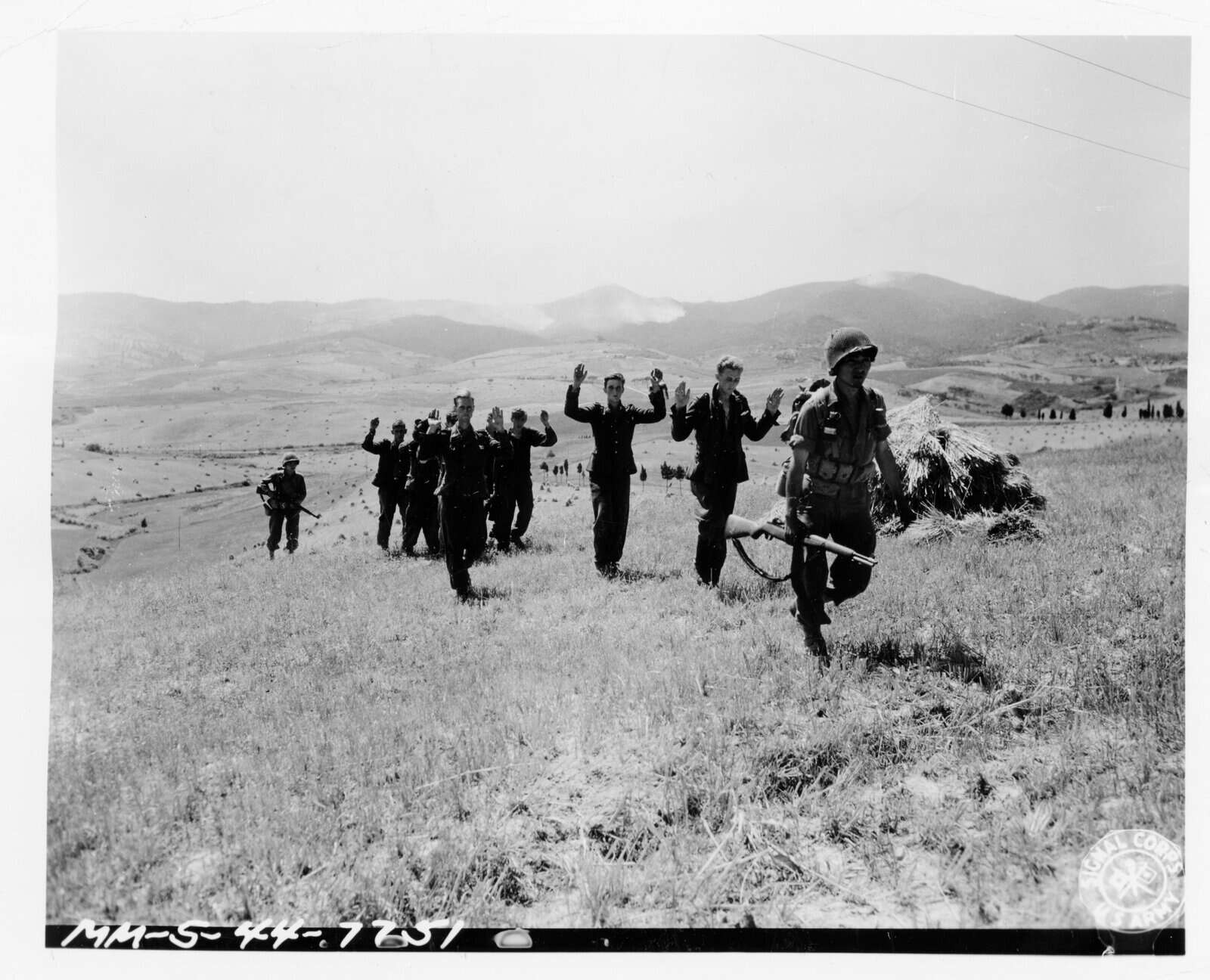
Orciano Pisano area, 15 July 1944. After a brief exchange of fire, some German soldiers surrender to riflemen of the 100th Infantry Battalion. For them the war ended there, in prisoner-of-war camps. (U.S. Army Signal Corps, photo by Baker; National Archives, 111-SC-192069-S, public domain)
Who the Nisei of the 442nd were, and what happened on Hill 140
The Nisei. Nisei, Japanese for “second generation,” were the children of Japanese immigrants, born in the United States and therefore American citizens. The 442nd Regimental Combat Team was made up of them; the 100th Infantry Battalion, recruited in Hawaii, had been attached to it on 11 June 1944.[62] Many of the soldiers from the mainland had volunteered while their families were held in the American government’s incarceration camps: the Go For Broke National Education Center, which preserves their memory, recalls that William K. Nakamura volunteered while “behind the barbed wire of the Minidoka incarceration camp in Idaho,” and Kazuo Otani from the Gila River camp. The government called them relocation centers: it was the official name, and a euphemism.[63]
The regiment in Tuscany. The 442nd was attached to the 34th Division. It fought in the hills between Castellina Marittima, Santa Luce and Pastina until mid-July; the regimental journals note that Italian partisans occasionally helped to locate German positions and minefields.[64] On 18 July the 100th Battalion passed to the 135th Infantry and on the 19th entered Livorno for police duties; between 20 and 22 July patrols of the 442nd reached the airfield and the southern edge of Pisa, one of them, with a partisan guide, as far as the northern edge of the city. On 27 July General Clark presented the 100th Battalion with the Distinguished Unit Citation streamers for the fighting at Belvedere and Sassetta on 26–27 June; on 28 July the 2nd Battalion served as guard of honor for King George VI of the United Kingdom, on his visit to Cecina.[65] From 26 June to 11 July the 100th and 3rd Battalions suffered, according to the regimental journals, about 400 killed and wounded; from Rome to the Arno, from 26 June to early September, the 442nd lost 1,272 men, more than a quarter of its strength (section 9).[66]
Hill 140. The American army-level sources do not name it; in the regiment’s memory it is the place that has come to symbolize those days. The German positions, the 442nd’s journals note, had reportedly been built by the Todt Organization, and withstood the heaviest artillery bombardments.[67] The 442nd’s journals place it in the Terriccio area; the Medal of Honor citation of Ted T. Tanouye refers to a place “near Molino A Ventoabbto” (garbled thus in the citation), which the same journals identify with Il Terriccio. It should not be confused with Monte Vaso, the 363rd Infantry’s Hill 634, nor placed “near Livorno,” as some popular web pages do: it lies much farther to the southeast, in the hills of Castellina. The journals record fighting from 4 to 7 July and the occupation on the 8th; the Go For Broke National Education Center dates the attack and the actions of Ono and Nakamura to 4 July.[68] The exact position of the hill still has to be checked on the topographic maps of the period.
The five citations. Frank H. Ono and William K. Nakamura, of Company G of the 442nd, were decorated for 4 July, “near Castellina”; Nakamura died that day. Ted T. Tanouye, of Company K, for 7 July near Il Terriccio; he died on 6 September 1944. Kaoru Moto, of Company C of the 100th Battalion, for 7 July, “near Castellina.” Kazuo Otani, of Company G, for 15 July, near Pieve di Santa Luce, where he died. A sixth Japanese American soldier, Masato Nakae, of Company A of the 100th Battalion, received the Medal of Honor for 19 August, near Pisa, on the static Arno front.[69]
To learn more. The Go For Broke National Education Center (Los Angeles) and the Densho Digital Repository preserve the stories, photographs and interviews of Japanese American veterans; in Italian there is a collection of testimonies, D. Del Giudice, Purple Heart Regiment (2022), not consulted for this article.[70]
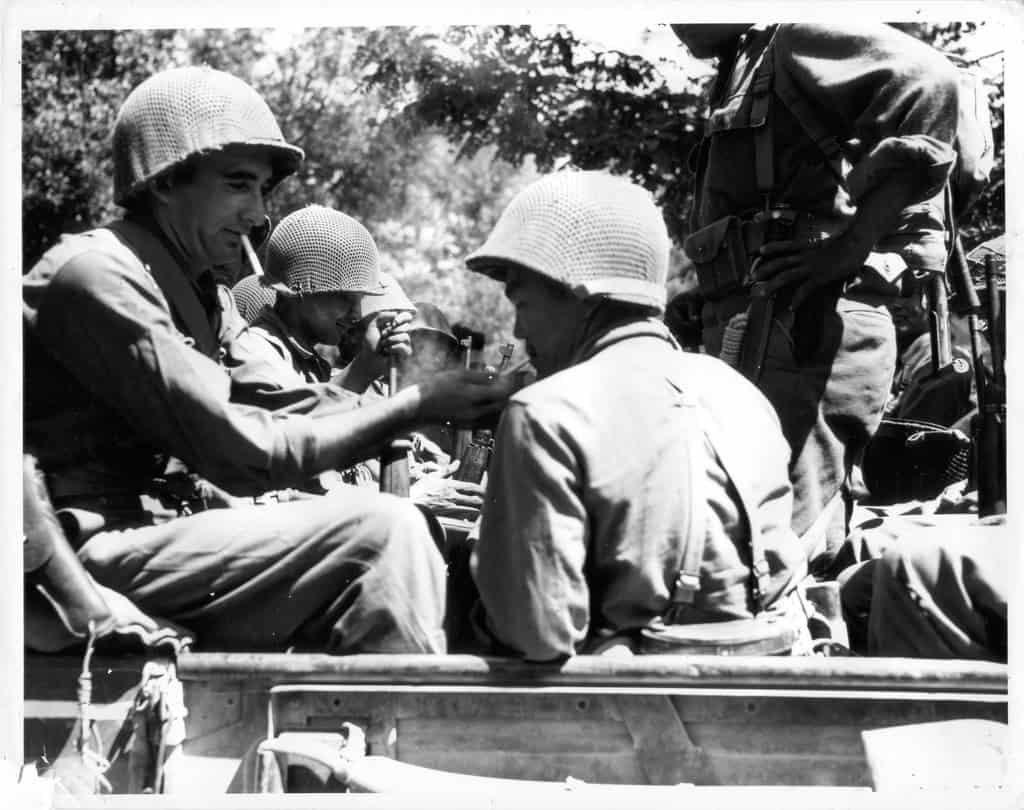
Castellina Marittima area, 15 July 1944. Lieutenant Charles Coyne and Sergeant Nakoto Taguchi (spelled thus in the original caption), of the 100th Infantry Battalion, attached to the 442nd, light up cigarettes before leaving the line, after sixteen days of fighting in the hills. Taguchi came from Lihue, on the island of Kauai, Hawaii. (Courtesy of the Seattle Nisei Veterans Committee and the U.S. Army. “Leaving for reserve,” ddr-densho-114-53, Densho, Seattle Nisei Veterans Committee Collection. Non-commercial and educational reuse.)
4. Volterra and the hills: the road of the 88th (8–25 July)
On 8 July the 88th Division relieved the 1st Armored Division in front of Volterra. At dawn, instead of attacking the town head-on, Colonel James C. Fry’s 350th Infantry outflanked it from the west, toward Lajatico, and the 349th from the east, taking Roncolla; at 10 p.m. the two regiments were on their objectives north and east of the walls.[71] During the night the German units pulled out, and the next morning American patrols entered the city.[72] The Region gives 8 July for Volterra.[73]

Volterra, 9 July 1944. Two men of Sergeant Laurier O. Belanger’s squad (349th Infantry, 88th Division) walk along an empty street in the town center. The American caption notes that the town had been a German strongpoint for eight days. (U.S. Army Signal Corps, photo by McWhirter; National Archives, 111-SC-360638, public domain)
Three days later the 88th met determined resistance at Lajatico, the village on the ridge overlooking the Era valley. The 351st Infantry attacked it at night: at 3 a.m. on 12 July the 2nd Battalion from the west and the 3rd, led by Captain Harold B. Ayers, from the east. At 3 a.m. on 13 July the whole ridge was taken.[74] According to the Fifth Army history about 400 prisoners were taken, “at little loss to our troops”; the division history speaks of more than 420 prisoners and over 250 Germans killed. These are American figures for enemy losses, to be read with caution.[75] For that battle the 3rd Battalion of the 351st received a collective commendation, the Distinguished Unit Citation.[76] The Region gives 13 July for Lajatico.[77]

Lajatico sector, 12 July 1944. German soldiers captured by the 351st Infantry, 88th Division, during the night attack on the village. The American caption of the time says they were smiling at their interrogator, pleased to be out of the war: that is how the photographer saw them, and we do not know what they really thought. (U.S. Army Signal Corps, SC 192054-S, photo by McWhirter; Signal Corps Archive scan, Wikimedia Commons; public domain)
Lajatico, 11–13 July: the night attack and the battalion’s citation
The regiment. The 351st Infantry was commanded by Colonel Arthur S. Champeny; in those days the 3rd Battalion was led by its executive officer, Captain Harold B. Ayers, who had taken command when the battalion commander was wounded.[78]
The sequence. At 3 a.m. on 11 July the 351st Infantry, until then in reserve, moved up to the foot of the hill; at dawn its 1st Battalion was pinned down on the western slopes, and Brigadier General Paul W. Kendall, the assistant division commander, brought the regiment orders for a night attack.[79] The Fifth Army history places the second night assault, the decisive one, at 3 a.m. on 12 July. The division history relates that Kendall reached the regimental command post “on the 12th” at 9 p.m. with the orders; then came the attack, daylight, the resumption at midnight and the ridge taken “by 0300 hours on the 13th.” The sequence only holds if the orders were given on the evening of the 11th: the assault was therefore made on the night of 11–12 July, and the occupation of the ridges was completed at 3 a.m. on the 13th.[80]
The German unit. The histories of the 88th place the I Battalion of the 1060th Regiment in front of the 351st; its command post was reached in the dark by the 3rd Battalion: We Were There calls it “1060th Grenadier Regiment,” Delaney “1060th Panzer-grenadier Regiment.” The correct name is Grenadier-Regiment 1060: from 20 June 1944 it belonged to the 362. Infanterie-Division, which was being rebuilt behind the front. According to the American histories, the battalion commander was killed in the attack.[81]
The citation. The Distinguished Unit Citation was the collective award that the US War Department granted to a unit for an action in combat; from then on its men wore a ribbon on their uniform. The histories of the 88th record the citation for the “four-day battle at Laiatico,” but not the number of the order that granted it, which has to be sought in the US Army archives. The citation was presented on 17 January 1945, in the presence of General Clark; it was the 88th’s first Distinguished Unit Citation.[82]
Remembrance. The date given by the Region, 13 July, is the day the ridge was taken. The sources consulted, the Atlante delle stragi among them, report no episode of violence against civilians at Lajatico or at Volterra; nor do they mention a monument or plaque commemorating the fighting, something that remains to be checked on the spot.[83]
After Lajatico the 88th resumed its advance through the hills: Villamagna on 13 July, Palaia on the 17th, Montaione during the night of 17–18 July. On 19 July its first patrols reached the Arno, and by the 25th the division had cleared the ground up to the river embankment, from San Romano to the outskirts of San Miniato (section 7).[84]
From Villamagna to San Romano, stage by stage (13–25 July)
- 13–14 July, Villamagna. At 12:22 p.m. on the 13th a platoon of the division’s reconnaissance troop entered Villamagna, a hamlet of Volterra; during the night the 3rd Battalion of the 349th occupied it, while the 2nd fought on the two nearby heights that the soldiers called “Bloody Ridge.”[85]
- 14–17 July, from Belvedere to Montaione. On the 14th the 351st took Belvedere, and on the 16th it passed through Montefoscoli. On 17 July, at 7 p.m., the 3rd Battalion of the 349th took Palaia and the heights to the north; that afternoon the 1st Battalion of the 351st, attached to Task Force Ramey, attacked Montaione at 5:15 p.m. and occupied it during the night. The Region gives 17 July for Montaione, and for Palaia only “July 1944.”[86]
- 18–19 July, at the Arno. On the 18th the units of the 88th halted on the heights five or six kilometers north of Palaia, with orders to send patrols to the river; on the 19th the first combat patrols reached the Arno.[87]
- 24–25 July, San Romano. On the 24th the 351st drove back a German company at Ponte a Evola and occupied Angelica and San Romano, in the municipality of Montopoli in Val d’Arno; on the 25th, after further German infiltration, San Romano was completely cleared. The American sources also name a place called “Buche,” near San Romano along the railroad, which could not be identified on the map.[88]
The push to the Arno, “the 25-mile push” (some 40 kilometers) of the division history, came at a high price: in the twenty-three days between Volterra and the relief at the end of July the 88th suffered 2,399 killed, wounded and missing (142 officers and 2,257 enlisted men), more than in the whole stretch from Minturno, on the Garigliano, to beyond Rome.[89] On 29 July the division withdrew toward Villamagna and Volterra to train for river crossings.[90]
5. The 91st in the Valdera: from Chianni to Pontedera (12–18 July)
The 91st Division went into battle as a complete division on 12 July. At 3 a.m., after forty-five minutes of artillery fire, the 363rd Infantry attacked south of Chianni, and Colonel John W. Cotton’s 362nd along the Sterza valley and the road from Casaglia to Capannoli.[91] That day, near Casaglia, Sergeant Roy W. Harmon of Company C, 362nd Infantry, was killed in the action for which he was posthumously awarded the Medal of Honor.[92] By evening the fighting had come to within a kilometer of Chianni.
On Poggio Le Grotte, writes the 1945 division history, the 362nd met “its first real baptism of fire”; and Robbins, in the 1947 history: “The sight of violent death struck men hard with the realization of the brutality of warfare.”[93] For the American units of the Fifth Army as a whole, 12 July was the costliest day of the month: 567 killed, wounded and missing, 118 of them killed.[94]
During the night the Germans broke contact with the Americans. In four days the 91st came down through the Valdera: Chianni on 14 July, where the partisans had arrived ahead of the Americans, Terricciola the same evening, Morrona and Soiana on the 15th.[95] On the evening of 16 July the leading units of the 361st reached the last high ground: from there, writes the Fifth Army history, they could “look down on the flat floor of the Arno Valley.”[96]
From Chianni to Le Selve, day by day (12–16 July)
- 12 July. At 4:15 a.m. Company C of the 362nd ran into the first German outpost, about three kilometers southeast of Chianni. A lone sniper killed Captain Hugh S. French of Company B; the 2nd Battalion of the 362nd repulsed an attack by twelve tanks.[97]
- Chianni. The partisans, the division history relates, reported that the Germans had gone and that they were mopping up the town themselves; at their request the artillery ceased fire. On 14 July the 3rd Battalion of the 363rd occupied Chianni without a fight and at 8 p.m. entered Bagni di Casciana; at nightfall the 362nd took Terricciola. The Region gives 12 July for Chianni and 15 July for Terricciola.[98]
- 15 July. At 4 a.m. the 361st passed through the 363rd at Bagni and took Morrona; a platoon of Company E took Soiana, with some thirty prisoners; the 362nd outflanked Selvatelle.[99]
- 16 July. In the afternoon (about 4 p.m. according to Robbins, at 6 p.m. according to the 1945 division history) the artillery broke up a counterattack forming at Le Selve, and the Germans fell back on Orceto; according to the Fifth Army history, two Tiger tanks and a light tank were destroyed that day.[100]
On that same day, 16 July, at Aiale, in the municipality of Lari, civilians who had come out of the shelters to celebrate the arrival of the American soldiers were hit by a German artillery shell fired from the woods of Lari. Fifteen civilians died, among them two children, and with them about three American soldiers. The episode is recorded in the Atlante delle stragi naziste e fasciste in Italia, the survey of intentional killings of civilians and partisans compiled by the Istituto nazionale Ferruccio Parri and ANPI, which classifies it as “deliberate shelling”; the unit has not been identified.[101]
On 17 July the 362nd went through Capannoli, crossed the Era and repulsed three counterattacks west of Forcoli and near Camugliano, where Sergeant Carroll D. Eggers of Company H was killed. By noon Companies I and K of the 361st were at Ponsacco, which the tanks had encircled: the garrison surrendered.[102] The Region gives 17 July for Ponsacco. Ten days earlier, on 7 July, Augusto Vanni had been killed there, accused of supporting the partisans; the Atlante does not identify the unit, and a plaque in the town hall remembers him.[103]
In seven and a half days, from 12 to 19 July, the 91st suffered 904 casualties: 143 killed (12 officers and 131 enlisted men) and 761 wounded and injured.[104]
Pontedera, 18 and 19 July, hour by hour
- From 5 to 9 a.m. on 18 July. The sequence is told at the beginning of the article: at 5 a.m. the renewed attack and the capture of Orceto, at 8 a.m. the entry into the town of Company K with the tanks of Company D, 1st Armored Regiment, at 9 a.m. the south bank of the Arno.[105] Robbins adds that the 1st Platoon of Company K entered the town less than three hours after the attack began. Company K, reinforced with heavy machine guns, mortars and the battalion’s antitank platoon, was ordered to hold the town.[106]
- The telegram. General Willis D. Crittenberger, commander of IV Corps, wired General William G. Livesay, the division commander, on 18 July: “Well done 91st Division.”[107]
- On the same day the 362nd halted on the last ridge, about three kilometers south of the river; the 88th on the heights north of Palaia. To the west, that evening, the 363rd was reaching the outskirts of Livorno (section 6).[108]
- On 19 July a patrol of the 91st’s reconnaissance troop forded the river, clashed with the Germans on the far bank and came back; at 3 p.m. the 362nd was on its objectives and sending patrols to the river.[109]
- What remains to be learned. The sources consulted say nothing about the people of Pontedera in those days. The war diary of Luciano Forte, which covers the period from 1 January to 8 September 1944 and was published in 2024, is the source to read in order to tell that story; it was not consulted for this article. The Atlante delle stragi records no episodes in Pontedera.[110]

Near Ponsacco, 18 July 1944. An American tank passes a knocked-out German Panzer IV. That morning at 5 a.m. the 361st Infantry and the tanks of the 1st Armored Regiment set out from Ponsacco toward Pontedera; at 9 a.m. they were on the Arno. We have found no photographs of Pontedera in those days. (U.S. Army Signal Corps; Signal Corps Archive scan, Wikimedia Commons; public domain)
6. Livorno and Pisa (17–28 July)
While the 91st was moving down into the Valdera, its 363rd Infantry set out for Livorno as Task Force Williamson, named after the division’s assistant commander, General Raymond E. S. Williamson.[111] During the night of 18–19 July units of the 363rd and of the 135th Infantry, of the 34th Division, which was advancing up the coast, entered the city; the Japanese American 100th Infantry Battalion arrived in the morning, for police duties.[112] Livorno commemorates its liberation on 19 July; the unit histories do not agree on who entered first.[113]
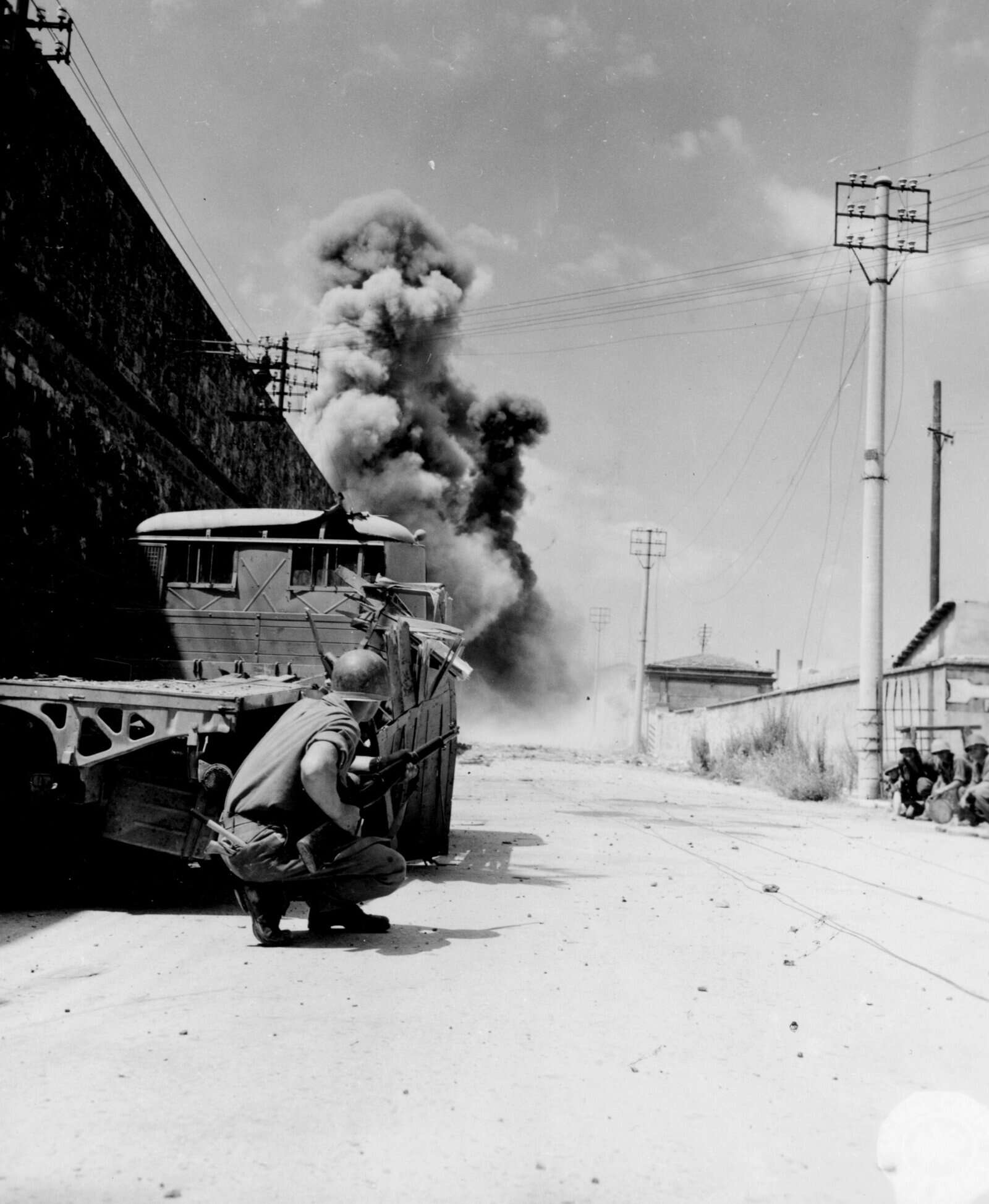
Livorno, 19 July 1944. Corporal Duane T. Moen, of the 91st Division’s 316th Engineer Battalion, keeps watch on the street while his comrades set off the mines sown in one of the streets leading to the harbor. In the weeks that followed, Fisher writes, hundreds of American soldiers fell victim to mines and booby traps. (U.S. Army Signal Corps, SC 192055-S = MM-5-44-7771, photo by Baker, 3131st Signal Service Co.; Signal Corps Archive scan, Wikimedia Commons; public domain)
The port was destroyed and the city mined. Thousands of mines and booby traps, Fisher writes, claimed hundreds of victims among the American soldiers in the first weeks.[114] On 20 July the 1st Battalion of the 363rd crossed the canal north of the city: under fire no bridge could be put across, and the Italian “Patriots,” as Allied documents called the partisans, served as carrying parties to supply the forward units.[115]
On 23 July the 363rd entered the part of Pisa south of the Arno.[116] At night German fire was directed from an observation post on the Leaning Tower, across the river; the fire was so heavy that Williamson withdrew one battalion south of the city, and return fire was prohibited.[117] Later, the Fifth Army history notes, it was discovered that the Tower and almost all the best-known monuments of the old city had suffered only superficial damage: American artillery had fired little into the part of Pisa north of the river.[118] That history does not mention the Camposanto Monumentale. On 27 July, in the fighting between the Germans north of the Arno and the Allies to the south, an artillery shell hit its roof and set the wooden trusses on fire. The city had no water, and the fire could not be put out: the heat and the molten lead of the roofing, running down the walls, destroyed most of the frescoes. The source does not say from which side the shell came.[119]
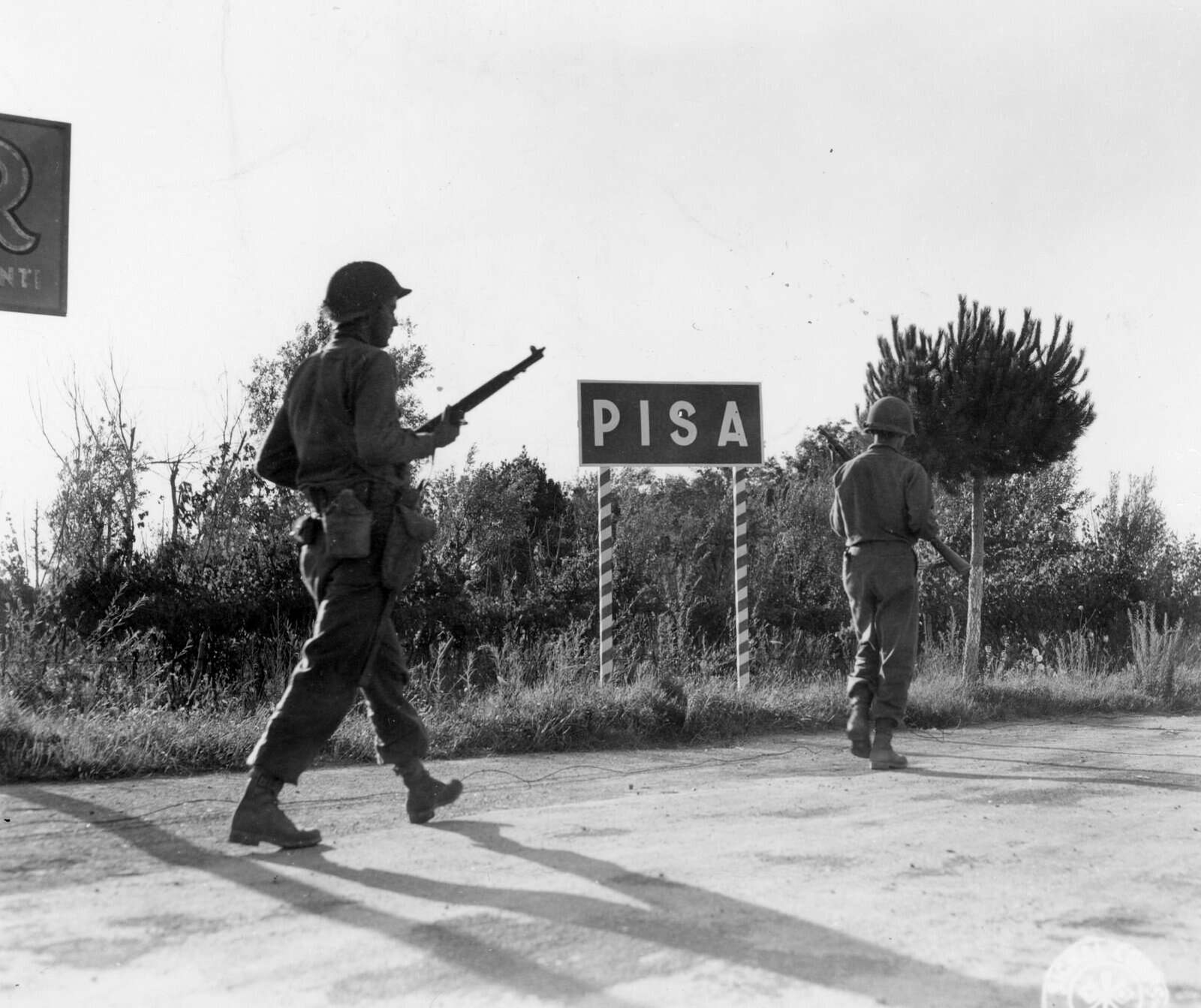
Pisa, 23 July 1944. Men of Company H, 363rd Infantry, 91st Division, walk past the city-limits sign. That afternoon the regiment reached the part of the city south of the Arno; all the bridges had been destroyed. (U.S. Army Signal Corps, photo by Edwards, SC 192179 = MM-5-44-7715; Signal Corps Archive scan, Wikimedia Commons; public domain)
At San Piero a Grado, in the part of the municipality of Pisa south of the river, on 23 July a unit of the 16th SS killed three men who, having heard that “the Americans are coming,” had returned home from the Tombolo woods; one was seventeen years old. The next day it killed Carabinieri marshal Valfredo Zanuccoli and Francesco Guidi, who had gone to look for them.[120] Task Force Williamson remained in Pisa under fire until the night of 28 July, when it was relieved.[121] The part of Pisa north of the Arno remained in German hands until 1 September (section 8).
Livorno: who entered first?
This is a classic case of unit histories competing to have been first.
- The departure. The 363rd Infantry, as Task Force Williamson, left the assembly area at 6:17 p.m. on 17 July.[122]
- The 91st Division’s history (1945) and Robbins (1947): the city “fell to Task Force Williamson” at 9 p.m. on 18 July; the first to enter were the 1st Battalion of the 363rd and the 2nd Platoon of the 91st Reconnaissance Troop.
- The Fifth Army history: at 8:45 p.m. on the 18th the 1st Battalion of the 363rd, with elements of the 752nd Tank Battalion, is in the eastern outskirts; the 3rd Battalion of the 135th enters the city at 2 a.m. on the 19th; the 2nd Battalion of the 135th and the 1st and 2nd of the 363rd about two hours later.
- The history of the 135th Infantry: “On the night of 18 July patrols entered the city.”
- Fisher: the two regiments enter “before daylight on the 19th.”
- The 442nd’s journals and the summary in the Fifth Army history date the fall of Livorno to the 18th; the Region and the city’s memory, to the 19th.
What can be said. On the evening of 18 July the first units of the 363rd reached the eastern outskirts; during the night units of the 135th also entered the city; on 19 July, the official and remembered date, Livorno was in American hands. The precedence of Task Force Williamson remains a claim of the 91st: the Fifth Army history confirms the outskirts at 8:45 p.m., not the “fall” of the city at 9 p.m.[123]
Pisa, 23 July: the arrival, the Tower as an observation post, the ban on return fire, and a recollection to be verified
23 July, hour by hour. At 3:30 a.m. the 1st Battalion of the 363rd reached Marina di Pisa; at 5:30 a.m. the first patrols were in the city; at 1:30 p.m. the 2nd Battalion arrived along the Via Aurelia in the part of Pisa south of the Arno, followed three hours later by the 3rd.[124] “Finding all bridges destroyed,” writes Fisher, “the men dug in along the south bank of the river while enemy guns and mortars poured in heavy fire.”[125] That evening the 34th held the south bank from the sea to some fifteen kilometers east of Pisa.[126]
The Tower. The contemporary American sources agree: after 23 July the Germans used the Tower as an observation post to direct fire on the American units south of the river, and return fire was prohibited (section 6).[127]
A more personal account comes from Leon Weckstein, who served in the 91st Division. In his memoir, Through My Eyes, he recounts that he was ordered to direct artillery fire onto the Tower, and that he did not carry out the order.[128] It is testimony written many years later, which we have not been able to check against documents: we report it as such.
Signal Corps photographs show American soldiers in Pisa from 23 July, on the south bank, and on 6 September, when they crossed the river on the destroyed railroad bridge and passed beneath the Tower, by then far from the front.[129]
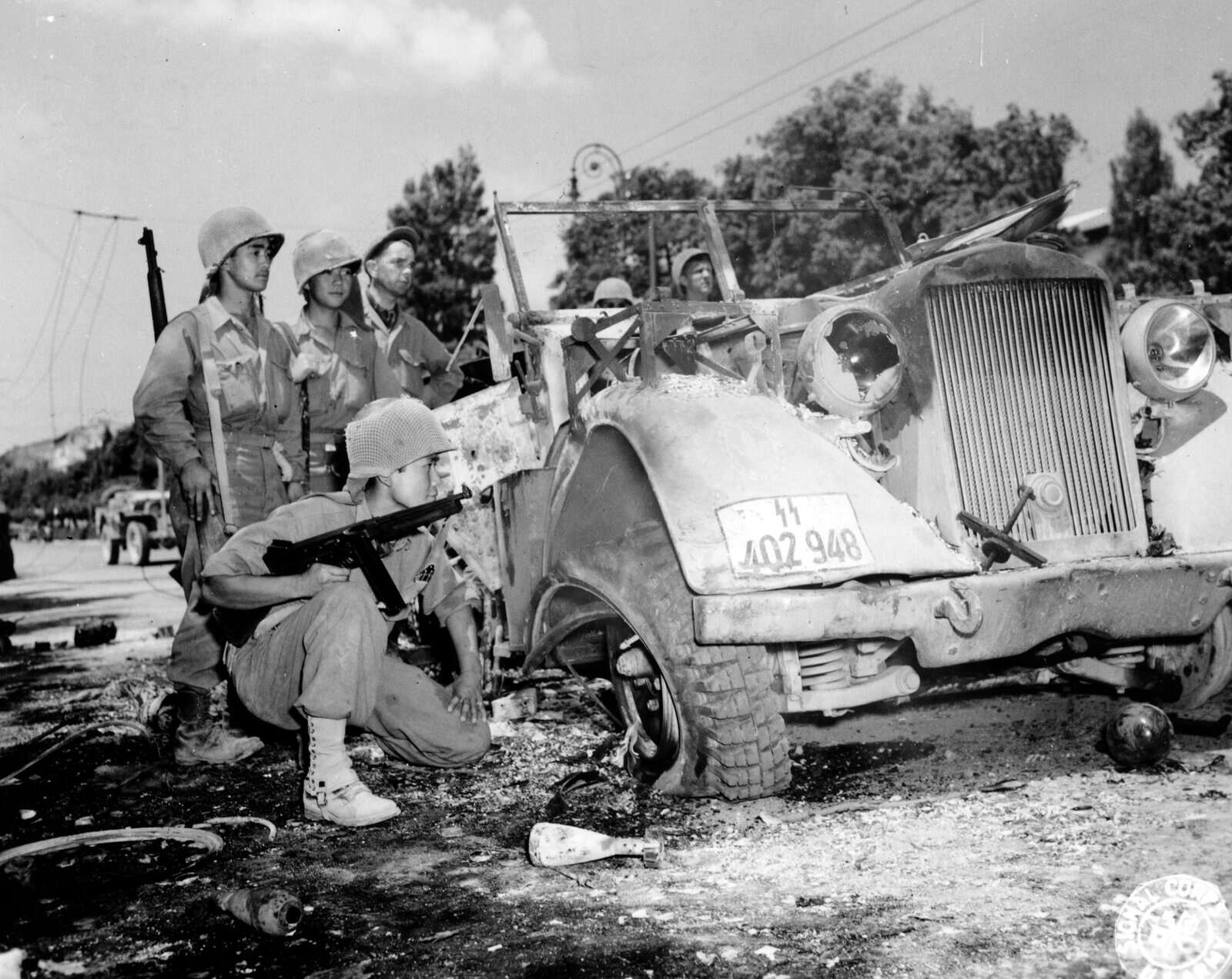
Livorno, 19 July 1944. Soldiers of the 100th Infantry Battalion, Japanese Americans from Hawaii, beside a still-smoldering German vehicle, on the day they entered the city on police duty. The caption of the time calls them “Hawaiian-American Japanese.” (U.S. Army Signal Corps, SC 192072-S, photo by Baker; Signal Corps Archive scan, Wikimedia Commons; public domain)
7. San Miniato: the cathedral and the entry into the town (14–24 July)
In July 1944 many evacuees had taken refuge in San Miniato, the hilltop town that overlooks the lower Valdarno, fleeing the Allied bombing of the towns along the railroad between Pisa and Florence. The population had dug shelters in the tufa, with shovels and picks, for the animals as well.[130] Tension between the Germans and the population was high. On 17 July, according to a message from the intelligence office of the German Fourteenth Army cited by Carlo Gentile, the Germans had detained fifty men in the area suspected of belonging to the “bands,” as they called the partisans, and five had been killed “during an attempt to escape.”[131] As the Americans advanced, the town was hit more and more often by the artillery emplaced in the valley: according to the municipality’s statistics, artillery rounds and shell bursts killed 9 people on 18 July, 13 on the 19th, 5 on the 20th, and 4 on the 21st.[132]
On how many German soldiers remained, the sources differ. According to testimony collected after the war, the bulk of the German 3. Panzergrenadier-Division had crossed the Arno on 16 July, leaving a few dozen engineers in the town; but the casualty lists studied by Gentile place units of the division in and around San Miniato until 23 July, and on that day, at Calenzano, about 180 Germans attacked an American company. The town may have been almost empty of soldiers while the heights around it were still defended.[133]
On the morning of Saturday, 22 July, German soldiers ordered the population to leave the shelters and gather on the Prato del Duomo, the open space before the cathedral; Bishop Ugo Giubbi acted as intermediary between the German command and the people. Many went into the cathedral: accounts speak of about 1,500 people. There were German sentries at the doors. “Seven or eight,” the bishop later told the American investigators. “They were there to stop people from leaving the church.”[134] After a short address and the blessing, the bishop left the cathedral for the shelters of the bishop’s palace. At about 10 a.m., after several rounds had fallen on the Rocca, the bell tower and the sacristy, a shell entered the church and exploded above the crowd. Fifty-five people died, instantly or of their wounds, according to the municipality’s statistics; many others were wounded.[135] Gina Scardigli lost three children and her mother-in-law there.[136]
For decades the massacre was attributed to the Germans: the first American inquiries, in 1944, spoke of a mine, the report of Judge Carlo Giannattasio, in 1945, of a German shell, and in 1954 the municipality put up a memorial plaque that spoke of “cold-blooded German murder.”[137] That same year, however, Canon Enrico Giannoni, studying the path of the round inside the church, argued that the shell was American.[138] In 2001 Giuliano Lastraioli and Claudio Biscarini published the journal for those hours of the 337th Field Artillery Battalion of the 88th Division: according to the two authors, it proves that an American round hit the church by mistake.[139] The studies collected in 2004–2005 by Leonardo Paggi for the municipality and for the Region of Tuscany, based on American and German documents, reached the same conclusion: the massacre was caused by a shell from the American artillery, fired at the German positions.[140]

San Miniato, the plaque placed by the municipality in 1954, on the tenth anniversary, with the inscription that blamed the Germans for the massacre in the cathedral; later studies have attributed the shell to American artillery. According to the photographer’s description, the photo was taken in 2019 in the Loggiati di San Domenico. (Photo by Mongolo1984, Wikimedia Commons, CC BY-SA 4.0)
One question remains open, raised by Gentile and Paggi: why did the Germans gather the population in so exposed a place, on the eve of the fight for the town? The answers proposed remain hypotheses. “Whatever the ballistic dynamics of the massacre,” writes Paggi, “does not the responsibility rest, indisputably, on the Germans for having concentrated, with the final clash for control of the town imminent, a great mass of defenseless people in a place plainly exposed to the fire of the American artillery?”[141] In 1994 a new plaque was placed in the cathedral, in the name of the Cathedral Chapter, the Archconfraternity of the Misericordia and the families, which remembers “the 55 people who died on 22 July 1944” as “blameless victims of wars, of violence, of intolerance.”[142]
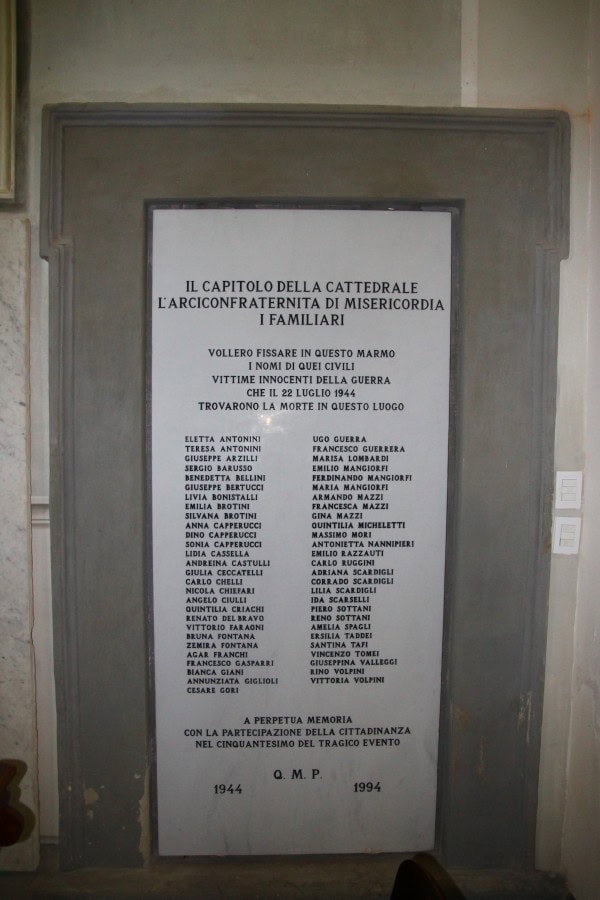
San Miniato Cathedral. The plaque placed in 1994 lists by name the victims of 22 July 1944, “blameless victims of wars,” without assigning blame. (Photo by Prof.Quatermass, Wikimedia Commons, CC BY-SA 3.0)
On 23 July at Calenzano, a hamlet of San Miniato a short distance east of the town (not the municipality of that name near Florence), some forty men of Company G of the 349th Infantry were besieged in a house until the tanks arrived.[143] That night Company G entered San Miniato. It found the town abandoned by the Germans, who before leaving had blown up the Rocca and mined the streets and the ruined houses.[144] The municipality commemorates its liberation on 24 July; some sources give the 23rd.[145] On the 24th, according to a history of the town published in 1981, Father Ambrogio greeted the first soldiers, who came in “wary, hesitant,” with these words: “The bulk of the troops passed through weeks ago [...] And for days and days you fired thousands of shells at us, and you took so long to come!”[146] On 29 July the town administration appointed by the Committee of National Liberation took office. But the plain between the railroad and the Arno remained in German hands until mid-August, and the town remained under German artillery fire until the end of August.[147]
San Miniato Cathedral: eighty years of inquiries and memory
The words. This is not “friendly fire”: the victims were civilians. Gentile speaks of a “tragic fatality,” one of the many “collateral effects” of the war; the judgment is his.[148] The Atlante delle stragi naziste e fasciste, which records intentional killings of civilians, does not include San Miniato Cathedral.[149]
Remembrance. The 1954 plaque, with a text by Luigi Russo and a speech by Ferruccio Parri, spoke of “cold-blooded German murder”; the Church did not bless it. Paolo and Vittorio Taviani’s film La notte di San Lorenzo (1982) restated German responsibility. The 1994 plaque, in the cathedral, remembers the victims without assigning blame. For Paggi the anti-German memory was not “a fake, cynically constructed by politics,” but “a spontaneous collective elaboration.” In July 2024 a copy of the bas-relief damaged by the explosion was placed in the cathedral.[150]
The open question. On why the people were gathered in the cathedral, Gentile lists several hypotheses: a punishment, preparation for a deportation, security during the demolitions, a simple precaution. None is documented; the context of tension with the population in the preceding days is documented (n. 131).[151]
The figures. The victims number 55 according to the municipality’s statistics of 1944–45 and the 1994 plaque; Gentile gives 56, an American note of 16 November 1944 “about 60”; Barzacchi, in 1944, spoke of “a hundred and fifty wounded and dead.” The list of names is in the historical archive of the Comune di San Miniato; it was not consulted for this article.[152]
The American unit. The 337th Field Artillery Battalion belonged to the 88th Division. Its history, written after the war, records positions in July at Mazzolla, at Montefoscoli and an “S. Miniato position,” and the fire of 23 July on Calenzano, but does not mention the cathedral. The document on which the attribution to the battalion rests is the daily journal for 21–22 July, from 6 p.m. to 6 p.m., published in 2001 by Lastraioli and Biscarini: according to the two authors, it proves that American fire hit the church by mistake. The first American inquiry, however, was conducted by an officer of another division, the 91st; the sources consulted do not say why.[153]
The inquiries and studies, in order. For readers who wish to follow every step, here are the inquiries and studies in chronological order.
| When | Who | On what basis | What was concluded |
|---|---|---|---|
| July 1944 | Cesare Barzacchi, photographer from Pisa, eyewitness | direct experience, photographs | the artillery rounds that preceded the explosion were German, they “came from Fucecchio”; he also mentions a “time bomb” |
| 28 July 1944 | Captain E. J. Ruffo, 362nd Infantry (91st Division) | witness statements; report by the regimental surgeon; report signed on 30 July by the bishop and by three priests and laymen | a mine laid by the Germans in reprisal; a conclusion “not supported by technical evidence,” observes the historian Pier Luigi Ballini |
| 1 August 1944 | Captain James R. Gromer | report | the same conviction |
| 10–14 August 1944 | board appointed by Fifth Army headquarters (Majors Edwin S. Booth, Carl H. Cundiff and a third officer) | eight witnesses | an atrocity committed by unidentified German soldiers; the church was said to have been mined before the population entered |
| 18 October 1944 | Lieutenants Charles R. Jacobs and Paul L. Sunberg | the nose of an American shell found in the cathedral | two shells: an American one, of which there was the fragment, and a German one, held to be the cause of the massacre, of which there was no fragment |
| September 1944 – June 1945 | commission of the town administration, chaired by Mayor Emilio Baglioni | testimony, mostly in favor of the mine | refers the judgment to Judge Giannattasio |
| 23 March 1945 | Lieutenant Colonel Cino Cini, expert appointed by the mayor | expert report | as Jacobs and Sunberg, but the second device was supposedly a small American smoke shell |
| 13 July 1945 | Judge Carlo Giannattasio, Court of Florence | the Jacobs memorandum, the Cini report, the absence of a crater, the fragments in the bodies | rules out the mine; two shells, one from north-northeast (German) and one from south-southwest (American); the massacre was caused “exclusively by the German shell”; clears the bishop and the clergy |
| 1947 | J. P. Delaney, history of the 88th Division | unit history | attributes the massacre to two German tanks said to have fired point-blank on the civilians shut in the church: this is the division’s version from the immediate postwar years |
| July–August 1954 | Canon Enrico Giannoni, articles in the “Giornale del Mattino” | the path of the shell inside the church | an American shell, which came in through a half rose window on the south side, struck the bas-relief of the Annunciation in the Chapel of the Sacrament and exploded two or three meters above the crowd. “Shell fragments do not travel in curves” |
| 1988–1990 | Giuliano Lastraioli; Claudio Biscarini and Giuliano Lastraioli, Arno-Stellung | American and German archival documents | American origin of the shell; Arno-Stellung reprints Giannoni’s articles |
| 1997 | Michele Battini, Paolo Pezzino, Guerra ai civili | the records of the 1944–45 inquiries | keep open both the hypothesis of the American shell and that of a delayed-action device planted by the Germans |
| 2000 | Paolo Paoletti, 1944, San Miniato. Tutta la verità sulla strage | American and Italian documents | American shell |
| 2001 | Giuliano Lastraioli, Claudio Biscarini, Un documento risolutivo sulla strage nel Duomo di San Miniato | the daily journal of the American 337th Field Artillery Battalion, 21–22 July 1944, and Allied maps | American fire hit the church by mistake |
| 2004–2005 | Leonardo Paggi (ed.), with essays by Giovanni Contini, Simone Moroni, Carlo Gentile, Pier Luigi Ballini | American and German archives, war diaries, critique of the inquiries, expert reports | American shell. Gentile: rounds from the Allied artillery fired at the German positions, “a tragic fatality”; Paggi: the old “vulgate” of the German shell is no longer “tenable” |
| 2022 | “Giuseppe Gori” Committee of Cigoli | commissions an explosives expert to carry out new investigations | outcome not known at the date of this article |
The 1944–45 inquiries are known here through the quotations in the volume edited by Paggi; their texts are published in Battini and Pezzino (1997) and in part in Paoletti (2000).[154]
Calenzano, 23 July: the besieged house
On 23 July the 88th Division was ordered to clear the ground up to the Arno embankment. At Calenzano, a hamlet of San Miniato about 900 meters east of the town, an officer and some forty men of Company G of the 349th Infantry, with Captain Lyons, the battalion executive officer, were surrounded in a house. They beat off eight German attacks until Company I arrived with the tanks. To keep the Germans away, the 337th Field Artillery Battalion fired 2,950 rounds around the house according to its history, 3,500 according to the division histories; all the artillery together, according to the Fifth Army history, more than 5,000. The same history estimates the attacking Germans at about 180 and reports 25 prisoners and about 75 German casualties: these are American figures for the enemy’s losses.[155] The sources also differ on the number of men besieged, 41 or 45. The date of 23 July is the one given in the history of the 337th; the division histories do not give the day.
8. Halted on the Arno (25 July – 1 September)
On 25 July II Corps under General Geoffrey Keyes took over the right-hand sector of the front, with the 85th, 88th and 91st Divisions; on the 26th Task Force 45, formed from antiaircraft units, relieved the 34th on the coast and at Pisa.[156] Clark, Fisher writes, “intended no extensive operations along the Arno,” because he wanted to conserve Keyes’s corps for the main attack on the Gothic Line.[157] The front stood still for six weeks: in August the American outposts lay mostly along the railroad embankment, about 800 meters south of the river.[158] Firing went on from one bank to the other, and Italian civilians crossed the lines to bring news of the German positions.[159]

Near Pisa, 18 August 1944. A dummy bridge of canvas and burlap, built at night by an American engineer camouflage unit to deceive the Germans, who could see it from the heights north of the city and had already shelled it. For six weeks the front stood still on the Arno, but it was not quiet. (U.S. Army Signal Corps, photo by Hartman; National Archives, 111-SC-219213, public domain)

The Arno front from late July to 1 September 1944. South of the river, the towns reached by the Allies in July; to the north, those that remained under German occupation until the American IV Corps crossed on 1 September: this is why many towns commemorate a liberation date different from the day the first units arrived. Small dark diamonds mark the main massacres of civilians north of the river, according to the Atlante delle stragi naziste e fasciste in Italia. Map by Gotica Toscana aps (2026). Base: ISTAT boundaries (Openpolis, CC-BY), rivers © OpenStreetMap contributors (ODbL). Click the map to open it at full resolution.
The boundary with the British Eighth Army ran a short distance east of San Miniato.[160] Empoli, farther east, lay in the British sector: in July 1944, contrary to what many remember, it was not liberated by the Americans. The Germans held the town and the south bank; on 24 July, in reprisal for a clash with partisans at Pratovecchio, a unit of the 3rd Panzergrenadier Division shot 29 civilians in Piazza Ferrucci, today Piazza XXIV Luglio.[161] On the evening of 11 August the New Zealanders entered the town.[162] They were to prepare the river crossing by the American II Corps, but the attack was canceled, Kay writes, because the Allied armies shifted their main offensive to the Adriatic, with Operation Olive against the eastern Gothic Line.[163] From 14–16 August the infantrymen of the American 85th Division held Empoli for about ten days; then the sector passed to the South Africans, who crossed the Arno on 1 September.[164] The memory of Americans in Empoli therefore has a basis, but it belongs to August, not July; the municipality commemorates its liberation on 2 September.[165]
North of the river, for six weeks, civilians remained exposed to the German retreat. Forced-labor decrees, compulsory evacuations and roundups ended in massacres more than once, from Pisa to the Serchio. The worst was at the Padule di Fucecchio marshes on 23 August, where units of the German 26th Panzer Division killed 174 people. According to the Atlante delle stragi , the 9th Panzergrenadier Regiment, the same one the Americans had faced in July, probably also took part.[166] These were German massacres, and they did not arise from the fighting with the Americans. But the halted front prolonged the occupation of the north bank by six weeks, and for six weeks the Arno separated those who had already left the German occupation behind them from those who were still under it.
On 29 August Kesselring ordered Lemelsen to fall back, and the withdrawal began two days later. On 1 September units of IV Corps crossed the Arno: Task Force 45 entered the part of Pisa north of the river, the 1st Armored crossed in the center, the South Africans on the right wing.[167] The municipalities on the north bank, from Santa Croce sull’Arno to Fucecchio, commemorate their liberation on 1 or 2 September.[168] The 88th, 91st and 85th, with II Corps, were meanwhile preparing for the attack on the Gothic Line, in the Apennines north of Florence.[169]

Pisa, 6 September 1944. American soldiers cross the Arno on the destroyed railroad bridge and enter the part of the city north of the river, abandoned by the Germans on 1 September. By now the front was in the Apennines. (U.S. Army Signal Corps, MM-5-44-10250; Signal Corps Archive scan, Wikimedia Commons; public domain)
Why Pisa, Pontedera and Empoli have two liberation dates
Three different situations. In the municipalities lying wholly south of the river, reached in July (Volterra, the Valdera, Livorno), the date commemorated is as a rule close to the arrival of the troops, with gaps of a few days (Rosignano, Fauglia, Chianni: see the table); the exception is Pontedera, which, although on the south bank, commemorates 2 September. The municipalities crossed by the river, or with a part left in German hands, have two: Pisa (23 July for the part south of the river, 1 September for the city to the north); San Miniato (the town on 23–24 July, the plain toward the Arno in mid-August). The municipalities on the north bank were liberated when IV Corps crossed the Arno, on 1 September and in the following days.[170]
Commemorated dates are not corrected: they are explained. The liberation date commemorated by a municipality may mark the entry of the troops, the end of the fighting within the municipal territory, the end of fire from the other bank or the installation of the new authorities. The web pages of the Region of Tuscany, which do not state their source, reproduce the tables published in 1994–95 by AICCRE (the Italian Association of the Council of European Municipalities and Regions) for the fiftieth anniversary, which in turn collect the dates given by the municipalities.[171] For Pontedera, on the south bank, the Region gives 2 September; the sources consulted do not explain why. One clue: as early as 1948 a municipal exhibition on the rebuilding of the town dated its start to 1 September 1944, the day the Americans crossed the river. That the commemorated date marks the end of German fire from the north bank is, however, a hypothesis, not a documented fact.[172] For Empoli the reason is military: the town remained in German hands until 11–13 August, and the Germans held the north bank until 31 August.
| Municipality | Arrival of Allied units (military sources) | Date given by the Region or commemorated by the municipality |
|---|---|---|
| Rosignano Marittimo | 3–8 July, 135th Infantry (34th); heights to the north until 11–12 July | 12 July |
| Castellina Marittima | 6 July, 168th Infantry (34th) | 12 July |
| Volterra | 8–9 July, 88th Division | 8 July |
| Lajatico | 12–13 July, 351st Infantry (88th) | 13 July |
| Chianni | 14 July, 363rd Infantry (91st); German withdrawal on the night of 12–13 July | 12 July |
| Casciana Terme (Bagni di Casciana) | 14 July, 8 p.m., 3rd Battalion, 363rd Infantry (91st) | 14 July |
| Terricciola | 14 July, evening, 362nd Infantry (91st) | 15 July |
| Ponsacco | 17 July, 361st Infantry (91st) | 17 July |
| Fauglia | 17 July, 10 p.m., 168th Infantry (34th) | 23 July |
| Palaia | 17 July, 7 p.m., 3rd Battalion, 349th Infantry (88th) | “July 1944” |
| Montaione | night of 17–18 July, 1st Battalion, 351st Infantry, with Task Force Ramey | 17 July |
| Pontedera | 18 July, Company K, 361st Infantry (91st) | 2 September |
| Livorno | night of 18–19 July, 135th and 363rd Infantry | 19 July |
| Pisa | 23 July the part south of the river (363rd); 1 September the part to the north (Task Force 45) | 2 September |
| San Miniato | night of 23–24 July the town (Company G, 349th Infantry); the plain in mid-August | 24 July |
| Montopoli in Val d’Arno | 24–25 July, San Romano (351st Infantry) | “July 1944” |
| Empoli | 11–13 August, New Zealanders; from 14–16 August, 85th Division | 2 September |
| Santa Croce sull’Arno, Castelfranco di Sotto, Fucecchio | 1 September, IV Corps units | 1 September |
| Calcinaia, Vicopisano | 1–2 September, IV Corps units | 2 September |
The sources for each row are in the notes to sections 3–8.[173]
Empoli, 22 July to 2 September: who was there, and when
- 22–23 July. At midnight the French sector along the Elsa passes to the British XIII Corps; the 8th Indian Division relieves the Moroccans as far as Castelfiorentino. In front of Empoli the Germans hold the south bank. On 22 July begins what Biscarini and Lastraioli have called “the quarantine of the Allies before Empoli.”
- 23–24 July. Clash between a unit of Grenadier-Regiment 29 and partisans at Pratovecchio; on the 24th the reprisal in Piazza Ferrucci, 29 dead. The shooting, begun at Pratovecchio, is interrupted by the arrival of an Allied reconnaissance plane and by British artillery fire; some of the hostages escape, the others are taken to the square. The only survivor of the shooting in the square, Arturo Passerotti, recounted that the German officer, “seeing that it was impossible to carry out the shooting there, decided to take us to Empoli, to Piazza Ferrucci.”[174]
- Until 6 August. The 8th Indian Division holds the sector between Lastra a Signa and Empoli.
- 6–7 August. The 2nd New Zealand Division relieves the Indians. In no man’s land on the south bank, Kay writes, there were “many Italians still living in their houses, refugees, partisans, fascists, and sympathisers and agents for both sides.”
- 10–11 August. The 5th New Zealand Brigade attacks; on its left flank is the American 362nd Infantry. On the evening of the 11th B Company of the 28th Māori Battalion, made up of soldiers of the Māori, the Indigenous people of New Zealand, enters the town from the south; on the 13th A Company clears the west side.
- 13 August. A patrol from the 91st makes contact with the New Zealand cavalry and announces that Isola will be occupied that evening. Before the Americans arrive, II Corps guns fire propaganda leaflets onto Isola and onto the New Zealand positions as well.
- Dawn, 14 August. All organized resistance south of the river ceases.
- 14–16 August. The American 85th Division relieves the New Zealanders: in the Empoli sector, the 338th and 339th Infantry.
- 16–22 August. An order of 16 August from Allied Armies headquarters assigns the 6th South African Armoured Division to the American IV Corps, to occupy the heights beyond the river between Empoli and the corps boundary; the transfer takes effect on the 22nd.
- 24–26 August. The South Africans relieve the 85th on a front of more than thirty kilometers, with the 24th Guards Brigade on the west. Facing them, as far as Empoli, is the 3. Panzergrenadier-Division.
- Night of 31 August – 1 September. South African units cross to the north bank; just west of Empoli the 3rd Battalion, Coldstream Guards, does the same.
- 2 September. The South Africans advance toward Monte Albano almost unopposed. This is the liberation date commemorated by the municipality of Empoli.[175]
The sources consulted do not show which unit was the first to enter the north-bank towns opposite Empoli, Vinci, Capraia e Limite and Cerreto Guidi, which the Region dates to 2 and 3 September. Neil Orpen’s volume on the South Africans in Italy, which probably gives the answer, could not be accessed; the reference works on the front before Empoli are Arno-Stellung by Biscarini and Lastraioli and Fronte dell’Arno by Biscarini.[176]
On the other bank: the killings of civilians north of the Arno, July – August 1944, place by place
We list the main ones, with the unit named by the Atlante delle stragi naziste e fasciste in Italia where it is documented. They are not events of the American advance; we record them because they took place on the other bank of the halted front, where civilians lived through the hardest weeks of the occupation.
- Piavola (Buti), 23 July: 18 men aged between 16 and 62, after German prisoners had been killed by a partisan band; 65. Infanterie-Division.
- Termine (Vicopisano), 25 July: 3 evacuees of the Petri family, looking for food; 65. Infanterie-Division.
- Via Sant’Andrea (Pisa), 1 August: 12 victims, among them Giuseppe Pardo Roques, president of the Jewish Community of Pisa; an unidentified SS unit. The Atlante describes it as a racially motivated massacre.
- San Biagio in Cisanello (Pisa), 2 August: 23 victims, after the roundup that followed the extension to Pisa of the German labor-conscription decree; 3rd Company, I Battalion, 36th SS Regiment (16. SS), the battalion commanded by Captain (SS-Hauptsturmführer) Ludwig Gantzer. Proceedings by the Stuttgart public prosecutor’s office were closed in 1970 without convictions (“acquittal for insufficient evidence,” in the words of the Atlante).
- La Romagna and Nozzano, 6–11 August: those rounded up at La Romagna, held in the school at Nozzano, were killed in groups on 11 August at Balbano, Quiesa, Sassaia, Ripafratta and other places along the Serchio: 76 victims in the five entries consulted; 16. SS.
- San Rossore (Pisa), 9 August: 9 evacuees, seven of them women and girls; 16. SS.
- Nodica and Migliarino (Vecchiano), 14 August: 25 evacuees in the reclaimed marshland; reconnaissance unit of the 16. SS.
- Via Donateschi (Fucecchio), 18 August: the Ficini couple, killed while defending a woman from an NCO; 26. Panzer-Division.
- San Giovanni alla Vena (Vicopisano), 19 August: 5 young evacuee women, raped and shot, and one man; Grenadier-Regiment 145, 65. Infanterie-Division.
- Padule di Fucecchio, 23 August: 174 victims, according to the count the Atlante gives as correct (estimates range from 174 to 184); reconnaissance unit and engineer battalion of the 26. Panzer-Division, probably with Panzergrenadier-Regiment 9, and with local Fascists as guides. The division commander, Eduard Crasemann, was sentenced in 1947 to ten years; in 2011 an Italian court sentenced three former German soldiers in absentia to life imprisonment.
- Laiano di Filettole (Vecchiano), 26–27 August: 37 victims; Feldgendarmerie of the 16. SS.[177]
9. What it cost
War figures must be read knowing what they count: whom, over what period, in which category. In military language “casualties” are not only the dead: they include the wounded and the missing. In July 1944 alone, according to the daily table in the Fifth Army history, the Americans suffered 7,081 casualties, 1,276 of them killed;[178] from 5 June, the day after the capture of Rome, to 15 August, 11,259, 1,933 of them killed.[179] The division histories give figures for different periods (sections 4 and 5), which cannot be added together: the details are in the table below.[180]
No total of German losses exists for this sector. For the whole Italian front, from mid-June to mid-August, the German commands recorded 63,500 killed, wounded and missing; the Fifth Army, from 5 June to 15 August, took 16,969 prisoners. According to Carlo Gentile, the 16th SS Division alone lost 3,587 men in a month of fighting between Grosseto and the Arno.[181]
Civilians must be counted with the same care, distinguishing those who were deliberately killed from those who died in the fighting, in bombardments or from mines. At San Miniato the municipality counted 172 residents dead from causes of war between February 1944 and October 1945, including the 55 who died in the cathedral.[182] Between 1 and 25 July, south of the Arno, the Atlante delle stragi records intentional killings of civilians, almost all with few victims, except Aiale (15), Empoli (29) and the two incidents at Rosignano (8 and 7); the worst came later, north of the river.[183] For many municipalities, Pontedera included, the sources consulted do not give the number of civilian victims.
All the figures, one by one: whom they count, over what period, according to which source
| Unit | Period | Category | Figure | Source |
|---|---|---|---|---|
| Fifth Army, all nationalities | 5 June – 15 August 1944 | killed, wounded, missing | 17,959 (3,278 killed, 13,807 wounded, 874 missing), including 5 British and 15 Italians | Fifth Army History, VI, pp. 106 and 138 |
| Fifth Army, Americans and French | “between Rome and the Arno” | killed, wounded, missing | 17,939 (“approximately 18,000” in Fisher’s text) | Fisher, p. 294 and n. 28 |
| Fifth Army, Americans | 5 June – 15 August 1944 | killed, wounded, missing | 11,259 (1,933 killed, 8,777 wounded, 549 missing) | Fifth Army History, VI, pp. 106 and 137–138; Fisher, n. 28 |
| Fifth Army, Americans | 1–31 July 1944 | killed, wounded, missing | 7,081 (1,276 killed, 5,460 wounded, 345 missing); 5,471 from 3 to 18 July; 567 on 12 July | sum of the daily rows, Fifth Army History, VI, annex 2 |
| Fifth Army, French | between Rome and the Arno | killed, wounded, missing | 6,680 (1,342 killed) | Fisher, p. 281; Fifth Army History, VI, p. 106 |
| 133rd Infantry (34th) | battle of Cecina, 29 June – 2 July | killed, wounded, missing | 404 (16 officers, 388 enlisted men) | Fisher, p. 265 |
| 34th Division | July 1944 | — | no figure found; the Fifth Army history says that after Cecina the division’s casualties “were not particularly high” | Fifth Army History, VI, p. 85 |
| 88th Division | from 8 July to the relief at the end of July | killed, wounded, missing | 2,399 (142 officers, 2,257 enlisted men) | G-1 data in We Were There |
| 91st Division | 12–19 July | killed; wounded or injured | 904: 143 killed, 761 wounded or injured (missing not included) | Robbins, p. 75 |
| 442nd RCT with the 100th Battalion | Rome to the Arno (26 June – early September) | killed, wounded, non-battle injuries, missing | 1,272: 239 killed, 972 wounded, 44 injured, 17 missing | Go For Broke National Education Center |
| 100th and 3rd Battalions of the 442nd | 26 June – 11 July | killed and wounded | about 400 | 442nd journals |
| Fifth Army, American equipment | 9 June – 12 August | tanks and tank destroyers lost | 100 light tanks, 151 medium tanks, 40 tank destroyers | Fifth Army History, VI, pp. 106 and 142 |
| Germans, Southwest Command (all of Italy) | mid-June – mid-August | killed, wounded, missing | 63.500 | Fisher, p. 294, from Verluste der Wehrmacht |
| Germans, prisoners taken by the Fifth Army | 5 June – 15 August | prisoners | 16,969 (14,889 taken by the Americans) | Fifth Army History, VI, pp. 106 and 138 |
| 16. SS-Panzergrenadier-Division | one month, between Grosseto and the Arno | combat losses | 3,587 (71 officers, 446 NCOs, 3,070 men), plus about 600 sick | Gentile NST |
| Germans at Lajatico | 12–13 July | prisoners; killed | about 400 prisoners (Fifth Army History); more than 420 prisoners and over 250 killed (88th Division histories) | American figures |
We have not added up or averaged figures with different scopes. Figures given by one side for the losses of the other (prisoners, German dead estimated by the Americans) are marked as such. The American dead buried in the Florence American Cemetery (section 10) are not a total: many of the fallen were brought home. The figure of 502 dead for the 34th from 26 June to 26 July, which appears on some web pages, has no traceable source and is not used.[184]
The killings of civilians south of the Arno, 1–25 July 1944, place by place
The Atlante delle stragi naziste e fasciste in Italia records the intentional killings of civilians and partisans; it does not record the victims of fighting, bombardment and mines. For the period of the American advance, south of the river, it reports the following incidents; the compiler of each entry is given in parentheses.
- 2 July, Botteghino (Crespina Lorenzana): three young draft evaders from Guasticce, Lorenzino Adorni and Antonio and Domenico Mammarella, shot and then hanged from acacia trees; an unidentified SS unit (G. Fulvetti).
- 2 July, “Saracino” farm, Rosignano Solvay: eight members of the Ricciarelli family; unidentified unit (G. Fulvetti).
- 4 July, Rosignano Marittimo: seven men, four of them from the Nocchi family; unidentified unit (G. Fulvetti).
- 7 July, Ponsacco: Augusto Vanni, accused of supporting the partisans (M. Conti, F. Creatini).
- 11 July, San Frediano (Cascina): Piero Betti, a laborer (F. Gori).
- 13 July, Perignano (Casciana Terme Lari): Gino Barsotti, found with a pistol, tortured (M. Conti, F. Creatini).
- 13 July, La Catena (San Miniato): two Italian soldiers who had escaped from a German transport in 1943 and been hidden by farmers, killed in reprisal after a German NCO had been killed (D. Bonciolini).
- 13–14 July, San Benedetto and Titignano (Cascina): six men, four accused of sabotage and two after an SS soldier had been killed (F. Gori).
- 16 July, Aiale (Lari): fifteen civilians who had come out of their shelters to welcome the Americans, hit by German artillery; some American soldiers died with them (C. Brogi).
- 23–24 July, San Piero a Grado (Pisa): five men; 16. SS-Panzergrenadier-Division (G. Fulvetti).
- 24 July, Empoli, Piazza Ferrucci: twenty-nine men rounded up at Pratovecchio; Grenadier-Regiment 29, 3. Panzergrenadier-Division (F. Fusi).
In the municipalities of Volterra, Lajatico, Chianni, Terricciola, Peccioli, Capannoli, Palaia, Montopoli in Val d’Arno, Pontedera and Montaione the Atlante records no incidents; this does not mean that there were no civilian war dead. Other minor incidents on the north bank, at Montefalcone (Castelfranco di Sotto), are recorded for 6, 15 and 22 July.[185]
10. Remembering today
Many of the American soldiers who died that summer rest in the Florence American Cemetery: 4,392 servicemen are buried there, and another 1,409 names are inscribed on the Tablets of the Missing. Most of them, writes the agency that administers the cemetery, died in the fighting that followed the capture of Rome (4 June 1944).[186] The German soldiers who fell in this sector rest in the cemeteries of the Volksbund Deutsche Kriegsgräberfürsorge, the German war graves commission: those from the provinces of Pisa and Florence in the German military cemetery at the Futa Pass, in the Apennines, and those from the province of Livorno at Pomezia, south of Rome.[187]
At San Miniato memory is twofold, like the plaques. On 22 July 2024, eighty years on, the diocese commemorated the victims of the massacre in the cathedral; on 24 July the municipality commemorates the liberation together with ANPI, the national association of Italian partisans, and in 2023 the Consul General of the United States attended the ceremony.[188] In 2025 the mayor stated that the version attributing responsibility to the Germans is not the official position of the municipality.[189] In Empoli the square where the 29 hostages were shot is now called Piazza XXIV Luglio.[190]
In the towns and villages between Rosignano and San Miniato, eighty years on, the dates of July and September recall different people: the infantrymen of the 34th, 88th and 91st Divisions; the Japanese Americans who had left the camps where their families were confined; the twenty-year-old soldier of the 16th SS who at Rosignano hoped to get out of it alive; the civilians who came out of their shelters at Aiale to welcome the Americans; the 55 dead in the cathedral; the 29 of Piazza Ferrucci. This article has tried to place them all in the same story.
Anyone whose family keeps memories, photographs or documents from those days, or who finds something here that needs correcting, can let us know by writing to info@goticatoscana.eu or through the Contact page of this site. The next article in the series will follow the South Africans of the 6th Armoured Division through the Chianti, from the Greve to Porta Romana, up to the liberation of Florence.
Visiting the places today, and searching for a fallen soldier
- The places of the advance, from west to east:
1. Rosignano Marittimo: the town taken house by house between 3 and 8 July; within the municipality, Rosignano Solvay and the “Saracino” farm.
2. Il Terriccio and Hill 140 (Castellina Marittima): the hills of the 442nd; Castellina Marittima and the Monte Vaso hill.
3. Santa Luce, Pieve di Santa Luce, Pastina, Lorenzana, Fauglia, Luciana: the Pisan hills, 13–17 July.
4. Volterra, bypassed by the 88th on 8 July; Mazzolla and Roncolla.
5. Lajatico, the ridge of the night attack of 12 July; Villamagna and “Bloody Ridge.”
6. Chianni, Casaglia, Poggio Le Grotte: the first day of the 91st.
7. Terricciola, Soiana, Morrona, Capannoli, Le Selve, Orceto, Ponsacco: the Valdera, 14–17 July; Aiale (Lari).
8. Pontedera: the south bank of the Arno, reached at 9 a.m. on 18 July.
9. Palaia, Montefoscoli, Montaione, San Romano, Angelica: the right flank.
10. San Miniato: the cathedral, with the 1994 plaque and the copy of the damaged bas-relief; the 1954 plaque; the Rocca; Calenzano.
11. Livorno, the port; Pisa, the Lungarni (the riverside streets) south of the river and the Leaning Tower; San Piero a Grado.
12. Empoli, Piazza XXIV Luglio. - Searching for a fallen soldier. For American soldiers, the database of the American Battle Monuments Commission (ABMC). For the Japanese Americans of the 442nd and the 100th Infantry Battalion, the lists of the Go For Broke National Education Center and of the 100th Infantry Battalion Veterans Education Center, which includes a listing of those killed in action by battle. For German soldiers, the grave search (Gräbersuche) of the Volksbund Deutsche Kriegsgräberfürsorge.[191]
- Further reading. The Museo Gotica Toscana (MuGot) at Ponzalla, Scarperia, and the pages of this site listed in the in-depth section “On the site: Gotica Toscana pages linked to this story,” below.
The sources disagree: the contested points
- Who took Volterra. The question: who entered the town first, and when? The sources: Fisher writes that the 350th Infantry of the 88th took Volterra on 8 July; the histories of the 88th, that the 349th bypassed it from the east and on the evening of the 8th blocked its entrances with patrols; the Fifth Army history, that the patrols entered on the morning of the 9th; Laurie’s Center of Military History pamphlet, that “Volterra fell on 8 July to the 1st Armored Division.” Why: the 1st Armored was in front of the town until the morning of the 8th, when it handed the sector over to the 88th; Laurie’s pamphlet, which has no notes, simplifies. What can be said: the 88th bypassed the town on 8 July, the Germans left it during the night, and patrols of the 349th entered it between the evening of the 8th and the morning of the 9th. Still open: the respective roles of the 349th and the 350th, which Howe’s history of the 1st Armored and Biscarini’s 2022 book might clarify.[192]
- Pontedera: 18 July. The Fifth Army history, the two histories of the 91st and Biscarini (2005) agree on 18 July: the entry into the town at 8 a.m., the bank of the Arno at 9 a.m. A date of 17 July, which also circulated on this site, probably stems from a mix-up with Ponsacco, taken that day.[193]
- “The first to the Arno.” The histories of the 91st claim it for Company K of the 361st; the Fifth Army history confirms it; Fisher writes that the 133rd Infantry emerged on 17 July from the hills overlooking the Arno. Why: having the river in sight is not the same as reaching its bank. What can be said: according to the Fifth Army history, the first Americans on the Arno were those of the 361st, at Pontedera, at 9 a.m. on 18 July.[194]
- Livorno: 18 or 19 July, and who was first. See the in-depth section “Livorno: who entered first?” in section 6. What can be said: on the evening of the 18th, the 363rd on the outskirts; during the night and on the 19th, the entry in force of the 135th and the 363rd.
- Pisa and the 442nd. The Go For Broke National Education Center writes that from 18 to 20 July the 2nd and 3rd Battalions of the 442nd “took” Pisa; the regiment’s own journals speak of reconnaissance patrols between 20 and 22 July, and the Fifth Army history and Fisher have the southern part of Pisa occupied by the 363rd on 23 July. The histories of the 91st say “24 July” at one point. What can be said: 23 July, 363rd Infantry; the 442nd’s patrols of 20–22 July reached the edge of the city.[195]
- 12 or 13 July for the 91st. The Fifth Army history, on two pages, dates the first action of the 91st to 13 July; all the other sources, including the same history on another page and the Medal of Honor citation of Roy W. Harmon, date it to the 12th. It is an internal error of the army history. What can be said: 12 July.[196]
- Lajatico, the night of the assault. The Fifth Army history places the decisive assault at 3 a.m. on 12 July; the history of the 88th has the orders arriving “on the 12th” at 9 p.m. and the crest taken at 3 a.m. on the 13th. The sequence holds if the orders date from the evening of the 11th (see the in-depth section “Lajatico, 11–13 July: the night attack and the battalion’s citation,” in section 4). What can be said: the decisive assault at 3 a.m. on 12 July, the crests taken at 3 a.m. on the 13th.[197]
- San Miniato: 23 or 24 July. Some witnesses and Ballini give the 23rd; other witnesses, Paggi, the municipality and the Region of Tuscany give the 24th; the American sources have Company G entering the town during the night of 23–24 July. What can be said: the night of 23–24 July; the municipality commemorates the 24th.[198]
- How many Germans remained at San Miniato. The sources: the testimonies collected in the volume edited by Paggi speak of the main body having crossed the Arno on 16 July and of a few dozen engineers left in the town (“32 men”); Father Ambrogio, on the 24th, told the first soldiers that the bulk of the troops had gone through weeks before; the German casualty lists studied by Gentile place units of the 3. Panzergrenadier-Division at San Miniato and in the surrounding area until 23 July; the Fifth Army history estimates at about 180 the Germans who attacked Company G at Calenzano on the 23rd. Why: the testimonies look at the town, the military sources at the heights around it. What can be said: only a few engineers remained in the town, but the German positions around San Miniato were held until the night of the 23rd.[199]
- The victims in the cathedral: 55, 56 or 60. See the in-depth section “San Miniato Cathedral: eighty years of inquiries and memory” in section 7. What can be said: 55, according to the municipality’s statistics and the 1994 plaque.
- The commander of the 1st Armored: 17 or 20 July. Fisher dates the change of command from Harmon to Prichard to 17 July, the Fifth Army history to the 20th. Howe’s history of the division, which has not been consulted, might settle the question. What can be said: between 17 and 20 July; the exact date remains open.[200]
Other minor differences, on the times at Montaione and Ponsacco and on the dates for Castellina Marittima, Rosignano, Terricciola and Fauglia, depend on the distinction between the military entry and the date commemorated by the municipality (section 8). One last caution: the Fifth Army history says at one point that the 8th Indian Division had cleared Empoli; the New Zealand histories and the municipality of Empoli credit the entry into the town to the New Zealanders of the 28th Battalion, on 11 August, and that version is followed here, since it rests on the records of the units that fought there.[201]
On the site: Gotica Toscana pages linked to this story
- July of war in Tuscany, recounted by Claudio Biscarini — an overview of the summer of 1944 in Tuscany, from Claudio Biscarini’s research.
- Liberating Florence: the battle of San Michele a Torri — the New Zealanders on the Paula Line, 27 July – 3 August 1944: the next stage on the road to Florence.
- The 34th “Red Bull” Division in Italy — the division’s profile in the Storia dei Reparti (Unit Histories) section.
- The 2nd New Zealand Division from Greece to Tuscany — the division that cleared Empoli in August 1944, in the Storia dei Reparti (Unit Histories) section.
- 6th Armoured Division: the South Africans in Italy and on the Gothic Line — the division that crossed the Arno opposite Empoli under the command of US IV Corps.
- The Battle of Monticelli in the 91st Division "Powder River" booklet — the 91st two months later, on the Gothic Line.
- War cemeteries — where the dead of both armies rest.
Notes
Note on sources and quotations. Times are those of the American military sources; distances, given in the sources in miles and yards, have been converted to kilometers and meters and rounded. Place names are given in their official Italian form (Lajatico, Terricciola, Livorno), even where the American sources write “Laiatico,” “Terriciola” or “Leghorn”; the sources’ spelling is kept only inside quotations. The military narrative rests above all on the official history of the US Fifth Army, written by its headquarters in 1945 from unit reports, and on the volume of the US Army official history by Ernest F. Fisher (1977), whose notes cite the American documents and the war diaries of the German 14. Armee; then on the histories of the divisions and of the 442nd read for this article, written between 1945 and 1949, rich in detail but one-sided, and on the extracts from the 442nd’s journals. For the British Eighth Army, Empoli and the strategic picture, the New Zealand official history by Robin Kay (1967) is used. The German documents are known at second hand, through Fisher, Kay and the studies of Carlo Gentile: German quotations are given in their English translation. For the civilians, the Atlante delle stragi naziste e fasciste in Italia is used and, for San Miniato, the volume edited by Leonardo Paggi (2005), with the testimonies and documents it cites. The original archives (National Archives in Washington, Bundesarchiv-Militärarchiv in Freiburg, municipal archives) have not been consulted, nor, for now, the local studies by Claudio Biscarini, Andrea Pestelli and the other authors cited in the in-depth section “Why this story is little known, and the studies this article is based on,” nor G. F. Howe’s history of the 1st Armored Division and N. Orpen’s South African official history. The monthly histories of the 133rd and 135th Infantry were read only in summary. The figures of the Fifth Army History were read on the page images of the scan. In this English version, quotations from English-language sources are given in their original wording, which is also reported in the notes.
Abbreviations and short forms. For full details see the Bibliography.
- FAH VI = Headquarters Fifth Army, Fifth Army History, Part VI, Pursuit to the Arno (5 June – 15 August 1944), [1945]; printed page numbers. FAH VII = idem, Part VII, ch. I.
- Fisher 1977 = E. F. Fisher Jr., Cassino to the Alps, Washington, Center of Military History, 1977; printed page numbers.
- Kay 1967 = R. Kay, Italy Volume II: From Cassino to Trieste, Wellington, 1967. Citations give chapter, section (Roman numeral) and subsection (in parentheses): for example “Kay 1967, ch. 5, II (iii).”
- 91-IE 1945 = 91st Infantry Division. Powder River. Let ’Er Buck, I-E Section, 1945, ch. III (Lone Sentry transcription, with approximate page numbers). Robbins 1947 = R. A. Robbins, The 91st Infantry Division in World War II, 1947.
- WWT 1945 = We Were There. From Gruber to Brenner Pass. With the 88th Division, Italy, 1945, parts III (“Volterra to the Arno”) and IV. Delaney 1947 = J. P. Delaney, The Blue Devils in Italy, 1947. WLH = Th. St. John Arnold, We Left Home, history of the 337th Field Artillery Battalion.
- Diari 442° = Battle Campaigns: Excerpts from the 442nd Journals, “Rome to Arno,” 2011. GFB = Go For Broke National Education Center, web pages cited (consulted 18 October 2026).
- 34-133 = monthly history of the 133rd Infantry, July 1944; 34-135 = A Partial History, 135th Infantry Regiment (34th Infantry Division Association, 34ida.org).
- Laurie [1994] = C. D. Laurie, Rome-Arno, CMH Pub 72-20.
- Paggi 2005 = L. Paggi (ed.), Stragi tedesche e bombardamenti alleati, 2005; Contini 2005, Gentile 2005, Ballini 2005 = the essays by G. Contini, C. Gentile and P. L. Ballini in the same volume. Paggi 2004 = the edition published by the municipality of San Miniato.
- Gentile NST = entries by C. Gentile on the portal “The German Massacres in Occupied Italy (1943–45),” ns-taeter-italien.org (CC BY-NC-SA 4.0).
- Tessin = G. Tessin, Verbände und Truppen der deutschen Wehrmacht und Waffen-SS im Zweiten Weltkrieg 1939–1945, vols. 4, 9, 13 (Bundesarchiv scans).
- Atlante = Atlante delle stragi naziste e fasciste in Italia, https://www.straginazifasciste.it/ ; entries are cited with their compiler (consulted 18 October 2026).
- RT = Regione Toscana (Region of Tuscany), “I giorni della Liberazione,” pages for the provinces of Pisa, Livorno and Florence (updated 23 April 2020).
- Cody 1956, Norton 1952, Ross 1959 = the New Zealand official histories of the 28th (Māori), 26th and 23rd Battalions, cited by chapter of the electronic edition (NZETC).
- Scientia Militaria 1974 = “6 S.A. Armoured Division in Italy,” Scientia Militaria, 4, 2, 1974.
- The web pages cited were consulted on 18 October 2026.
[1] FAH VI, pp. 87–88: attack at 5 a.m. on 18 July; the 1st Battalion, 361st Infantry, takes Orceto, and the 3rd Battalion, with tanks and tank destroyers, heads north. Robbins 1947, p. 70.
[2] FAH VI, p. 87: “Company K and tanks from Company D, 1st Armored Regiment, entered this sizeable river city at 0800, 18 July.” 91-IE 1945, p. 29: “An hour later, at 180900, having disposed of the enemy machine gun and sniper fire, the Company pushed to the south bank of the Arno to become the first element of Fifth Army to reach the river.” Robbins 1947, p. 70: the 1st Platoon of Company K entered the town “less than three hours after the attack opened,” that is, before 8 a.m.; the same page dates the arrival at the river “16 July,” a misprint for the 18th. The 1st Armored Regiment was one of the tank regiments of the 1st Armored Division, before the reorganization at the end of July.
[3] FAH VI, pp. 87–88; 91-IE 1945, pp. 29 and 31.
[4] FAH VI, p. 87: “While troops forming the long spearhead of the 361st Infantry thrust ahead to the river and became the first Americans to reach the Arno…”. The Fifth Army history is a source from a higher command, distinct from the histories of the 91st, which claim the same distinction (“the first element of Fifth Army to reach the river,” 91-IE 1945, p. 29). None of the sources consulted places an American unit on the river before 18 July: on 17 July the 133rd Infantry of the 34th Division came within sight of the valley (“emerging from hills overlooking the Arno on 17 July,” Fisher 1977, p. 276), but did not reach the bank; the 88th sent patrols to the river on the 19th (WWT 1945, part III; FAH VI, p. 90). The Fifth Army history probably rests on the division’s own reports: this is why we write “according to the Fifth Army history.”
[5] Robbins 1947, p. 70 (Company K, with a section of heavy machine guns, a section of 81 mm mortars and the antitank platoon of the 3rd Battalion, “was ordered to hold Pontedera”); FAH VI, p. 103: “In Pisa, Pontedera, and at scattered other spots our forward lines were located on the banks of the river.”
[6] Pisa south of the river: FAH VI, p. 84; Fisher 1977, p. 281. Pisa north of the river: on 1 September Task Force 45 “also crossed the river to occupy that part of Pisa lying on the north bank” (Fisher 1977, p. 319); the municipality celebrates the liberation on 2 September (GoNews, 2 September 2021). RT, province of Pisa: Pisa, Pontedera and other municipalities of the lower Arno, 2 September 1944. The Region’s pages do not state their source; their dates coincide with the table “Provincia di Pisa. I giorni della liberazione” in the AICCRE volume for the fiftieth anniversary (1943–1945. La liberazione in Toscana. La storia, la memoria. Libri e ricordi nel cinquantesimo, Florence, Pagnini, [1995], p. 186, consulted only in fragments on Google Books), which collects the dates given by the municipalities.
[7] Rome: Kay 1967, ch. 1, VI. The arrival at the Arno at Florence: Kay 1967, ch. 4, VII; on this site, “Liberating Florence: the battle of San Michele a Torri.”
[8] C. Biscarini, La strada per l'Arno dei Blue Devils. L'88th US Infantry Division da Volterra a San Miniato (7–24 luglio 1944), Arcidosso, Effigi, 2022 (OPAC SBN IT\ICCU\IEI\0694255; in the SBN record the title has the misprint “San Marino”); A. Pestelli, Gli Americani dalla Maremma al fiume Arno (giugno–luglio ’44), Arcidosso, Effigi, 2021 (SBN IT\ICCU\GRO\0000058). For Biscarini’s other studies on the Arno front, see the in-depth section “Why this story is little known, and the studies this article is based on,” which follows, and the Bibliography. The two books were not read directly for this article.
[9] The author’s assessment, based on the catalogs: according to OPAC SBN (consulted 18 October 2026), Biscarini’s 2022 book is held by nine libraries, and Pestelli’s by no library in Pisa, Livorno or Pontedera.
[10] FAH VI (1945); Fisher 1977, chs. XV–XVI (pp. 271–294). Division histories: 91-IE 1945 and Robbins 1947 (91st); WWT 1945 and Delaney 1947 (88th); Hougen 1949 (34th); Schultz 1949 (85th); Shirey 1946 (442nd); Murphy 1954 (100th Battalion); Howe 1954 (1st Armored).
[11] OPAC SBN, search of 18 October 2026.
[12] Brown 1986, from the title: Draftee Division. The 88th Infantry Division in World War II. The book is cited by its title and was not read for this article.
[13] Biscarini, Lastraioli 1991 (offprint from the Bullettino storico empolese, years 32–34, no. 9, 1988–1990); Biscarini, Niccolai, Mandorlini 1998; Biscarini, Niccolai, Mandorlini 1999; Biscarini 2003; Biscarini 2022; Biscarini 2024 (period covered: 15 July – 4 September 1944, according to the preface by M. Guerrini, FLORE record of the University of Florence). Full details in the Bibliography.
[14] Pestelli 2021. The subtitle: “Cronaca delle operazioni militari che portarono alla liberazione delle province di Grosseto, Pisa e Livorno ad opera della Quinta Armata americana del Gen. Mark Clark.”
[15] Pettinelli 1990 and 2005; Barsotti 2017 (2nd ed. 2018); Costagli 2017; Forte 2024; among the municipal publications, San Miniato 1944–1984 (1984) and Batistini, Cavallini, Lorenzini 2014 (Volterra). None of these works was read directly.
[16] Battini, Pezzino 1997; Fulvetti 2009; Gentile 2015 (orig. ed. 2012); Atlante; Paggi 2004 (edition published by the municipality of San Miniato) and Paggi 2005 (Carocci – Regione Toscana).
[17] An assessment based on OPAC SBN (18 October 2026). One example: of the booklet by Lastraioli and Biscarini on the diary of the 337th Field Artillery Battalion (2001; see section 7), SBN records a single copy, in Perugia.
[18] Fisher 1977, p. 270, from the AOK 14 war diary (Ia KTB Nr. 4, 1 July 1944, cited ibid., n. 31): the Arno as the last delaying line before the Gothic Line; Rosignano Solvay among the three sectors to be held.
[19] Kay 1967, ch. 4, I (v), n. 1: “The German withdrawal towards the Arno was based on a series of phase lines known by girls’ names, which included Irmgard, Karin, Maedchen, Nora, Olga and Paula. These were not connected areas of fortified or even dug-in defences, but merely lines of withdrawal marked on the map where the topography seemed to offer advantageous delaying positions. The Heinrich Line appears to have been the name given to the line of the Arno River from the sea to about the Elsa River confluence.”
[20] Kay 1967, ch. 5, I (i): Fifth Army “had been deprived of the French Expeditionary Corps… and 6 US Corps, altogether seven of its best divisions”; ch. 4, I (iv): “Fifth Army, reduced to a front of four divisions to release troops for the landing in southern France, penetrated over Route 67…, entered the southern part of Pisa on 23 July, and began to regroup along the Arno.”
[21] Kay 1967, ch. 4, I (iv): the sector taken over by the New Zealand and Indian divisions “passed from the French Expeditionary Corps of Fifth Army to 13 Corps of Eighth Army at midnight on 22–23 July”; Fisher 1977, p. 281.
[22] 34th and 442nd: Fisher 1977, p. 262 (the 34th relieves the 36th on 26 June, and the 442nd takes the place of the 517th Parachute Infantry); Diari 442°, p. 1 (General Order 44 of the 34th, 12 June 1944, attaching the 442nd to it). 88th: FAH VI, p. 88. 91st: Fisher 1977, p. 275; FAH VI, p. 81; 91-IE 1945, p. 24; Robbins 1947, p. 53 (first action as a complete division, 12 July); the 361st was attached to the 1st Armored (Fisher 1977, p. 260), the 363rd to the 34th from 4 July (Fisher 1977, pp. 274 and 276; FAH VI, p. 81).
[23] FAH VI, ch. VI, “Capture of Leghorn and Pisa” (pp. 77–95). Kay 1967, ch. 3, I (iii), on the decision of the Combined Chiefs of Staff of 14 June: “All such plans were contingent on the completion of the ground advance to the Pisa-Rimini line…”. Kay also notes that the need for an additional port to land the American divisions in France was the decisive argument in favor of ANVIL (ch. 5, I, n. 2).
[24] Kay 1967, ch. 3, I (iii): “Wilson received a directive from the Combined Chiefs of Staff on 2 July that he was to carry out the operation against southern France, on the target date of 15 August if possible. He informed Alexander on the 5th that the new operation must receive priority over the Italian campaign but assured him that not more than four French and three American divisions were to be taken from his command; they were to be replaced by 92 US (Negro) Infantry Division and a Brazilian infantry division.”
[25] Kay 1967, ch. 5, I (i).
[26] Kay 1967, ch. 5, I (i). Eisenhower (Crusade in Europe, p. 294, cited ibid.): “There was no development of that period which added more decisively to our advantage or aided us more in accomplishing the final and complete defeat of the German forces than did this secondary attack coming up the Rhone Valley.” Alexander (The Allied Armies in Italy, p. 2930, cited ibid.): “Whatever value the invasion of Southern France may have had as a contribution to the operations in North-western Europe, its effect on the Italian campaign was disastrous. The Allied Armies in full pursuit of a beaten enemy were called off from the chase, Kesselring was given a breathing space to reorganise his scattered forces…”
[27] Kay 1967, ch. 5, I (i). Clark (Calculated Risk, pp. 368–372, cited ibid.): “the weakening of the campaign in Italy in order to invade southern France instead of pushing on into the Balkans was one of the outstanding political mistakes of the war.” Böhmler (Monte Cassino: A German View, p. 297, cited ibid.): “had not Anvil snatched the spear from Alexander’s hand…”. Von Senger (Neither Fear Nor Hope, cited ibid.): “German resistance in the Bologna area in the winter of 1944/45 could not have been so effective if several Allied divisions had not been withdrawn.”
[28] Kay 1967, ch. 5, I (i): the seven divisions “were inadequately replaced by one American division (the 92nd Negro) and the 25,000-strong inexperienced Brazilian Expeditionary Force”; “Thus Böhmler, like Clark and others, presumes that an Allied offensive beyond the Italian frontier would have succeeded. Nevertheless the Allied armies might have been checked—as they had been in the peninsula south of Rome…”.
[29] FAH VI, ch. VI (pp. 77–95), sections “Advance of the 34th Division, 2–26 July” and “Action in the Center, 8–26 July” (91st, 88th, right flank); for Task Force Ramey, FAH VI, pp. 90–91.
[30] Fisher 1977, pp. 264–265: 16 officers and 388 enlisted men killed, wounded and missing; the battle was “the costliest for an American unit since the fall of Rome.”
[31] GFB, “Rome-Arno Campaign – Livorno”: the 100th Battalion was attached to the 442nd on 11 June 1944; Nakamura “had volunteered to serve while behind the barbed wire of the Minidoka incarceration camp in Idaho”; Otani was “a volunteer from Gila River camp” (consulted 18 October 2026). For the 100th Battalion, Murphy 1954 (The Story of Hawaii’s 100th Battalion).
- Armee and XIV. Panzerkorps: Fisher 1977, pp. 231 and 274 (Lagekarten, Anlagen AOK 14, July 1944, cited ibid., n. 5); Kay 1967, ch. 4, I (v). 16. SS and the 19. and 20. Luftwaffe field divisions: Fisher 1977, pp. 262 and 273–274; FAH VI, p. 79. 26. Panzer-Division: FAH VI, p. 80; Robbins 1947, pp. 53 and 61; 91-IE 1945, p. 26. 90. Panzergrenadier-Division: Fisher 1977, p. 275 (AOK 14, Ia KTB Nr. 4, 8–12 July 1944, cited ibid., n. 10). Grenadier-Regimenter 1059 and 1060: WWT 1945, part III; Delaney 1947, p. 109; 91-IE 1945, p. 26; part of the 362. Infanterie-Division from 20 June 1944: Tessin, Bd. 13 and Bd. 9. 3. Panzergrenadier-Division: Gentile 2005, pp. 91–92.
[33] Diari 442°, p. 6: “Prisoners taken belonged to the 36th SS Regiment and reported that they had orders to hold the line until defenses at Pisa had been completed.” The prisoners were taken in the 442nd’s sector, on the hills of Castellina Marittima east of Rosignano, and not at Rosignano, where the 135th Infantry was fighting (FAH VI, pp. 79–80).
[34] Fisher 1977, p. 275: “the loss of Volterra on 8 July to the 88th Division, which opened a wide gap in a sector occupied by the 90th Panzer Grenadier Division”; “Even as the 91st Division during the night of 12 July prepared to attack, the Fourteenth Army broke contact across its entire front and fell back on the Arno” (AOK 14, Ia KTB Nr. 4, 8–12 July 1944, cited ibid., n. 10). The German document is quoted in Fisher’s English translation.
[35] FAH VI, pp. 82–83 and 86–87; Robbins 1947, pp. 62–73; 91-IE 1945, pp. 26–27.
[36] The originals are in the Bundesarchiv-Militärarchiv in Freiburg (series RH 20-14 for the 14. Armee) and, in copy, in the microfilms of captured German records at the National Archives in Washington; they were not consulted for this article.
[37] Fisher 1977, p. 264 (AOK 14, Ia KTB Nr. 4, 1 July 1944, cited ibid., n. 24).
[38] Fisher 1977, p. 275 (AOK 14, Ia KTB Nr. 4, 8–12 July 1944, cited ibid., n. 10): “the loss of Volterra on 8 July to the 88th Division, which opened a wide gap in a sector occupied by the 90th Panzer Grenadier Division.”
[39] FAH VI, p. 81: “sudden withdrawal along the mountain front,” on the night of 12–13 July; Diari 442°, p. 9 (a withdrawal of about 10 kilometers).
[40] Fisher 1977, p. 262 (OKW KTB and Lagekarten, cited ibid., nn. 21–22); Gentile NST, entry “16. SS-Panzer-Grenadier-Division ‘Reichsführer-SS’” (commander and movements); FAH VI, p. 101 (early August).
[41] Tessin, Bd. 4 (“durch Umbenennung am 1.6.1944”); Fisher 1977, pp. 273–274, and FAH VI, p. 106, use “Luftwaffe Field Division” or “GAF Field Division”; Kay 1967, ch. 4, I (v): “North of Pisa two German Air Force divisions were being converted into one formation.”
[42] Commanders: Gentile NST, entry “26th Panzer-Division.” Grenadier-Brigade 1027: Tessin, Bd. 13 (disbanded on 1 July 1944 and absorbed into the 26. Panzer-Division: the I Battalion into Panzergrenadier-Regiment 67, the II into Panzergrenadier-Regiment 9). American identifications: Robbins 1947, pp. 53 and 61; 91-IE 1945, p. 26 (which writes “93rd Artillery Regiment” and “1027th Regiment”); FAH VI, p. 80.
[43] Tessin, Bd. 9, p. 298 (“Juni/Juli (Auffr.) z. Vfg. 14. Armee”).
[44] Gentile 2005, pp. 91–92, from the Wehrmacht casualty lists (WASt): at San Miniato and in the surrounding area, Grenadier-Regiment (mot.) 8 and Panzer-Aufklärungs-Abteilung 103.
[45] Gentile NST, entry “16. SS-Panzer-Grenadier-Division ‘Reichsführer-SS’”: the I/SS-Panzergrenadier-Regiment 36 “was demonstrably responsible for the murder of ca. 60 civilians in the area of Pisa,” with “two massacres in San Biagio Cisanello in early August.” Atlante, entries San Piero a Grado 23 and 24 July 1944 (G. Fulvetti), San Biagio in Cisanello 2 August 1944 (G. Fulvetti, M. Conti), Nodica and Migliarino 14 August 1944, Laiano di Filettole 26–27 August 1944, La Romagna and Nozzano 6–11 August 1944 (G. Fulvetti, M. Conti, J. Pieri); Padule di Fucecchio 23 August 1944 (M. Conti).
[46] Kay 1967, ch. 4, I (v): the LXXV Corps “disposed one division around the mouth of the Arno River and on the Ligurian coast to the north, and another in the Pisa area.”
[47] American commanders: FAH VI, p. 149 (Gruenther); Fisher 1977, pp. 275, 281, 285–286; 91-IE 1945, pp. 31–32; WWT 1945, parts III and IV; Robbins 1947, p. 53; Diari 442°, p. 13; Delaney 1947, p. 109. Ryder: “a relief without prejudice” (Fisher 1977, p. 281). Harmon–Prichard: 17 July according to Fisher 1977, p. 285, the 20th according to FAH VI, p. 100. Sloan and Kendall: WWT 1945, parts III and IV (on 9 August Sloan gives up command to be admitted to the hospital in Livorno, and Kendall is designated commander by Fifth Army); en.wikipedia, “John E. Sloan” (John Emmitt Sloan; “John S. Sloan” in a caption of WWT 1945 is a misprint); Lone Sentry, list of the commanders of the 88th. Champeny: en.wikipedia, “Arthur S. Champeny”; WWT 1945, part IV. Ramey: Rufus Stanley Ramey (“Rufus S.” in Fisher; “Rufus T.” in WWT 1945 is a misprint; valor.militarytimes.com, entry for Rufus Stanley Ramey). Decorated soldiers: GFB (Medal of Honor citations); Fisher 1977, p. 275, n. 8 (Harmon); Diari 442°, p. 19 (death of Tanouye). Ruffo: Ballini 2005, p. 107; Contini 2005, p. 63. German commanders: Fisher 1977, pp. 231, 270, 275; Gentile NST; Gentile 2005, p. 94 (Hecker); de.wikipedia, “3. Panzergrenadier-Division (Wehrmacht),” list of commanders (Hecker from 25 June to 3 October 1944). Lemelsen: Fisher 1977, p. 231 (6 June); other sources give 5 June. Von Senger, memoirs: details from the bibliography of Kay 1967. Crasemann: Gentile NST, entry “26th Panzer-Division.” Giubbi, Giannattasio, Baglioni: Paggi 2005, pp. 17–21; Ballini 2005, pp. 107–108.
[48] The definitions follow the sources cited in the article; for the German designations, Tessin; for the American decorations, GFB (Medal of Honor citations) and WWT 1945, part IV (Distinguished Unit Citation).
[49] Fisher 1977, pp. 285–286 and n. 2 (G. F. Howe, The Battle History of the 1st Armored Division, pp. 363–366); FAH VI, p. 88.
[50] Tessin, Bd. 4, 9 and 13; Fisher 1977, pp. 262–286; FAH VI, pp. 79–106; Kay 1967, ch. 4, I (v); Gentile NST; Gentile 2005, pp. 91–94. Task Force 45: FAH VI, p. 99 (91st and 107th Antiaircraft Artillery Groups, with the 435th, 439th, 536th and 898th Battalions; 2nd Armored Group with the British 39th Light Antiaircraft Regiment; 751st Tank Battalion; 34th Division artillery). Fauglia: FAH VI, p. 82 (“seven Tiger tanks”), with no indication of the unit.
[51] FAH VI, pp. 78–80; Fisher 1977, p. 274.
[52] FAH VI, p. 79: Rosignano was “garrisoned by the same tough 16th SS Panzer Grenadier Division units which had resisted so fiercely at Cecina”; “From the top floors of these houses the defenders threw hand grenades; from the lower floors and cellars they poured out heavy fire from automatic weapons.” On 4 July, according to the history of the 135th, half the town was in American hands by 6 p.m. (34-135).
[53] FAH VI, p. 79 (at 8:30 p.m. on 7 July the 3rd Battalion, 135th Infantry, at the northern edge, with isolated houses still held by the Germans) and p. 105 (“finally cleared” on 8 July); Fisher 1977, p. 274 (“late on 7 July”); 34-135 (on 11 July attacks in strength drive the Germans from the heights); the notebook of the 16. SS soldier cited by Gentile NST: on 10 July his unit is on the “back heights of Rosignano.” RT, province of Livorno: Rosignano Marittimo, 12 July. The Region’s date corresponds to the end of the fighting within the municipality rather than to the entry into the town.
[54] Gentile NST, entry “16. SS-Panzer-Grenadier-Division ‘Reichsführer-SS’,” in the English translation by J. Golb: “We’re lying on the edge of Rosignano with the S[ub]M[achine]G[un]. Artillery fire. Hopefully, we’ll manage to escape this shit” (7 July); “We’re still holding Rosignano. We should soon be replaced, but when?” (8 July). The notebook is quoted in this English translation; the German original was not consulted.
[55] Atlante, entries Rosignano Solvay (Rosignano Marittimo), 2 July 1944, and Rosignano Marittimo, 4 July 1944, compiler G. Fulvetti. For the episode of 2 July, L. Piazzano (Cecina anni di guerra, 1987) names the 16. SS; the Atlante entry notes that Carlo Gentile’s materials do not confirm this, and leaves the unit unidentified.
[56] Diari 442°, pp. 4–7 (“8 July – The 3rd Battalion occupied Hill 140”); GFB, “Rome-Arno Campaign – Livorno”: “As the casualties mounted, the men renamed Hill 140 ‘Little Cassino.’” For the location of the hill in the municipality of Castellina Marittima, see also the exhibition “The battle of Castellina Marittima” (Terre di Pisa, 2022).
[57] GFB, Medal of Honor citations of F. H. Ono, W. K. Nakamura, T. T. Tanouye, K. Moto and K. Otani (consulted 18 October 2026); for the date on which the Distinguished Service Crosses were upgraded to the Medal of Honor, GFB.
[58] FAH VI, p. 80 (Castellina taken by noon on 6 July; “Mount Vase (Hill 634),” “two and one-half miles northeast of Castellina”; a counterattack at 11:30 a.m. on 7 July by the 9th Panzer Grenadier Regiment, “reportedly… brought from the area around Siena,” which drives the 3rd Battalion, 363rd Infantry, back to Hill 553) and p. 81 (the 1st Battalion, 363rd Infantry, retakes the hill on 9 July); Fisher 1977, p. 274 (the 168th Infantry takes “four days”). The American source writes “Mount Vase”: it is Monte Vaso (634 m), in the municipality of Chianni, above the hamlet of Montevaso.
[59] RT, province of Pisa: Castellina Marittima, 12 July. The monthly history of the 133rd Infantry records on 10 July that “the town of Castellina was occupied by our troops” (34-133, read only in summary): perhaps it refers to places in its own sector.
[60] FAH VI, pp. 81–83 (Santa Luce and Pieve di Santa Luce; Lorenzana cleared before noon on the 16th; Fauglia: “The last German effort was a strong counterattack at 1800 supported by seven Tiger tanks, but the massed fire of all available artillery broke this threat; after regrouping the 2d Battalion finally captured the town at 2200”; the 133rd in the plain at about 6 p.m. on the 17th); Fisher 1977, p. 276; Diari 442°, pp. 9–11 (Luciana, cleared before midnight).
[61] RT, province of Pisa: Fauglia, 23 July.
[62] GFB, “Rome-Arno Campaign – Livorno” (attachment of 11 June 1944); Murphy 1954, from the title.
[63] GFB, “Rome-Arno Campaign – Livorno,” which uses the expression “incarceration camp” for the camps. “Relocation center” was the official name of the camps run by the US federal administration; this English version of the article follows the usage of Densho and of the Go For Broke National Education Center.
[64] Diari 442°, p. 7: “our forces had occasional help from Italian Partisans as to enemy emplacements and minefields.”
[65] Diari 442°, pp. 11–14 (the 100th Battalion passes to the 135th Infantry on 18 July; patrols toward Pisa on 20–22 July; on 27 July the presentation of the Distinguished Unit Citation; on 28 July the honor guard at Cecina); FAH VI, p. 84 (the 100th Battalion enters Livorno at 8 a.m. on 19 July).
[66] Diari 442°, p. 8 (11 July): “the 100th and 3rd Battalions to date have suffered approximately 400 killed and wounded”; GFB, “Rome-Arno Campaign – Livorno”: “From Rome to Arno, the 100th/442nd had lost 1,272 men (17 missing, 44 non-combat injuries, 972 wounded, and 239 killed), more than a quarter of its total strength,” a figure the Go For Broke National Education Center takes from C. Tanaka, Go For Broke (1997), p. 24.
[67] Diari 442°, p. 4: “On the 4th, enemy resistance continued from prepared positions on Hill 140. These positions were reportedly built by the Todt Labor Organization and withstood the heaviest shelling of our artillery.” On the Todt Organization, see the Glossary.
[68] Diari 442°, pp. 4 (“Molino A Ventoabbto (Il Terriccio)”) and 7; GFB, Medal of Honor citation of T. T. Tanouye (“near Molino A Ventoabbto, Italy”); GFB, “Rome-Arno Campaign – Livorno.” The Fifth Army history (FAH VI) and Fisher do not name Hill 140.
[69] GFB, Medal of Honor citations (Ono, Nakamura, Tanouye, Moto, Otani, Nakae); Diari 442°, p. 19 (death of Tanouye, 6 September 1944).
[70] D. Del Giudice, Purple Heart Regiment. I Nisei del 100°/442° Regimental Combat Team. Campagna d’Italia 1943/’45. Testimonianze dal fronte, [Massa], Associazione culturale Sarasota, 2022 (SBN IT\ICCU\BMC\0006582); Densho Digital Repository, https://ddr.densho.org/ ; Go For Broke National Education Center, https://www.goforbroke.org/ .
[71] FAH VI, pp. 88–89 (attack at 5:30 a.m.; WWT 1945 and Delaney 1947, p. 108, say 5 a.m.); Delaney 1947, pp. 108–109; WWT 1945, part III. The history of the 337th Field Artillery Battalion records 1,206 rounds fired that day and the move of the batteries to Mazzolla (WLH, p. 31). The sources disagree on who entered Volterra first: see the in-depth section “The sources disagree.”
[72] FAH VI, p. 89: “Patrols entered the city the next morning and found the enemy had evacuated it during the night. Badly outflanked, he had decided to retire without a fight for this strong position.”
[73] RT, province of Pisa: Volterra, 8 July.
[74] FAH VI, pp. 89–90; WWT 1945, part III; Delaney 1947, pp. 109–110. On the date of the assault, see the in-depth section “Lajatico, 11–13 July: the night attack and the battalion’s citation,” which follows.
[75] FAH VI, p. 90: “So demoralizing was the effect of the artillery fire followed closely by the infantry attack that approximately 400 prisoners were taken at little loss to our troops.” WWT 1945, part III, and Delaney 1947, p. 110: “more than 420” prisoners and “over 250” German dead.
[76] WWT 1945, part IV (“For Outstanding Performance”); Delaney 1947, p. 105.
[77] RT, province of Pisa: Lajatico, 13 July.
[78] Delaney 1947, p. 109; WWT 1945, part III (Ayers, “executive officer who had taken over when the battalion commander was wounded”). For Champeny’s name: en.wikipedia, “Arthur S. Champeny”; WWT 1945, part IV (“Colonel Champeny”).
[79] FAH VI, p. 89; WWT 1945, part III; Delaney 1947, p. 109.
[80] FAH VI, pp. 89–90: “second night assault… at 0300, 12 July”; WWT 1945, part III; Delaney 1947, p. 109 (“by 0300 hours on the 13th”).
[81] WWT 1945, part III; Delaney 1947, p. 109; Tessin, Bd. 13 (Grenadier-Regiment 1060) and Bd. 9 (362. Infanterie-Division).
[82] WWT 1945, part III (“the first unit in the Division to win such an award”) and part IV (presentation on 17 January 1945, in the presence of General Clark); Delaney 1947, p. 105.
[83] Atlante, search by municipality (18 October 2026): no episodes recorded for Volterra and Lajatico in the period 1943–1945.
[84] FAH VI, pp. 88–92; WWT 1945, part III; Delaney 1947, pp. 110–115. Details and sources in the in-depth section “From Villamagna to San Romano, stage by stage (13–25 July),” which follows.
[85] WWT 1945, part III (the platoon of the reconnaissance troop, “taken by the same unit which was first in Rome,” according to the army G-3 report quoted there); Delaney 1947, pp. 110–111 (Hills 184 and 188); FAH VI, p. 90 (Villamagna occupied “by daylight” on the 14th).
[86] FAH VI, pp. 90–91 (Belvedere at 5:05 a.m. on the 14th; Palaia at 7 p.m. on the 17th; Montaione attacked at 5:15 p.m. and occupied “by midnight”); WWT 1945, part III (Montaione “at 0100 hours on the 18th”); Delaney 1947, pp. 111 and 113 (which gives 10 a.m. on the 18th, probably an error for 1 a.m.). For Palaia, Delaney 1947, p. 111, records the Distinguished Service Cross awarded to Lieutenant Kenneth W. Gray of the 349th Infantry. RT: Montaione (province of Florence) 17 July; Palaia “July 1944,” with no day.
[87] FAH VI, p. 90; WWT 1945, part III.
[88] FAH VI, p. 92; Delaney 1947, p. 115. “Buche”: Delaney 1947, p. 115, and 91-IE 1945, p. 37 (“the small town of Buche along the railroad just south of the Arno”); the WWT 1945 transcription writes “Buore,” probably a misprint.
[89] WWT 1945, part III: “…the Division had suffered a higher casualty toll in the 25-mile push than in the entire stretch from Minturno to above Rome. G-1 figures listing 142 officers and 2,257 enlisted men killed, wounded and missing during the operation.”
[90] WLH, p. 32; WWT 1945, part III.
[91] Robbins 1947, p. 53; 91-IE 1945, p. 24 (attack at 3 a.m., after a 45-minute preparation); Fisher 1977, p. 275; FAH VI, p. 81. The Fifth Army history, at pp. 85–86, dates the attack to 13 July: this is an internal error in the work itself, which at p. 81 states that the 363rd passed to the 91st “at 0200, 12 July.”
[92] Robbins 1947, pp. 53–59; 91-IE 1945, pp. 24–25; Medal of Honor citation of Roy W. Harmon, Company C, 362nd Infantry, “near Casaglia,” 12 July 1944 (transcribed by Lone Sentry, consulted 18 October 2026; Fisher 1977, p. 275, n. 8). Robbins places the action about three kilometers southeast of Chianni; Casaglia is a hamlet of Montecatini Val di Cecina: the exact spot remains to be checked on the map.
[93] Robbins 1947, pp. 59–61 (French; “within a half-mile east of Chianni”); p. 61: “The sight of violent death struck men hard with the realization of the brutality of warfare.” 91-IE 1945, p. 25: “At Pgio Le Grotte, on the Division Line of Departure, the Regiment met its first real baptism of fire”; the twelve tanks, ibid.
[94] FAH VI, annex 2, table of daily casualties, pp. 135–137: for 12 July, 567 American casualties, 118 of them killed. The figure covers all the American units of Fifth Army, nearly all of them in IV Corps in those days; figures checked on the page images.
[95] 91-IE 1945, pp. 25–26; Robbins 1947, pp. 55–67; FAH VI, pp. 86–87. Details and sources in the in-depth section “From Chianni to Le Selve, day by day (12–16 July),” which follows.
[96] FAH VI, p. 87: “By dark leading elements had reached the last high ground and could look down on the flat floor of the Arno Valley, stretching out about six miles ahead to the river.”
[97] Robbins 1947, pp. 53–61; 91-IE 1945, pp. 24–25; sources and original quotations at nn. 92 and 93.
[98] 91-IE 1945, p. 25 (“Italian Patriots reported that the enemy had retreated and that the Patriots were mopping up”); Robbins 1947, p. 55 (which places the report on 13 July and mentions the suspension of fire) and p. 62 (Bagni at 8 p.m. on the 14th); FAH VI, p. 86 (Chianni occupied “early in the morning” of the 14th, without resistance); 91-IE 1945, p. 26 (Terricciola “at last light 14 July”). RT, province of Pisa: Chianni 12 July, Casciana Terme 14 July, Terricciola 15 July.
[99] FAH VI, pp. 86–87; Robbins 1947, pp. 62–67; 91-IE 1945, p. 26.
[100] FAH VI, p. 87 (two “Mark VI Tiger” and one “Mark II” destroyed); Robbins 1947, p. 67 (artillery of the 916th, 346th and 348th Battalions); 91-IE 1945, p. 27. On the time of the counterattack: 91-IE 1945, p. 27, “At 161800”; Robbins 1947, p. 67, “shortly before 1600.”
[101] Atlante, entry Aiale (Lari), 16 July 1944, compiled by C. Brogi: the civilians come out of the shelters “to celebrate the arrival of the American soldiers”; also killed were “an unspecified number of American soldiers, about three”; the type of episode is “deliberate shelling.” The entry refers to G. Barsotti, La linea dell'Arno (2018), and to F. Pettinelli, Quando passò il fronte (2005) and 1944. Uomini e fatti della guerra in Valdera (1990). The classification as a massacre is the Atlante’s; there have been no judicial investigations into the event.
[102] Robbins 1947, pp. 70–73 (Companies I and K half a mile from Ponsacco at 11:30 a.m.; the surrender of the garrison; Eggers, Company H, 362nd Infantry); 91-IE 1945, p. 27 (“by noon Companies I and K had reached Ponsacco”; the estimate of 25 German tanks, Mark II, IV and VI); FAH VI, p. 87 (the 2nd Battalion enters Ponsacco at 8:30 p.m.).
[103] RT, province of Pisa: Ponsacco, 17 July. Atlante, entry Ponsacco, 7 July 1944, compiled by M. Conti and F. Creatini.
[104] Robbins 1947, p. 75: “The Division had suffered 904 casualties: 12 officers and 131 enlisted men killed and 37 officers and 724 enlisted men wounded or injured.” The figure does not include the missing and probably does not include the 363rd after 17 July, when it passed to Task Force Williamson.
[105] FAH VI, pp. 87–88; Robbins 1947, p. 70; 91-IE 1945, pp. 29–31 (sources and original quotations in nn. 1–4).
[106] Robbins 1947, p. 70; see n. 5.
[107] 91-IE 1945, p. 31: “Major General Willis D. Crittenberger … wired General Livesay on 18 July.”
[108] FAH VI, pp. 84, 88 and 90.
[109] 91-IE 1945, p. 31; FAH VI, p. 88.
[110] L. Forte, Diario di guerra. Pontedera 1 gennaio – 8 settembre 1944, Pontedera, Tagete, 2024 (SBN IT\ICCU\PBI\0001008); Atlante, search by municipality (18 October 2026).
[111] 91-IE 1945, p. 32 (departure “at 1817” on 17 July); Robbins 1947, p. 77; FAH VI, pp. 83–84: at 3:40 a.m. on the 18th the Task Force slipped in between the 135th and the 442nd; at 5 a.m. it attacked Casone, which it took at 2:45 p.m.
[112] FAH VI, p. 84: “The two infantry regiments continued to converge on the city, which the 3d Battalion, 135th Infantry, entered at 0200, 19 July”; at 8:45 p.m. on the 18th the 1st Battalion, 363rd Infantry, with elements of the 752nd Tank Battalion, in the eastern outskirts; the 100th Battalion at 8 a.m. on the 19th. Fisher 1977, p. 276: the 135th and the 363rd in the city “before daylight on the 19th.”
[113] 91-IE 1945, p. 34; Robbins 1947, p. 77. RT, province of Livorno: Livorno, 19 July. See the in-depth section “Livorno: who entered first?”
[114] Fisher 1977, pp. 276–277: “In their turn the Germans had sown the ruins indiscriminately with thousands of mines and booby traps. Hundreds of American soldiers fell victim to these devices in the early weeks following the fall of Leghorn.” The destroyed port: FAH VI, p. 84.
[115] 91-IE 1945, p. 35: “Patriots were then used as carrying parties to keep the forward troops supplied.”
[116] FAH VI, pp. 84–85 (Marina di Pisa at 3:30 a.m.; the 2nd Battalion “reached south Pisa at 1330” along Highway 1; the 3rd three hours later); 91-IE 1945, p. 35 (patrols in the city at 5:30 a.m., a company at 12:45 p.m.). The history of the 91st, in its introduction to the chapter (p. 32), and Robbins 1947, p. 77, write “24 July”: this is an inaccuracy in the summary. The Go For Broke National Education Center writes that “from July 18 to 20, the 2nd and 3rd Battalions [of the 442nd] took the strategic city of Pisa”: the 442nd’s own journals, by contrast, speak of reconnaissance patrols between 20 and 22 July (Diari 442°, p. 12).
[117] 91-IE 1945, p. 35: “…mortar and artillery fire, directed from a German OP located in the famous Tower of Pisa north of the Arno, was so heavy that General Williamson ordered one Battalion to withdraw south of the city. Retaliatory fire was prohibited…”.
[118] FAH VI, p. 103: “Little Fifth Army fire was sent directly into the northern portion of the city; it was later discovered that the famous Leaning Tower and most of the other well known structures there had escaped all but superficial damage.”
[119] University of Zurich, website on the Camposanto of Pisa, page “Damage, Destruction and Restoration,” https://dlf.uzh.ch/sites/camposanto/damage-destruction-and-restoration/ (consulted 19 October 2026): “the Camposanto was hit by artillery fire on July 27, 1944,” “during intense combat between German troops north of the Arno and Allied forces attacking from the south”; “an artillery shell hit the roof of the cemetery and set its wooden framework alight”; the city was “without a water supply in those days,” and “there was no possibility of extinguishing the fire that gradually destroyed the roof”; “The heat of the flames and the molten lead running down the walls destroyed large parts of the murals.” The page does not say from which side the shell was fired. According to the same page, after American troops entered the city the US Army’s monuments subcommission (MFAA) had a temporary roof built, and between 1947 and 1955 all the frescoes were detached from the walls. The Camposanto has not been the subject of specific research for this article: the story of the fire, of the rescue efforts and of the restoration deserves a separate study, based on the records of the Opera della Primaziale Pisana and of the MFAA.
[120] Atlante, entries San Piero a Grado (Pisa), 23 and 24 July 1944, compiled by G. Fulvetti, which attribute the killings to the 16. SS-Panzergrenadier-Division on the basis of the war diary of the LXXV. Armeekorps (BA-MA, RH 24-75/9, 24 July 1944) and of the records of the Military Prosecutor’s Office of La Spezia. The bodies of the first three victims were recovered after forty-five days.
[121] 91-IE 1945, p. 36.
[122] 91-IE 1945, p. 32 (“at 1817”).
[123] 91-IE 1945, p. 34; Robbins 1947, p. 77; FAH VI, pp. 84 and 105; 34-135: “On the night of 18 July patrols entered the city”; Fisher 1977, p. 276; Diari 442°, p. 11; RT.
[124] FAH VI, pp. 84–85; 91-IE 1945, p. 35; see n. 116.
[125] Fisher 1977, p. 281: “During the afternoon of 23 July, two battalions of the 363d Infantry occupied that part of Pisa lying south of the Arno. Finding all bridges destroyed, the men dug in along the south bank of the river while enemy guns and mortars poured in heavy fire.”
[126] Fisher 1977, p. 281 (“about ten miles east of Pisa”); FAH VI, p. 85.
[127] 91-IE 1945, p. 35 (quotation at n. 117); FAH VI, p. 103 (n. 118).
[128] L. Weckstein, Through My Eyes. 91st Infantry Division in the Italian Campaign 1942–1945, Central Point (Oregon), Hellgate Press (year not established), according to the publisher’s description (https://www.hellgatepress.com/?p=964, consulted 18 October 2026). The book has not been read.
[129] U.S. Army Signal Corps, photographs SC 192179 (= MM-5-44-7715: 23 July 1944, Company H, 363rd Infantry) and MM-5-44-7684 (transmitted by radiophoto on 25 July 1944; date of the photograph not given), MM-5-44-10249, MM-5-44-10250 and MM-5-44-10268 (6 September 1944); copies on Wikimedia Commons (Signal Corps Archive project) and at the National WWII Museum in New Orleans (ww2online.org). The date 25 July, which appears on some copies, is the date of the radiophoto transmission, not of the photograph.
[130] Paggi 2005, p. 13 (evacuees) and p. 17 (shelters dug “with shovels and picks” for protection against the fire of the “American batteries positioned in the valley”).
[131] Gentile 2005, pp. 91 and 94–95, from the message of the intelligence section (Ic) of the 14. Armee to Kesselring of 19 July 1944 (BA-MA, RH 20-14/114): “17 July, in the San Miniato area 50 male civilians suspected of belonging to the bands detained. Five of them killed [erschossen] in an escape attempt.” Gentile considers it plausible that the tension with the population explains the gathering of 22 July, but regards a reprisal in the cathedral as “highly unlikely.”
[132] Paggi 2005, p. 13, from the statistics compiled by the municipal offices (Archivio storico del Comune di San Miniato, Carteggio): 172 citizens “who died as a result of the war during the passage of the front” between 12 February 1944 and 17 October 1945, including the 55 in the cathedral; the victims of 18–21 July, caused by “shellfire” and shell bursts, ibid. (figures checked against the page image).
[133] Gentile 2005, pp. 91–92, from the Wehrmacht casualty lists (WASt): units of the 3. Panzergrenadier-Division in and around San Miniato between 14 and 23 July (see n. 44); Paggi 2005, p. 19, from the testimonies: the bulk of the troops had crossed the Arno “as early as 16 July,” and in the town there remained “a few dozen engineers (the testimonies speak of 32 men),” who withdrew on the night of the 23rd; FAH VI, p. 92: at Calenzano, on 23 July, “about 180 counterattacking Germans.” See also the in-depth section “The sources disagree.”
[134] Paggi 2005, pp. 13 and 19; Contini 2005, p. 31 and pp. 53–54 (Giubbi’s statement to the American investigators). One witness, Franco Beccari, spoke in 1944 of “about two thousand” people (Contini 2005, p. 63, n. 24).
[135] Paggi 2005, p. 19 (the bishop leaves the cathedral); Ballini 2005, p. 107 (“At about 10”); Father Luigi Neri, 30 July 1944, “around 10.00” (Contini 2005, p. 53); Paggi 2005, p. 13 (municipal statistics) and p. 26.
[136] Paggi 2005, pp. 18–19.
[137] Ballini 2005, pp. 107–108; Paggi 2005, pp. 18–24. Details and sources in the in-depth section “San Miniato Cathedral: eighty years of inquiries and memory,” which follows.
[138] Paggi 2005, pp. 22–23 (Giannoni; for Paggi his reconstruction “still appears today [...] as the most reasonable”).
[139] G. Lastraioli, C. Biscarini, Un documento risolutivo sulla strage nel Duomo di San Miniato [on the cover, according to Ballini: “46.48/99.50. La prova”], San Miniato, FM edizioni, 2001, 12 pp. (SBN IT\ICCU\UM1\0273014), cited by Ballini 2005, pp. 111–112, n. 37. Its content is described in Claudio Biscarini’s bibliography (dellastoriadempoli.it, consulted 18 October 2026): the pamphlet uses the daily journal of the 337th Field Artillery Battalion to show that an American shell hit the church by mistake. The pamphlet was not consulted for this article.
[140] Ballini 2005, p. 109: the studies and the expert reports “allow us to conclude that the massacre in the cathedral was caused by an American shell”; Gentile 2005, p. 90: the research shows “convincingly and surely definitively” that the killing was done by “shells of the Allied artillery fired at the Wehrmacht positions at San Miniato”; Paggi 2005, p. 7. The same studies first appeared in Paggi 2004, published by the municipality.
[141] Gentile 2005, pp. 90–91; Paggi 2005, p. 16.
[142] Paggi 2005, p. 26. The promoters are those inscribed on the plaque (“The Chapter of the Cathedral, the Archconfraternity of the Misericordia, the families”: photograph by Prof.Quatermass, Wikimedia Commons, CC BY-SA 3.0); other accounts name the municipality, the diocesan curia and the Archconfraternity.
[143] FAH VI, p. 92; WWT 1945, part III; Delaney 1947, p. 113; WLH, p. 31: “It was while we were in this position on the 23rd of July that part of ‘G’ Company 349th Infantry was surrounded and trapped by the enemy in the village of Calenzano” (text reconstructed from a faulty OCR).
[144] WWT 1945, part III: “Company ‘G’ moved into San Miniato that night, found that the enemy had withdrawn after salting the rubble-strewn streets and houses with mines and booby-traps”; Delaney 1947, p. 113. The Rocca: Ballini 2005, p. 107.
[145] RT, province of Pisa: San Miniato, 24 July; the municipality celebrates on the 24th (GoNews, 24 July 2023). For the 24th: Barzacchi and Father Ambrogio, cited in Paggi 2005, pp. 11 and 29, n. 20; Paggi 2005, p. 17 (“four days after the entry,” referring to the 28th). For the 23rd: Ballini 2005, p. 107 (“the day after” the massacre); Marshal Conforti, cited in Contini 2005, p. 63, n. 26. Paggi 2005, p. 11, writes “between 23 and 24 July.” The American sources have Company G entering the town “that night,” after the fight at Calenzano on the 23rd (n. 143): that is, during the night of 23–24 July.
[146] D. Lotti, San Miniato. Vita di un'antica città, Genoa, Sagep, 1981, p. 180, cited in Paggi 2005, p. 29, n. 20.
[147] Paggi 2005, p. 17, citing the report of Mayor Emilio Baglioni of July 1945 (Archivio di Stato di Pisa, Gabinetto della Prefettura, b. 2). On 13 August a patrol of the 91st told the New Zealanders that it would occupy Isola, a hamlet of San Miniato in the plain, that evening (Kay 1967, ch. 5, II (iii)).
[148] Gentile 2005, p. 90: “The cathedral massacre therefore appears as a tragic mischance, one of the many ‘collateral effects’ that accompanied the march of the Allied troops through our country.”
[149] Atlante, search by municipality and page of doubtful or disputed episodes (18 October 2026): for San Miniato only one episode is recorded, La Catena, 13 July 1944.
[150] Paggi 2005, pp. 7 and 22–26; Ballini 2005, p. 108 (removed from Russo’s text were, among other things, the adjective “attilesca” (Attila-like) and a sentence against the “straniero di ogni parte” (foreigner of whatever side)); for the film, Paggi 2005, pp. 24–25, who notes that the scenes in the cathedral were shot in the cathedral of Empoli; for the bas-relief, the program of the Diocese of San Miniato for the commemoration of 22 July 2024. For an overview of the memory of the event (not consulted): C. Orlandi, “Rappresaglia o fatalità? La strage del Duomo di San Miniato del 22 luglio 1944,” in P. Clemente, F. Dei (eds.), Poetiche e politiche del ricordo, Rome, Carocci, 2005, pp. 134–162; for English-language readers, J. Foot, Italy's Divided Memory, New York, Palgrave Macmillan, 2009.
[151] Gentile 2005, pp. 90–91.
[152] Paggi 2005, pp. 13, 26 and 28, n. 3; Ballini 2005, p. 107 (“about 60,” transmittal note from Allied headquarters to Washington, 16 November 1944); Gentile 2005, p. 91; Barzacchi in Paggi 2005, p. 11.
[153] WLH, pp. 27–33 (the battalion “activated as part of the 88th Infantry Division”); Ballini 2005, pp. 111–112, n. 37; on Ruffo, Ballini 2005, p. 107, and Contini 2005, p. 63.
[154] Barzacchi: Paggi 2005, pp. 11–12. Ruffo, Gromer and the Fifth Army commission: Ballini 2005, p. 107 and nn. 22–24; Contini 2005, pp. 53 and 63; documents in NARA, RG 153 (Judge Advocate General, War Crimes Office), Box 529, Case n. 305, “San Miniato Cathedral Massacre” (Paggi 2005, p. 29, n. 16); transcripts in Battini, Pezzino 1997, pp. 339–366. The Paggi volume spells the name of the third member of the commission “Milton R. Wexier,” a spelling that needs checking; some popular web pages attribute the appointment of the commission to General Alfred M. Gruenther, Fifth Army chief of staff, but the sources consulted do not confirm this. Jacobs and Sunberg: Battini, Pezzino 1997, pp. 369–371; Paoletti 2000, pp. 245–246; Ballini 2005, p. 108. Municipal commission: Ballini 2005, p. 107 and n. 25; Contini 2005, pp. 54–55. Cini: Battini, Pezzino 1997, pp. 372–373. Giannattasio: Battini, Pezzino 1997, pp. 374–381; Ballini 2005, p. 108; Paggi 2005, pp. 18–19. Delaney 1947, pp. 113–114. Giannoni: Paggi 2005, pp. 22–23; Ballini 2005, pp. 108 and 112, n. 38. Lastraioli and Arno-Stellung: Paggi 2005, p. 26. Battini and Pezzino: Ballini 2005, p. 111, n. 28; Battini, Pezzino 1997, p. 105 and p. 139. Paoletti 2000. Lastraioli, Biscarini 2001: n. 139. Paggi 2004 and 2005; Gentile 2005, p. 90; Paggi 2005, p. 7. Gori Committee: GoNews, 26 January and 11 February 2022 (expert Danilo Coppe); no news of the outcome found as of 18 October 2026.
[155] FAH VI, p. 92; WLH, p. 31 (2,950 rounds; 45 men; three German companies of 60–70 men, according to the prisoners); WWT 1945, part III, and Delaney 1947, p. 113 (41 men; 3,500 rounds from the 337th). Captain Lyons is “James L.” in WWT 1945, “James P.” in Delaney 1947.
[156] FAH VI, pp. 98–99 (II Corps in command of the right sector from 25 July; Task Force 45, formed on 26 July, “first step in the relief of the 34th Division”) and p. 85 (by 26 July all reliefs completed, the 34th in a rest camp near Rosignano); Fisher 1977, p. 286. The 34th left the line in echelons between 23 and 27 July: Diari 442°, pp. 12–13; 34-133; 34-135.
[157] Fisher 1977, p. 286: “Clark, nevertheless, intended no extensive operations along the Arno since he planned to conserve Keyes' corps to carry the main burden of the army's offensive against the Gothic Line north of the river.”
[158] FAH VI, p. 103 (7–10 August): the outposts move forward to the railroad embankment, about 800 meters south of the river; “In Pisa, Pontedera, and at scattered other spots our forward lines were located on the banks of the river.”
[159] FAH VII, ch. I: “Italian civilians who filtered through the enemy lines.” Signal Corps photograph MM-5-44-8285 (3 August 1944) shows a 240 mm howitzer at Ponsacco firing on the roads beyond the Arno.
[160] FAH VI, ch. VII: the new army boundary “a short distance east of San Miniato”; Kay 1967, ch. 5, II (i): the Eighth Army stood on the Arno “to its boundary with Fifth Army west of Empoli.”
[161] Atlante, entry Empoli, 24 July 1944, compiled by F. Fusi; confirmation from German sources in Gentile 2005, p. 94 and entry 3, p. 95: “Empoli reprisal of 24 July 1944 [...] Grenadier-Regiment (mot) 29. The civilians executed numbered 29,” from BA-MA, RH 20-14, from the casualty lists of II/Grenadier-Regiment 29 (WASt) and from Biscarini, Lastraioli 1991.
[162] Kay 1967, ch. 5, II (ii)–(iii): “B Company, 28 Battalion, supported by artillery fire, entered Empoli from the south in the evening of the 11th”; “By daybreak on the 14th all organised resistance on the south bank had ceased”; “On the morning of the 13th contact was made with a patrol from 91 US Division who stated that the village of Isola was to be occupied that evening.” Cody 1956, ch. 15.
[163] Kay 1967, ch. 5, II (ii): “The New Zealanders were to clear the south bank of the Arno before the Americans crossed to secure Monte Albano. Although the Americans did eventually take over this sector, the attack was cancelled because of a change in the Allied armies' plan.” On the new plan, the Adriatic offensive called Operation OLIVE: Fisher 1977, ch. XVII (pp. 297–311) and Map X.
[164] Kay 1967, ch. 5, II (iv); Cody 1956, ch. 15; Ross 1959, ch. 15; Norton 1952, ch. 16 (the 338th and 339th Infantry of the 85th). Fisher 1977, p. 310 and n. 24 (Operation Order No. 3 of Allied Armies in Italy headquarters, 16 August 1944: the South Africans to IV Corps “to occupy the high ground just beyond the river between Empoli and the intercorps boundary”). “6 S.A. Armoured Division in Italy,” Scientia Militaria, 4, 2, 1974, p. 50 (effective from 22 August; relief of the 85th between 24 and 26 August; on the night of 31 August–1 September “just west of Empoli 3 Coldstream Guards did the same”).
[165] RT, province of Florence: Empoli, 2 September; GoNews, 2 September 2020 (text from the press office of the municipality of Empoli, which recalls the New Zealanders of the 28th Battalion as the first to reach the town center) and 14 September 2021.
[166] Atlante, entries via Sant'Andrea (Pisa), 1 August 1944, and San Biagio in Cisanello (Pisa), 2 August 1944 (G. Fulvetti; M. Conti); Nodica and Migliarino (Vecchiano), 14 August 1944 (G. Fulvetti); Padule di Fucecchio, 23 August 1944, entries “Padule – Fucecchio,” “Padule – Cerreto Guidi” and “Padule – Ponte Buggianese” (M. Conti): they name as responsible the reconnaissance battalion and the engineer battalion of the 26. Panzer-Division and state that “The responsibility of the 9. Regiment Panzer Grenadier is not certain, although probable”; on the number of victims, “the correct number of victims is 174” (M. Grasso; other estimates: 175, 176 and 184). Panzergrenadier-Regiment 9 had been identified by the Americans on Monte Vaso on 7 July (FAH VI, p. 80) and in the Valdera (91-IE 1945, p. 26; Robbins 1947, p. 61).
[167] Fisher 1977, p. 319 and n. 19 (IV Corps, Report of Operations, September 1944, cited ibid.): Kesselring orders the withdrawal on 29 August; Task Force 45 “also crossed the river to occupy that part of Pisa lying on the north bank”; “That afternoon the 6th South African Armoured Division began crossing the river on the right wing of the IV Corps.”
[168] RT, province of Pisa (Santa Croce sull'Arno and Castelfranco di Sotto 1 September; Calcinaia and Vicopisano 2 September) and province of Florence (Fucecchio 1 September). The municipality of Santa Croce, in its poster for the seventieth anniversary (2014), recalls the crossing of the Arno by the tanks of the “I° Divisione Corazzata” (1st Armored Division) on 1 September 1944.
[169] FAH VII, ch. I, pp. 13–15; Fisher 1977, chs. XVII–XVIII. On this site, the battle of Monticelli as told by the history of the 91st Division (see the in-depth section “On the site: Gotica Toscana pages linked to this story”).
[170] See nn. 6, 145 and 147 (Pisa and San Miniato) and 167–168 (north bank).
[171] The Region of Tuscany’s pages “I giorni della Liberazione” were last updated on 23 April 2020 and name neither author nor source. Their dates coincide with those of the volume 1943–1945. La liberazione in Toscana. La storia, la memoria. Libri e ricordi nel cinquantesimo, Florence, Pagnini – AICCRE Federazione toscana, [1995], p. 186 (table “Provincia di Pisa. I giorni della liberazione,” read in snippets on Google Books); Ballini 2005, p. 110, n. 1, cites the same work for the liberation dates of the Tuscan municipalities.
[172] A. Giglioli, Mostra della ricostruzione [della] città di Pontedera (1 settembre 1944 – 1 marzo 1948), Florence–Empoli, Stet, 1948 (SBN IT\ICCU\CUB\0311320), from the title. For the crossing of the Arno, Fisher 1977, p. 319.
[173] Rosignano and Castellina: nn. 52–53 and 58–59. Volterra and Lajatico: nn. 38 and 71–77. Chianni, Casciana Terme, Terricciola, Ponsacco: nn. 98 and 102–103. Fauglia: nn. 60–61. Palaia and Montaione: n. 86. Pontedera: nn. 2 and 6. Livorno: nn. 112–113. Pisa: nn. 6 and 116. San Miniato: nn. 145 and 147. Montopoli: n. 88; RT, province of Pisa. Empoli: nn. 162–165. North bank: nn. 167–168.
[174] Atlante, entry Empoli, 24 July 1944 (F. Fusi); the testimony of Arturo Passerotti, 12 September 1944 (Archivio comunale di Empoli), cited in Paggi 2005, p. 29, n. 9; Gentile 2005, p. 94.
[175] Kay 1967, ch. 4, I (iv) and II; ch. 5, II (ii)–(iv): “many Italians still living in their houses, refugees, partisans, fascists, and sympathisers and agents for both sides”; Ross 1959, ch. 15 (“362 American Regiment”; Norton 1952, ch. 16, writes “302,” probably a misprint); Cody 1956, ch. 15; Fisher 1977, p. 310 and n. 24; Scientia Militaria 1974, p. 50 (“over 20 miles”; the 3. Panzergrenadier-Division “as far as Empoli”; an advance “virtually unresisted”); Biscarini, Lastraioli 1991, from the title. For the commemorative dates, RT and GoNews, 2 September 2020.
[176] N. Orpen, Victory in Italy, Cape Town, Purnell, 1975, ch. 12, “Crossing the Arno”: the HyperWar transcription could not be reached on 18 October 2026. Biscarini, Lastraioli 1991; Biscarini 2024.
[177] Atlante, entries: Piavola (Buti), 23 July 1944 (D. Bernardini, L. Puccini); Termine (Vicopisano), 25 July 1944 (G. Fulvetti); via Sant'Andrea (Pisa), 1 August 1944 (G. Fulvetti; bibliography: C. Forti, Il caso Pardo Roques, Turin, Einaudi, 1998); San Biagio in Cisanello, 2 August 1944 (G. Fulvetti, M. Conti; on Ludwig Gantzer, SS-Hauptsturmführer commanding I Battalion, Gentile NST, entry 16. SS); La Romagna, Ripafratta, Vecchiano, Balbano, Quiesa and Sassaia, 6–11 August 1944 (G. Fulvetti, M. Conti, J. Pieri: 3 + 4 + 7 + 11 + 51 victims in the five entries read; the total in the main entry was not read); San Rossore, 9 August 1944 (G. Fulvetti); Nodica and Migliarino, 14 August 1944 (G. Fulvetti); via Donateschi (Fucecchio), 18 August 1944 (F. Fusi); San Giovanni alla Vena, 19 August 1944 (G. Fulvetti); Padule di Fucecchio, 23 August 1944 (M. Conti; see n. 166; the breakdown of the victims by sex and age was not verified in the entries read); Laiano di Filettole, 26–27 August 1944 (G. Fulvetti). Trials for the Padule massacre: Gentile NST, entry “26th Panzer-Division.” The figure of 69 victims for Nozzano that circulates in the press does not match the Atlante entries and is not used.
[178] Sum of the daily rows from 1 to 31 July in the “Statistics” table of FAH VI, annex 2, pp. 135–137, made during the research phase of this article: same source, same categories. It includes all American units of the Fifth Army, at that time almost all in IV Corps. The figures were checked against the page images.
[179] FAH VI, p. 106 (text) and p. 138 (annex 2, table): 17,959 casualties, of whom 3,278 killed, 13,807 wounded and 874 missing, including 5 British and 15 Italians (in the printed table on p. 138 the total appears as “17,859,” a misprint: the sum of the rows and the sum of the columns both give 17,959, the figure in the text on p. 106); Americans: FAH VI, pp. 106 and 137–138. Fisher 1977, p. 294 and n. 28: “Of the 17,939 casualties in the Fifth Army, American casualties totaled 11,259: 1,933 killed, 8,777 wounded, 549 missing,” from the report of the 9th Machine Records Unit of 10 June 1945; Fisher’s 17,939 are American and French (6,680). The Center of Military History pamphlet by C. D. Laurie, Rome-Arno (p. 24), gives 17,931 American casualties: it covers, however, the period from 11 May to the capture of Rome, and is not comparable.
[180] 88th: WWT 1945, part III (G-1 figures; quotation at n. 89). 91st: Robbins 1947, p. 75 (n. 104). 442nd: GFB, “Rome-Arno Campaign – Livorno” (n. 66).
[181] Fisher 1977, p. 294: “The Germans listed their combat losses…” (from Verluste der Wehrmacht, cited ibid., n. 28), for Command South-West from mid-June to mid-August; FAH VI, pp. 106 and 138 (16,969 prisoners, 14,889 of them taken by the Americans and 2,080 by the French); Gentile NST: “In one month, 3,587 men had been lost in fighting between the Grosseto and Arno rivers” (71 SS officers, 446 NCOs, 3,070 enlisted men), plus about 600 sick.
[182] Paggi 2005, p. 13 (municipal statistics; n. 132).
[183] Atlante, search by province (Pisa, Livorno, Florence), June–September 1944, consulted 18 October 2026; see the in-depth section “The killings of civilians south of the Arno, 1–25 July 1944, place by place” below and, for the north bank, the in-depth section “On the other bank: the killings of civilians north of the Arno, July – August 1944, place by place” in section 8.
[184] Sources as in nn. 178–181, 30, 89, 104, 66, 75; FAH VI, p. 85 (“Casualties were not particularly high in the 34th Division after the heavy losses suffered at Cecina”); FAH VI, pp. 106 and 142 (equipment); Diari 442°, p. 8. ABMC, Florence American Cemetery (n. 186).
[185] Atlante, entries cited, consulted 18 October 2026. The entry for Palazzino (Cecina), 22 July 1944, is not included because its date conflicts with the capture of Cecina (1–2 July; see the in-depth section “Essential chronology, 1 July to 2 September 1944”) and needs checking. Montefalcone (Castelfranco di Sotto), 6 and 15 July (D. Bonciolini; Carlo Gentile’s database places the engineer battalion of the 16. SS at Montefalcone in July, although responsibility cannot be established with certainty); Castelfranco di Sotto, 22 July (Erivo Salvadori, a partisan of the San Romano band, captured at Montalto di Montopoli; D. Bonciolini).
[186] American Battle Monuments Commission (ABMC), “Florence American Cemetery,” https://www.abmc.gov/cemeteries-memorials/about-florence-american-cemetery/ (consulted 19 October 2026): 4,392 burials and 1,409 names on the “Tablets of the Missing”; most of those buried died “in the fighting that occurred after the capture of Rome in June 1944”; the burials “represent 39 percent of the U.S. Fifth Army burials originally made between Rome and the Alps.”
[187] Volksbund Deutsche Kriegsgräberfürsorge, entry “Futa-Pass”: 30,776 burials, recovered from field graves and municipal cemeteries in the provinces of Bologna, Florence, Forlì, Lucca, Modena, Pesaro, Pisa, Pistoia, Ravenna and Reggio Emilia; cemetery inaugurated on 28 June 1969. Entry “Pomezia”: after the Italian-German agreement of 1955 the dead from the provinces of Arezzo, Grosseto, Livorno and Siena were also transferred there (https://kriegsgraeberstaetten.volksbund.de/ ; consulted 19 October 2026). On this site: War cemeteries.
[188] Diocese of San Miniato, program of the commemoration of the victims in the cathedral, 22 July 2024; GoNews, 24 July 2023 (the municipality’s ceremony for the liberation, with the US Consul General).
[189] La Nazione, 8 July 2025.
[190] RT, provinces of Livorno, Pisa and Florence; GoNews, 2 September 2020 (Empoli) and 2 September 2021 (Pisa); Atlante, entry Empoli, 24 July 1944 (F. Fusi).
[191] ABMC, search for the fallen: https://weremember.abmc.gov/ (address given on the ABMC page); Go For Broke National Education Center, https://www.goforbroke.org/ ; 100th Infantry Battalion Veterans Education Center, “Listing of KIA By Battle,” https://www.100thbattalion.org/history/veterans/soldiers-who-died-in-service/listing-of-kia-by-battle/ ; Volksbund Deutsche Kriegsgräberfürsorge, https://www.volksbund.de/ .
[192] Fisher 1977, p. 265 (the 350th “capturing the walled town of Volterra”; the paragraph cites Howe); WWT 1945, part III; Delaney 1947, pp. 108–109 (a photograph caption reads “349th enters Volterra”); FAH VI, pp. 88–89; Laurie [1994], p. 27: “Volterra fell on 8 July to the 1st Armored Division.”
[193] FAH VI, p. 87; 91-IE 1945, p. 29; Robbins 1947, p. 70; C. Biscarini, San Michele, la battaglia dimenticata, Scandicci, CentroLibro, 2005, p. 26 (snippet in Google Books: “18 July 1944, the 91st Division liberated Pontedera”). The page on this site “July of war in Tuscany, recounted by Claudio Biscarini” also gives 18 July.
[194] See n. 4.
[195] GFB, “Rome-Arno Campaign – Livorno”: “from July 18 to 20, the 2nd and 3rd Battalions took the strategic city of Pisa”; Diari 442°, p. 12; FAH VI, p. 84; Fisher 1977, p. 281; 91-IE 1945, p. 32; Robbins 1947, p. 77.
[196] FAH VI, pp. 81 and 85–86 (“initial assignment on 13 July… launched its attack at 0300, 13 July”); Fisher 1977, p. 275; 91-IE 1945, p. 24; Robbins 1947, p. 53; Laurie [1994], p. 27; Medal of Honor citation of Roy W. Harmon.
[197] See nn. 80 and 74.
[198] See n. 145.
[199] See nn. 133, 146 and 155.
[200] Fisher 1977, p. 285; FAH VI, p. 100: “On 20 July General Harmon turned over command.”
[201] FAH VI, p. 110 (“After clearing Empoli,” referring to the 8th Indian Division); Kay 1967, ch. 5, II (iii); Cody 1956, ch. 15; GoNews, 2 September 2020.
Bibliography
1. Published sources
Texts written between 1944 and 1947 by headquarters and units, used here as sources.
- Headquarters Fifth Army, Fifth Army History. 5 June – 15 August 1944. Part VI: Pursuit to the Arno, ed. Lt. Col. Chester G. Starr, [Milan], Pizzi e Pizio, [1945], chs. VI–VII and annexes 2–4; Part VII: The Gothic Line, ch. I. Scans consulted on sulleormedeinostripadri.it (Museo “Sulle orme dei nostri padri”).
- 91st Infantry Division. Powder River. Let ’Er Buck, prepared by the I-E Section of the Division, [Mediterranean Theater of Operations], 1945, ch. III “Arno River Campaign.” Lone Sentry transcription: https://lonesentry.com/91stdivision/ch3.html
- Robbins, R. A., The 91st Infantry Division in World War II, Washington, Infantry Journal Press, 1947, chs. 6–7. https://archive.org/details/91stInfantryDivisionInWWII
- We Were There. From Gruber to Brenner Pass. With the 88th Division, Italy, compiled by Headquarters, 88th Infantry Division, Information and Education Section, MTOUSA, 1945. Lone Sentry transcription: https://lonesentry.com/unithistory/88thinfantry/index.html
- Delaney, J. P., The Blue Devils in Italy. A History of the 88th Infantry Division in World War II, Washington, D.C., Infantry Journal Press, 1947, pp. 105–115. PDF: https://88thinfantrydivisionarchive.com/
- Arnold, Th. St. John, We Left Home, history of the 337th Field Artillery Battalion, 88th Infantry Division, n.p., n.d., pp. 27–33. PDF: https://88thinfantrydivisionarchive.com/
- History, 133rd Infantry Regiment, 34th Infantry Division, July 1944, signed by Col. W. H. Schildroth; A Partial History, 135th Infantry Regiment, 34th Infantry Division. 34th Infantry Division Association transcriptions: https://www.34ida.org/ (read in summary).
- Battle Campaigns: Excerpts from the 442nd Journals, “Rome to Arno,” 9 June – 5 September 1944, Americans of Japanese Ancestry World War II Memorial Alliance – Japanese American Living Legacy (“Echoes of Silence”), 2011. https://www.100thbattalion.org/wp-content/uploads/D_-Rome-Arno-1.pdf
- Medal of Honor citations of F. H. Ono, W. K. Nakamura, T. T. Tanouye, K. Moto, K. Otani, M. Nakae (Go For Broke National Education Center) and of R. W. Harmon (Lone Sentry transcription).
- German documents, known at second hand: Armeeoberkommando 14, Kriegstagebuch Nr. 4, July–August 1944, and Lagekarten, cited in Fisher 1977; war diary of the LXXV. Armeekorps, cited in the Atlante; messages of the intelligence section of the 14. Armee, cited in Gentile 2005. Originals at the Bundesarchiv-Militärarchiv, Freiburg (RH 20-14, RH 24-75).
- U.S. Army Signal Corps (National Archives and Records Administration, Record Group 111-SC), photographs 111-SC-191694, 111-SC-360638, 111-SC-191903, 111-SC-192069-S, 111-SC-219213, SC 192054-S, SC 192055-S, SC 192056-S, SC 192072-S, SC 192179, MM-5-44-7684, MM-5-44-10250 and a photograph of Ponsacco taken on 18 July 1944: copies from the NARA catalog and from the scans of the Signal Corps Archive project on Wikimedia Commons, public domain; captions and numbers also checked against the copies held by the National WWII Museum, New Orleans (ww2online.org).
- Present-day photographs of the memorial plaques in San Miniato Cathedral: Mongolo1984 (CC BY-SA 4.0) and Prof.Quatermass (CC BY-SA 3.0), Wikimedia Commons.
- Densho Digital Repository, ddr-densho-114-53, Seattle Nisei Veterans Committee Collection (reuse permitted for non-commercial and educational projects).
2. Official histories
- Fisher, E. F., Jr., Cassino to the Alps, United States Army in World War II. The Mediterranean Theater of Operations, Washington, D.C., Center of Military History, United States Army, 1977 (CMH Pub 6-4-1), chs. XIV–XVIII and maps 7 and IX. HyperWar transcription: https://ibiblio.org/hyperwar/USA/USA-MTO-Cassino/index.html
- Laurie, C. D., Rome-Arno, 22 January – 9 September 1944, The U.S. Army Campaigns of World War II, Washington, D.C., U.S. Army Center of Military History, CMH Pub 72-20, [1994].
- Kay, R., Italy. Volume II: From Cassino to Trieste, Official History of New Zealand in the Second World War 1939–45, Wellington, Historical Publications Branch, Department of Internal Affairs, 1967, chs. 3–5. NZETC: https://nzetc.victoria.ac.nz/
- Cody, J. F., 28 (Maori) Battalion, Wellington, War History Branch, 1956, ch. 15; Norton, F. D., 26 Battalion, Wellington, War History Branch, 1952, ch. 16; Ross, A., 23 Battalion, Wellington, War History Branch, 1959, ch. 15. NZETC.
- “6 S.A. Armoured Division in Italy,” Scientia Militaria, 4, 2, 1974, p. 50. https://scientiamilitaria.journals.ac.za/
3. Studies and reference tools consulted
- Paggi, L. (ed.), Stragi tedesche e bombardamenti alleati. L'esperienza della guerra e la nuova democrazia a San Miniato (Pisa). La memoria e la ricerca storica, Rome, Carocci – Regione Toscana, 2005 (Toscana tra passato e presente, 9), with essays by L. Paggi, G. Contini, S. Moroni, C. Gentile (“La Panzer-Grenadier-Division a San Miniato”), P. L. Ballini. PDF: https://www.toscananovecento.it/wp-content/uploads/2014/02/Paggi-Stragi-tedesche-e-bombardamenti-alleati.pdf
- Gentile, C., entries “16. SS-Panzer-Grenadier-Division ‘Reichsführer-SS’” and “26th Panzer-Division,” portal The German Massacres in Occupied Italy (1943–45) in the Memory of the Perpetrators, English translation by J. Golb, CC BY-NC-SA 4.0. https://www.ns-taeter-italien.org/
- Tessin, G., Verbände und Truppen der deutschen Wehrmacht und Waffen-SS im Zweiten Weltkrieg 1939–1945, Osnabrück, Biblio, vols. 4, 9, 13. Bundesarchiv scans: https://www.bundesarchiv.de/
- Atlante delle stragi naziste e fasciste in Italia, Istituto nazionale Ferruccio Parri – ANPI, entries cited in the notes. https://www.straginazifasciste.it/
- University of Zurich, website on the Camposanto of Pisa, page “Damage, Destruction and Restoration.” https://dlf.uzh.ch/sites/camposanto/damage-destruction-and-restoration/
- Go For Broke National Education Center, “Rome-Arno Campaign – Livorno.” https://www.goforbroke.org/
4. Databases, registers, memory and press
- American Battle Monuments Commission, Florence American Cemetery. https://www.abmc.gov/cemeteries-memorials/about-florence-american-cemetery/
- Volksbund Deutsche Kriegsgräberfürsorge, entries for the “Futa-Pass” and “Pomezia” cemeteries. https://kriegsgraeberstaetten.volksbund.de/
- 100th Infantry Battalion Veterans Education Center, “Listing of KIA By Battle.” https://www.100thbattalion.org/
- Regione Toscana (Region of Tuscany), “I luoghi e le date della liberazione in Toscana” and “I giorni della Liberazione,” provinces of Pisa, Livorno and Florence. https://www.regione.toscana.it/-/i-luoghi-e-le-date-della-liberazione-in-toscana
- 1943–1945. La liberazione in Toscana. La storia, la memoria, introduction by I. Tognarini, Florence, Pagnini – AICCRE Federazione toscana, [1994]; … Libri e ricordi nel cinquantesimo, ibid., [1995] (consulted only in fragments).
- OPAC SBN, Servizio bibliotecario nazionale. https://opac.sbn.it/
- Terre di Pisa, exhibition “The battle of Castellina Marittima” (2022). https://www.terredipisa.it/en/events/the-battle-of-castellina-marittima/
- GoNews, 2 September 2020 (Empoli); 2 September 2021 (Pisa); 14 September 2021 (Empoli); 26 January and 11 February 2022 (Comitato Gori); 24 July 2023 (San Miniato). https://www.gonews.it/
- La Nazione, 8 July 2025 (San Miniato).
- Diocese of San Miniato, program of the commemoration of the victims in the cathedral, 22 July 2024.
- E. F. Fisher Jr., Cassino to the Alps, maps 7 and IX, U.S. Army Center of Military History, public domain (basis for the maps in this article).
5. Further reading: works not consulted for this article
The reference works on the American advance and on the Arno front, which it has not yet been possible to consult:
- Biscarini, C., La strada per l'Arno dei Blue Devils. L'88th US Infantry Division da Volterra a San Miniato (7–24 luglio 1944), Arcidosso, Effigi, 2022 (Archivi riemersi), 301 pp., ISBN 978-88-552-4369-8.
- Pestelli, A., Gli Americani dalla Maremma al fiume Arno (giugno–luglio '44). Cronaca delle operazioni militari che portarono alla liberazione delle province di Grosseto, Pisa e Livorno ad opera della Quinta Armata americana del Gen. Mark Clark, Arcidosso, Effigi, 2021, 458 pp., ISBN 978-88-552-4220-2.
- Biscarini, C., Fronte dell'Arno luglio–settembre 1944. La guerra da San Miniato a Empoli nei documenti inediti degli archivi tedeschi, preface by M. Guerrini, Fucecchio, Edizioni dell'Erba, 2024 (Gli studi, 15), 185 pp., ISBN 978-88-96954-64-5.
- Biscarini, C., Lastraioli, G., Arno-Stellung. La quarantena degli alleati davanti a Empoli, 22 luglio – 2 settembre 1944, in “Bullettino storico empolese,” years 32–34, no. 9 (1988–1990), pp. 95–412; offprint Empoli, ATPE, 1991 (Collana di testi e studi storici empolesi, 7).
Unit histories and official histories
- Brown, J. S., Draftee Division. The 88th Infantry Division in World War II, Lexington, University Press of Kentucky, 1986 (cited by title only).
- Hougen, J. H., The Story of the Famous 34th Infantry Division, 1949.
- Howe, G. F., The Battle History of the 1st Armored Division, Washington, Combat Forces Press, 1954.
- Murphy, T. D., Ambassadors in Arms. The Story of Hawaii's 100th Battalion, Honolulu, University of Hawaii Press, 1954 (cited by title only).
- Orpen, N., Victory in Italy, South African Forces World War II, vol. V, Cape Town, Purnell, 1975, ch. 12.
- Schultz, P. L., The 85th Infantry Division in World War II, Washington, Infantry Journal Press, 1949.
- Shirey, O. C., Americans. The Story of the 442d Combat Team, Washington, Infantry Journal Press, 1946.
- Starr, C. G. (ed.), From Salerno to the Alps. A History of the Fifth Army, 1943–1945, Washington, Infantry Journal Press, 1948 (derived from the Fifth Army History).
- Von Senger und Etterlin, F., Krieg in Europa, Cologne–Berlin, Kiepenheuer & Witsch, 1960; English edition Neither Fear Nor Hope, London, Macdonald, 1963 (cited through Kay 1967).
Studies on the massacres and on memory
- Battini, M., Pezzino, P., Guerra ai civili. Occupazione tedesca e politica del massacro. Toscana 1944, Venice, Marsilio, 1997 (cited through Paggi 2005).
- Fulvetti, G., Uccidere i civili. Le stragi naziste in Toscana (1943–1945), Roma, Carocci; Firenze, Regione Toscana, 2009.
- Fulvetti, G., Pelini, F. (eds.), La politica del massacro. Per un atlante delle stragi naziste in Toscana, Naples, L'ancora del Mediterraneo, 2006.
- Gentile, C., I crimini di guerra tedeschi in Italia 1943–1945, Turin, Einaudi, 2015 (original edition Wehrmacht und Waffen-SS im Partisanenkrieg: Italien 1943–1945, Paderborn, Schöningh, 2012).
- Paggi, L. (ed.), L'eccidio del Duomo di San Miniato. La memoria e la ricerca storica, 1944–2004, San Miniato, Comune, 2004 (first edition of the studies read in Paggi 2005).
- Lastraioli, G., Biscarini, C., Un documento risolutivo sulla strage nel Duomo di San Miniato [“46.48/99.50. La prova”], San Miniato, FM edizioni – Centro di documentazione internazionale storia militare, 2001, 12 pp.
- Lastraioli, G., Biscarini, C., De Bilia. Ultima ripassata sulla strage nel Duomo di San Miniato, 22 luglio 1944, Empoli, 2007 (Le memoriette, 3).
- Paoletti, P., 1944, San Miniato. Tutta la verità sulla strage, Milan, Mursia, 2000.
- Orlandi, C., “Rappresaglia o fatalità? La strage del Duomo di San Miniato del 22 luglio 1944,” in P. Clemente, F. Dei (eds.), Poetiche e politiche del ricordo. Memoria pubblica delle stragi nazifasciste in Toscana, Rome, Carocci, 2005, pp. 134–162.
- Foot, J., Italy's Divided Memory, New York, Palgrave Macmillan, 2009.
Local studies and municipal publications
- Barsotti, G., La linea dell'Arno. Cronache dell'occupazione militare tedesca di Pisa, Pisa, Campano, 2017; 2nd ed. 2018.
- Batistini, G., Cavallini, M., Lorenzini, L., Nei giorni del dolore e del coraggio. Nel 70° anniversario della liberazione di Volterra (1944–2014), Volterra, Migliorini, 2014.
- Biscarini, C., Niccolai, L., Mandorlini, F., Montopoli 1940–1944. Il passaggio della guerra nei documenti italiani, tedeschi e alleati, San Miniato, FM edizioni, 1998.
- Biscarini, C., Niccolai, L., Mandorlini, F., I giorni della liberazione. Il passaggio del fronte a S. Croce, Castelfranco e S. Maria a Monte, San Miniato, FM edizioni, 1999.
- Biscarini, C., Montelupo 40–44 sulla linea del fronte, San Miniato, FM, [2003].
- Costagli, C. G., I giorni della tribolazione. 1944 – Il passaggio del fronte nei diari dei parroci della Diocesi di Volterra, ed. L. Benvenuti, Pontedera, Tagete, 2017.
- Forte, L., Diario di guerra. Pontedera 1 gennaio – 8 settembre 1944, Pontedera, Tagete, 2024.
- Giglioli, A., Mostra della ricostruzione [della] città di Pontedera (1 settembre 1944 – 1 marzo 1948), Florence–Empoli, Stet, 1948 (cited by title only).
- Lastraioli, G., Biscarini, C., Kiwis a Empoli. La notte di San Lorenzo del caporale Hiatt e altre cronache neozelandesi dell'agosto 1944, Empoli, 1991 (Le memoriette, 1).
- Pettinelli, F., 1944. Uomini e fatti della guerra in Valdera, Ponsacco, Amici della Musica, 1990.
- Pettinelli, F., Quando passò il fronte. La provincia di Pisa nel 1944, Fornacette, CLD libri, [2005].
- San Miniato 1944–1984. Testimonianze del luglio 1944, San Miniato, Comune, 1984.
Memoirs
- Weckstein, L., Through My Eyes. 91st Infantry Division in the Italian Campaign 1942–1945, Central Point (Oregon), Hellgate Press (publisher’s description).
- Del Giudice, D., Purple Heart Regiment. I Nisei del 100°/442° Regimental Combat Team. Campagna d’Italia 1943/’45. Testimonianze dal fronte, [Massa], Associazione culturale Sarasota, 2022.


