

the editorial team
George D. before the War
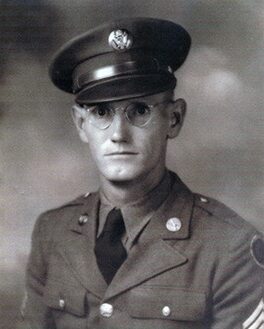
Staff Sergeant George Dennis Keathley was a soldier of great valour who served in the US Army during the Second World War, fighting and dying in Italy. Born on 10 November 1907 in Olney, Texas, Keathley showed the great courage and leadership that earned him a place in history during the battle of the Giogo Pass to break through the Gothic Line.
In his youth George Keathley attended Olney High School, followed by Cameron Junior College (now Cameron University) in Lawton, Oklahoma. In 1933 Keathley was also enrolled in the Texas A&M University to study for a degree in agriculture. He was a member of Troop D, cavalry, of the school's Corps of Cadets. For financial reasons, however, he withdrew from A&M and worked for a time for the Soil Conservation Service, where he oversaw soil erosion projects.
He graduated from Texas A&M in 1937.
In 1942 he married Inez Edmunson; they had two daughters.
Recruitment and training
- In 1942 George Keathley enlisted in the US Army at Lamesa, Texas. He was assigned to the 338th Infantry Regiment of the 85th. “Custer” Division.
- He began training at Camp Shelby, Mississippi, under the command of Major General Wade H. Haislip.
- In 1943 Keathley was promoted to Staff Sergeant.
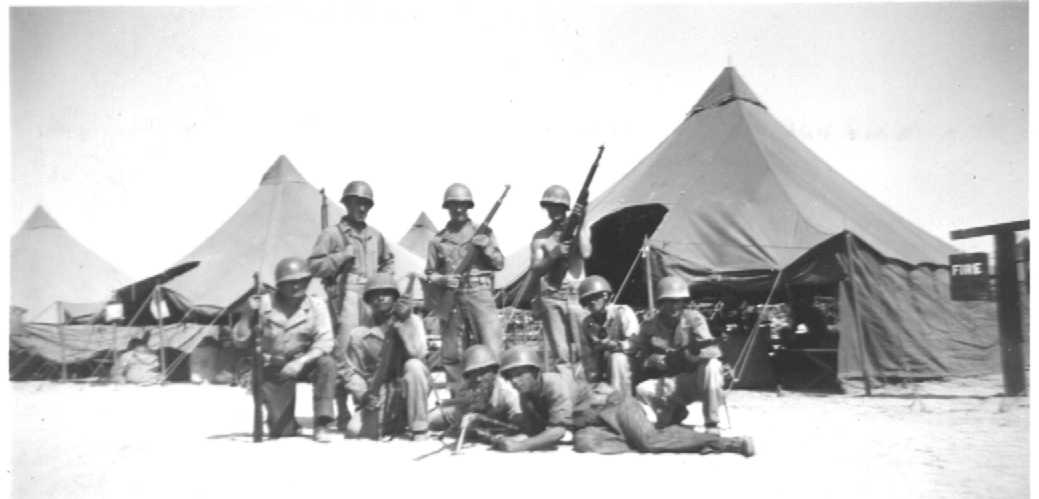
- In April 1943 the 85th. Division took part in large-scale military training in the Louisiana Maneuvers, near Leesville.
- In August the division moved to Camp Coxcomb, California, for desert warfare training.
- The final tests were at Fort Dix, New Jersey, in preparation for the Division's move to Europe as part of the 5th. Army US.
- L’85. “Custer” Division left the United States on 24 December 1943 and arrived in Casablanca, Morocco, on 2 January 1944, to be assigned to the Mediterranean fronts.
His action on Monte Altuzzo
As guide of the 1st Platoon, Company B, 338th Infantry Regiment, 85th. “Custer” Infantry Division, George Dennis Keathley was mortally wounded near Monte Altuzzo, Italy, on 14 September 1944, while leading two platoons decimated in the fighting against the German paratroopers defending the Gothic Line. The attack on the firing line had gone on for two days, under the crossfire of German machine guns. All the officers and non-commissioned officers had been killed or wounded. The platoons led by Staff Sergeant Keathley were heavily outnumbered and dangerously short of ammunition.
Under deadly mortar and automatic-weapons fire, Staff Sergeant Keathley crawled across the difficult battlefield to the casualties, among the dead and wounded, giving them first aid. He collected the unused ammunition and distributed it to the remaining men of the platoons he led. Although mortally wounded in the left side, he went on giving orders and urging his men to fight for a quarter of an hour. Thanks to his valour the enemy was forced to withdraw, leaving many dead and wounded behind.
Staff Sergeant Keathley died a few minutes later. Without his indomitable courage and inspired leadership, the remnants of three platoons of Company B might have been wiped out.
The citation in the official records
Killed in action: the Medal of Honor citation
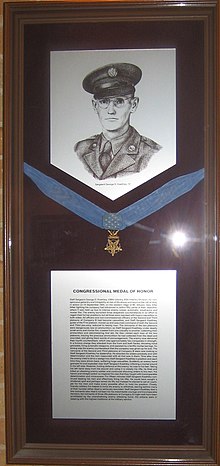
The President of the United States of America, in the name of Congress, takes pride in presenting the Medal of Honor (Posthumously) to Staff Sergeant George D. Keathley (ASN: 30185361), United States Army, for conspicuous gallantry and intrepidity at risk of life above and beyond the call of duty on 14 September 1944, while serving with Company B, 85th Infantry Division, in action on the western ridge of Mount Altuzzo, Italy. After bitter fighting Staff Sergeant Keathley’s company had advanced to within 50 yards of the objective, where it was held up due to intense enemy sniper, automatic, small arms, and mortar fire. The enemy launched three desperate counterattacks in an effort to regain their former positions, but all three were repulsed with heavy casualties on both sides. All officers and noncommissioned officers of the 2d and 3d platoons of Company B had become casualties, and Staff Sergeant Keathley, guide of the 1st platoon, moved up and assumed command of both the 2d and 3d platoons, reduced to 20 men. The remnants of the two platoons were dangerously low on ammunition, so Staff Sergeant Keathley, under deadly small arms and mortar fire, crawled from one casualty to another, collecting their ammunition and administering first aid. He then visited each man of his two platoons, issuing the precious ammunition he had collected from the dead and wounded, and giving them words of encouragement. The enemy now delivered their fourth counterattack, which was approximately two companies in strength. In a furious charge they attacked from the front and both flanks, throwing hand grenades, firing automatic weapons, and assisted by a terrific mortar barrage. So strong was the enemy counterattack that the company was given up for lost. The remnants of the 2d and 3d platoons of Company B were now looking to Staff Sergeant Keathley for leadership. He shouted his orders precisely and with determination and the men responded with all that was in them. Time after time the enemy tried to drive a wedge into Staff Sergeant Keathley’s position and each time they were driven back, suffering huge casualties. Suddenly an enemy hand grenade hit and exploded near Staff Sergeant Keathley, inflicting a mortal wound in his left side. However, hurling defiance at the enemy, he rose to his feet. Taking his left hand away from his wound and using it to steady his rifle, he fired and killed an attacking enemy soldier, and continued shouting orders to his men. His heroic and intrepid action so inspired his men that they fought with incomparable determination and viciousness. For 15 minutes Staff Sergeant Keathley continued leading his men and effectively firing his rifle. He could have sought a sheltered spot and perhaps saved his life, but instead he elected to set an example for his men and make every possible effort to hold his position. Finally, friendly artillery fire helped to force the enemy to withdraw, leaving behind many of their number either dead or seriously wounded. Staff Sergeant Keathley died a few moments later. Had it not been for his indomitable courage and incomparable heroism, the remnants of three rifle platoons of Company B might well have been annihilated by the overwhelming enemy attacking force. His actions were in keeping with the highest traditions of the military service.

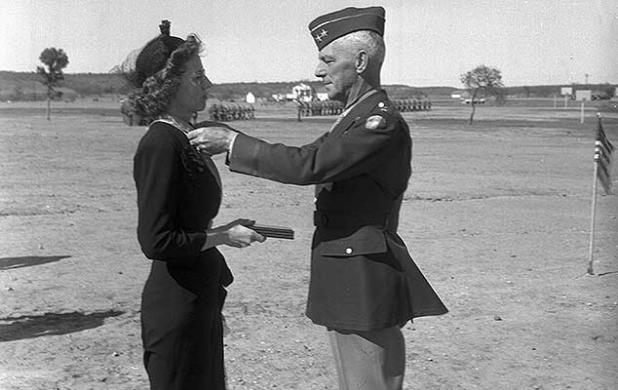
Staff Sergeant Keathley rests in peace…
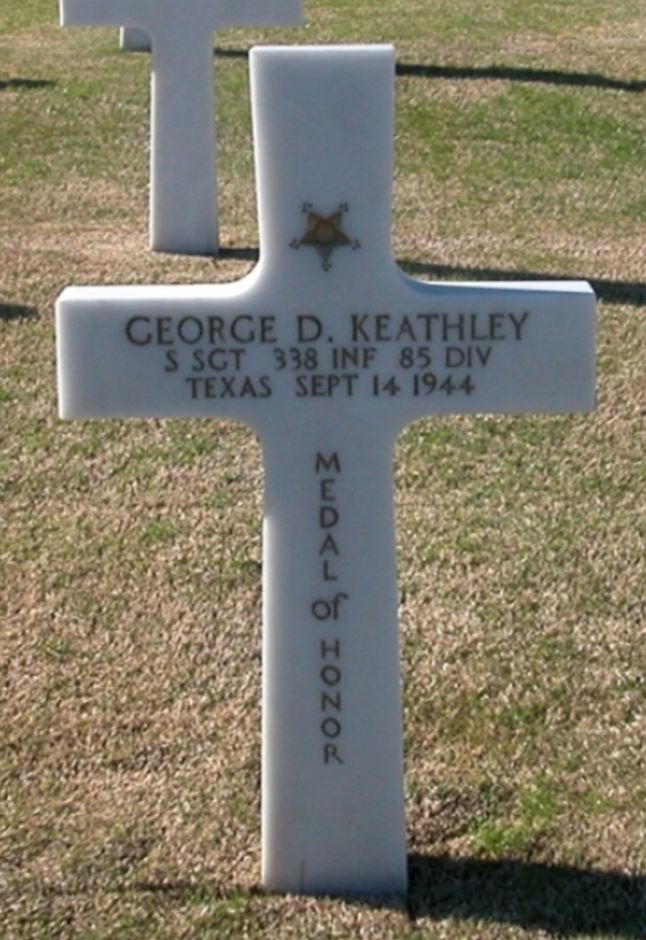
Keathley, 36 at the time of his death, is buried in the Florence American Cemetery, cared for by the American Battle Monuments Commission, at Falciani near Florence.
His Legacy
George Dennis Keathley's heroism has been honoured in many ways.
- In Lawton, Oklahoma, the Veterans of Foreign Wars Post is named in his honor.
- Cameron College paid tribute to its former student by naming the drill team of its Reserve Officers' Training Corps (ROTC) the “Keathley Rifles”.
- A naval ship, the USNS George D. Keathley , named after the Texan sergeant in 1949.
- In Lamesa, the Veterans of Foreign Wars Post is named for its former resident.
- At Texas A&M, Keathley's original Medal of Honor, Bronze Star and Purple Heart are displayed beneath a bronze plaque in the Sam Houston Sanders Corps of Cadets Center.
- Texas A&M also named the Keathley Hall dormitory at Texas A&M University after its former student.
Bibliography
- 338th Infantry in World War II, http://yourpage.blazenet.net/cjheiser/ct/338moh2.htm,
- October 17, 2005. “Above and Beyond: The Medal of Honor in Texas,” Capitol Visitors Center, State Preservation Board of Texas.
- Dictionary of American Naval Fighting Ships, Department of the Navy, http://www.histroy.navy.mil/danfs/s10/sgt_george_d_keathley.htm, October 17, 2005.
- Handbook of Texas Online, Texas State Historical Association, University of Texas, http:www.tsha.utexas.edu/handbook/online/articles/KK/fke55.html, September 26, 2005.
- Texas A&M University, Residence Life, http://reslife.tamu.edu/housing/halls/keathley/default.asp, October 13, 2005.