

Manuel Noferini and Daniele Baggiani
In September 1944 the German 4th Parachute Division was engaged in the defence of the Gothic Line against the Allied forces. In particular, the 12th Parachute Regiment (Fallschirmjäger-Regiment 12), into which the remnants of Luftlande-Sturm-Regiment 1, Schill’s air-landing assault regiment, had been absorbed, was facing the attacks of the US Army’s 85th and 91st Infantry Divisions, defending the positions of the Green Line along the crest of the Apennines, in the area of the Giogo Pass and Monte Altuzzo. The task of this unit was to hold the front in order to slow the Allied advance towards Bologna and the Po Valley.
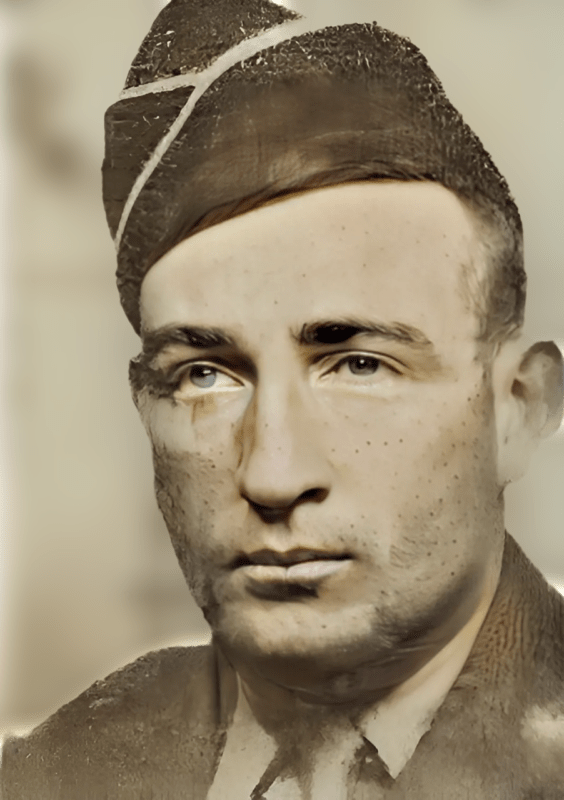
Hans Schill
Hans Schill was a soldier like many others. He was born on 29 December 1922 in Niederhadamar, a village of about 1,000 people some 80 kilometres north-west of Frankfurt, in Hesse. We know little about him – only what the death notification sent to his family tells us. His identity disc bore the number 1321 – 18. / Luftgau-Nachrichten-Regiment 11. This regiment was responsible for telephone communications, signals and intelligence, and during training it was stationed in Hanover. Hans's mother, Elisabeth, lived in Hadamar, in a pretty little house at Mainzer Landstraße 5.
Schill was a lance corporal – a Obergefreiter and he was part of the Luftlande-Sturm-Regiment 1, Stabskompanie—the Headquarters Company—assigned to personnel support. His duties involved organizational tasks to assist the operational unit's headquarters, focusing on managing internal and external communications. This included relaying orders and information between command and field troops. The Headquarters Company also handled logistics, medical services, administrative tasks, and transportation management. Hans Schill’s specific role centered on coordinating communications. It might seem like a relatively quiet position, but it was far from it.


His deployment to the front line
The assault regiment to which Hans Schill was assigned, whose remnants had by then been absorbed into the 12th Parachute Regiment, was known for its experience in close combat. These were front-line combat troops, so losses were heavy, above all in the preceding months, during the retreat from the Gustav defensive line to the Gothic Line. The Germans had suffered heavy losses and replacements were few. In 1944, therefore, men were drawn from every unit that had them to fill out the front line. Rear-area and logistics personnel were sent to fight. A signaller, and so in a role that was itself important, it was now Hans Schill’s turn to go into battle as a replacement. This is why he was sent to face the Fifth Army’s attack on the Gothic Line in the Giogo Pass sector: for lack of men.
The assault on Monte Altuzzo and Schill's death
On 14 September 1944 the I Battalion of the 12th Parachute Regiment, with Corporal Schill, was deployed along the Western Ridge of Monte Altuzzo, a secondary ridge linking the summit with the stronghold of Peabody Peak, a defensive position dropping sheer to the valley on one side and to the road on the other, and vital to the defence of the Giogo Pass. This ridge was one of the strategic observation points of the German forces, who in this sector had built trenches and fortified strongpoints in naturally protected places. These defensive positions were particularly hard for the Allies to take, given the steep slopes and the very stubborn German resistance, which had equipped these heights with firing points for the deadly MG 34 and MG 42 machine guns and for Granatwerfer mortars. To be precise, these mortars were the 8 cm Granatwerfer 34 – also GrW 34 – which earned an excellent reputation as a deadly weapon thanks to its extreme accuracy and high rate of fire. The crews were especially well trained, and in many cases these infantry weapons made up for the shortcomings of the artillery, which during the retreat up the peninsula became less and less available to counter the Allies.
On 14 September the American forces launched repeated attacks against the German positions on the Western Ridge, with the aim of taking Monte Altuzzo. The paratroopers resisted fiercely, but the fighting became especially intense under the fire of the Allied artillery. The situation grew confused and chaotic, with German and American soldiers fighting hand to hand. It was in this situation that Corporal Hans Schill lost his life, probably hit during an artillery bombardment. Hans Schill died before he could celebrate his twenty-second birthday.
The notification of his death was sent to his mother Elisabeth by the I Battalion of the 12th Parachute Regiment, which was defending Monte Altuzzo (Monticelli, on the other side of the pass, was held by the II Battalion). The records of the Deutsche Dienststelle (WASt) (formerly the Wehrmachtauskunftstelle), the Berlin-based agency responsible for notifying the next of kin of soldiers killed in the Second World War, show no burial of Hans Schill in any military cemetery. His body may therefore have remained on the battlefield, or he may have been buried without a name in a small village cemetery, as often happened.
Broken lives
The death of Hans Schill, a young corporal of the 12th Parachute Regiment and a signaller, sent to the front line for lack of men to face the Americans of the Fifth Army under heavy artillery fire, is an example of the brutality of the fighting that unfolded along the Gothic Line in that terrible week of 12 to 18 September 1944. Many lost their lives, young Germans and young Americans who faced each other as enemies without knowing one another. Unfortunate young men whom history made protagonists of a series of bloody battles that, in the Apennines, marked the last two seasons of the Second World War.
May the memory of these soldiers – young men raised for war and forced by their times to do their duty, sometimes against their will – be for us a testimony of courage and of lives cut short, a memory we keep so that peace between peoples may endure.